Flamenco Biennial

What to do in Seville during the Flamenco Biennial 2026

Seville during the Biennial: much more than going from one show to the next

The Seville Flamenco Biennial 2026 takes place from 9 September to 3 October and during those weeks the city takes on a different rhythm. Its major theatres, historic venues and open-air stages host an exceptional programme, but limiting your visit to going in and out of shows means missing an important part of the experience.

The Biennial can also be enjoyed in the morning, between performances and after the final show. There are free exhibitions, street flamenco, neighbourhoods linked to the art form’s history, markets, terraces, monuments, walks beside the Guadalquivir and a year-round selection of tablaos operating independently of the official programme.

This guide is for visitors to Seville during the Biennial who would like to plan their whole day: what to do before a performance, how to make the most of the time between shows and where to continue your flamenco evening.

Quick answer: during the Flamenco Biennial 2026 you can combine the official programme with the free exhibition La noche azul, activities in “Otras perlas”, walks through Triana and the historic centre, visits to the Real Alcázar, the Cathedral or Plaza de España, Sevillian food and flamenco shows beyond the official line-up. The key is to organise your day by area to reduce travelling time.

Morning: Seville before the flamenco begins

Most of the Biennial’s stage programme takes place in the afternoon and evening, although there are matinées and special activities. That leaves plenty of mornings free to discover Seville without missing the shows.

The Real Alcázar and Santa Cruz neighbourhood

The Real Alcázar is particularly interesting during this edition because it is also one of the Biennial’s venues. Visiting in the morning helps you appreciate the heritage dimension of a programme that uses historic buildings as stages.

Afterwards, you can explore Santa Cruz, head towards the Cathedral and the Giralda and continue to the Archivo de Indias. These sights are within easy walking distance of several regular Biennial venues, making this a good option when you have an afternoon performance in the centre.

For the programme at this monument in particular, we have a guide dedicated to flamenco at the Real Alcázar during the Biennial 2026.

Plaza de España and María Luisa Park

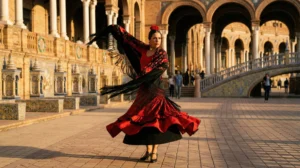
Another straightforward morning option is to explore María Luisa Park and Plaza de España. This area is particularly convenient if you later have a performance at the Teatro Lope de Vega, beside the park.

The advantage of planning your sightseeing around that evening’s venue is simple: central Seville is easy to explore on foot, but unnecessary journeys can be tiring when you still have several hours of performances ahead.

Make the most of “Otras perlas”: the Biennial beyond the theatres

The official accompanying programme for 2026 is presented under the name “Otras perlas” and includes exhibitions, street events, family activities and other cultural initiatives. It is one of the best ways to fill the time between performances while staying immersed in flamenco.

La noche azul: a free exhibition exploring Ópera Flamenca

From 2 September to 22 November 2026, the Real Fábrica de Artillería hosts La noche azul. Ópera Flamenca en la colección de Carlos Martín Ballester. The exhibition brings together hundreds of documents, posters, records, gramophones, photographs and other materials relating to the expansion of Ópera Flamenca during the first half of the twentieth century.

Admission is free, subject to capacity. The opening hours announced by the City Council are Monday to Saturday, 10:00–20:00, and Sunday, 10:00–14:00. It is especially worthwhile in the morning or early afternoon, giving you a deeper understanding of flamenco singing before you hear it live.

You can find further information in our guide to La noche azul.

Flamenco on the streets

The Biennial also takes part of its programme into squares and outdoor spaces. These activities offer encounters with flamenco outside the format of a conventional performance and connect the festival with different Seville neighbourhoods.

The accompanying programme also includes initiatives such as the travelling installation “Sala de revelado”, created to reveal the work normally hidden behind the performances: rehearsals, creative processes, personal accounts and documentary materials.

To find things to do at no cost, see our updated selection of free shows and activities at the Biennial 2026.

Explore Seville’s flamenco neighbourhoods

Triana: an obvious choice during the Biennial

Triana is part of Seville’s flamenco history and deserves a visit even when your evening performance is elsewhere in the city. You can cross the Puente de Isabel II, explore Calle Pureza, visit Triana Market, walk along Calle Betis and finish beside the river.

During the Biennial, the neighbourhood also holds special significance because of the activities historically associated with Hotel Triana. In 2026, owing to high demand, the three performances scheduled there for 17, 18 and 19 September have been moved to Muelle de la Sal, with the announced dates and times unchanged.

The historic centre: from San Luis to the Alameda

The northern part of the centre makes it easy to combine heritage and flamenco. The church of San Luis de los Franceses hosts the Matinés Únicas and nearby are the Alameda de Hércules, Calle Feria and some appealing places to eat or have a drink without going far.

Before attending a matinée, consult our guide to the Matinés Únicas at the Biennial 2026.
El Arenal: the river, Maestranza and the Biennial

El Arenal is another strategic area. Here you can combine a walk beside the Guadalquivir with the Torre del Oro, the Real Maestranza bullring, Muelle de la Sal and the Teatro de la Maestranza. If your performance is at one of these venues, setting aside the whole afternoon for this area is the most practical approach.

What to do between two Biennial shows

One of the most common planning challenges arises when you book two shows on the same day and have two or three hours between them. In that situation, trying to fit in a full monument visit makes little sense.

When you are in the centre

You can walk around the Cathedral, Avenida de la Constitución, Plaza Nueva and Plaza de San Francisco; have a drink on a terrace; visit an exhibition; or head towards the Guadalquivir. These are flexible activities that you can finish whenever you need to leave for the next venue.

When you are in Cartuja

The Teatro Central is further from the historic centre. For a performance there, allow more travelling time and avoid scheduling activities too tightly immediately before or afterwards. One option is to stay in the Cartuja area, returning to the centre only when you have enough time.

Between Lope de Vega and Maestranza

The distance allows you to walk through a good part of the centre. You can go via María Luisa Park, Puerta de Jerez, Torre del Oro and Paseo de Colón. It is a pleasant route that makes travelling between venues part of your sightseeing day.

Food: eating well without arriving late for a show

During the Biennial, it makes sense to adapt mealtimes to the tickets you have booked. Some shows begin at 19:00 or 20:00, others around 21:30, and late performances may start after 22:00.

For an early show, a useful strategy is to have a slightly later main meal and save a light dinner or tapas for afterwards. If the performance starts at 22:30, you can dine beforehand, but avoid restaurants far from the venue or meals likely to take too long.

What to try

September is still warm in Seville, making dishes such as gazpacho, salmorejo, ensaladilla, spinach with chickpeas, fried fish and cold tapas particularly appealing. You can also try Sevillian classics such as montaditos, pringá, pork fillet in whisky sauce and different cod dishes.

Triana, Arenal, Santa Cruz, Alameda and the area around Calle Feria offer plenty of options for fitting meals into your route. During the Biennial, the priority should be eating close to your next show, rather than crossing the city for a particular restaurant just before the performance.

After the show: flamenco does not end with the Biennial

A Biennial performance may be the centrepiece of your evening, but not necessarily its end. Seville has a year-round programme of flamenco shows, with tablaos offering very different formats and atmospheres.

This is particularly useful in three situations: when you have not found a ticket for the show you wanted, when official performances cover only part of your stay, or when you would like to compare a large theatre with a smaller venue.

Our guide to flamenco in Seville during the Biennial beyond the official programme offers alternatives. To understand the difference between a competent tourist show and a performance with greater artistic interest, also read where to see authentic flamenco in Seville.

And when a particular performance is sold out, we have a dedicated guide to what to see when you can no longer find Biennial tickets.

Three itineraries for making the most of a full day during the Biennial

Itinerary 1: heritage and the Biennial in the centre

  • Morning: Real Alcázar, Cathedral and Santa Cruz neighbourhood.
  • Lunchtime: a meal in the centre.
  • Afternoon: the La noche azul exhibition at the Real Fábrica de Artillería.
  • Evening: an official Biennial show.
  • Afterwards: a walk or a drink in Arenal, the centre or Alameda, depending on the venue.

Itinerary 2: Triana, the river and flamenco

  • Morning: Triana Market, Calle Pureza and a walk around the neighbourhood.
  • Lunchtime: tapas in Triana.
  • Afternoon: Calle Betis, Triana Bridge, Muelle de la Sal and Paseo de Colón.
  • Evening: a performance at Maestranza, in Arenal or at another nearby venue.
  • Afterwards: a tablao or another show to extend your evening.

Itinerary 3: a full day of flamenco

  • Morning: an accompanying activity or exhibition.
  • Lunchtime: a walk around San Luis, Alameda or Calle Feria.
  • Afternoon: your first Biennial performance or a free activity.
  • Evening: a second performance, a Noche Única or a tablao.

For performances specifically conceived as one-off experiences, see the Noches Únicas calendar for the Biennial 2026.

Tips for planning your time in Seville during the Biennial

  • Group activities by area. Avoid combining Triana, Cartuja and María Luisa Park within a few hours.
  • Allow time before each performance. Rushing is especially inconvenient when there are entry checks, numbered seats or large audiences.
  • Do not fill every hour of the day. The Biennial may mean several consecutive evenings of performances; making time to rest improves the experience.
  • Check for last-minute changes. In 2026, for example, the performances originally scheduled at Hotel Triana have already been moved to Muelle de la Sal.
  • Make the most of free activities. They let you experience the Biennial even on days when you have no tickets.
  • Combine large-scale shows with intimate venues. A show at Maestranza or Lope de Vega and an evening at a tablao offer very different, complementary experiences.
  • Book ahead. Both the Biennial and regular shows can attract high demand in September.

The best way to experience the Biennial is to combine the festival and the city

The Flamenco Biennial is an exceptional opportunity to see artists who are rarely in the same city at the same time and to attend premieres, galas and formats created specifically for this edition. But Seville is not merely a backdrop: it is part of the experience.

Attending a matinée at San Luis, crossing Triana, visiting an exhibition at the Real Fábrica de Artillería, walking beside the Guadalquivir and ending the evening with live flamenco helps you understand the relationship between the city and this art.

So, when staying for several days during the Biennial, do not simply pack in one performance after another. Mix heritage, neighbourhoods, food, free activities, the official programme and flamenco beyond the major stages. That combination is probably the fullest way to experience Seville between 9 September and 3 October 2026.

Frequently asked questions about what to do in Seville during the Biennial 2026

The 24th Seville Flamenco Biennial takes place from 9 September to 3 October 2026, although some accompanying activities began before the official opening.

Yes. The accompanying programme includes exhibitions and activities in public spaces. The exhibition La noche azul, for example, has free admission, subject to capacity.

You can visit the Real Alcázar, Cathedral and Santa Cruz; explore Plaza de España and María Luisa Park; discover Triana; or enjoy the Biennial’s exhibitions and accompanying activities.

Yes. Seville’s tablaos and other flamenco venues continue their regular programmes during the Biennial, offering alternatives every day beyond the official line-up.

Triana is essential for its historic connection with flamenco, but Arenal, Santa Cruz, San Luis, Alameda and the area around Calle Feria are also very interesting. The best choice depends on your show’s venue.

On some days, yes, because performances are scheduled at different times. Check the estimated finishing time and the distance between venues before buying both tickets.

You can explore other official performances, free activities or Seville’s regular tablao programmes. Avoid unofficial resale and check the Biennial’s channels for updates.

Not for most activities in the centre. Many venues and visitor areas can be reached on foot or by public transport. For places further away, such as the Teatro Central in Cartuja, allow more time for the journey.

Book online: the key to securing your seat

In many cities, flamenco tablaos sell out easily, especially on weekends and during peak season. That’s why, if your dates are set, the most important thing is to book online.

Direct recommendation: book online through our website to guarantee your seat and arrive with everything confirmed. If you already have your destination, go straight to your city to see available options and clear recommendations.

Flamenco Sevilla | Tablaos Flamencos

Seville

Flamenco Madrid | Tablaos Flamencos

Madrid

Flamenco Barcelona | Tablaos Flamencos

Barcelona

Flamenco Granada | Tablaos Flamencos

Granada

Flamenco Córdoba | Tablaos Flamencos

Cordoba

Flamenco Málaga | Tablaos Flamencos

Malaga

Flamenco Valencia | Tablaos Flamencos

Valencia

Flamenco Jerez | Tablaos Flamencos

Jerez

Find out more about this with your favorite AI:

Did you like this article? Share it!:

Tags: Bienal 2026, Bienal de Flamenco, sevilla, things to do in Seville, what to do in Seville

Article published by:

Related articles

Seville Flamenco Biennial 2026 side events: exhibitions, cinema, street flamenco and more
What to see at the Seville Flamenco Biennial, 14–20 September 2026