Is the Seville Flamenco Biennial 2026 sold out?
No. This is the first point worth clarifying. The Biennial does not operate with one single ticket or one shared capacity. Each performance is sold independently and takes place in a specific venue, with very different seating capacities. One performance may therefore be completely sold out while another on the same day, or even only a few hours apart, may still have tickets available.
The 2026 edition runs for several weeks and uses a wide range of venues: Teatro de la Maestranza, Teatro Lope de Vega, Teatro Central, Espacio Turina, Teatro Alameda, the Real Alcázar, the Real Fábrica de Artillería, the church of San Luis de los Franceses, Hotel Triana and other locations. These very different venues naturally create different capacities and sales patterns.
The type of production also matters. World premieres by major artists, encounters conceived as one-off performances, shows in heritage venues with limited capacity and certain matinées can sell out far in advance. Other productions may have more seats available or attract demand more gradually.
So when you read that “there are sold-out tickets for the Biennial”, you should not interpret that as “there are no tickets left for the Biennial”. The correct conclusion is different: demand in 2026 is exceptionally high, so it is advisable to buy available performances as early as possible.
The first sold-outs arrived many months in advance
The level of demand for this edition became clear very early. In March, less than a month after the programme went on sale, the organisers reported that revenue had already exceeded half a million euros. In April, with around six months still to go before the Biennial began, Seville City Council was already talking about a historic record for advance sales and listed a number of performances that had already sold out.
Among those first sold-out performances were both appearances by Pedro El Granaíno at San Luis de los Franceses, Israel Fernández at the Real Alcázar, both performances by Encarna Anillo at San Luis, the show by Juan Tomás de la Molía and Águeda Saavedra at Teatro Central, the encounter between Aurora Vargas and Juana Amaya at the Lope de Vega, Ángeles Toledano at Teatro Alameda, Mayte Martín at the Lope de Vega, Alejandro Hurtado at San Luis and Dorantes at the Lope de Vega.
The list did not stop there. In August, the Biennial itself also confirmed that both performances by Ana Morales at the Real Fábrica de Artillería, scheduled for 13 and 14 September, were sold out. And on 26 August it again announced that Encarna Anillo would reach her matinées on 26 and 27 September with all tickets sold.
The conclusion is not that we should create a fixed list and assume it remains valid throughout the Biennial. Availability is dynamic and more performances may sell out as the dates approach. What matters is understanding the trend: 2026 is proving to be an exceptionally strong year for ticket sales, so postponing the purchase of an available ticket because you plan to decide “later” could leave you without that option.
Why some performances sell out earlier than others
Several factors are involved. The first is obvious: the artist’s name. A performer with an international following, an established company or a highly anticipated premiere attracts searches from the very day the programme is announced.
But popularity is not the only factor. The venue capacity is decisive. A performance in a church, historic courtyard or unusual venue may have far fewer seats than a major theatre. That means an apparently less mainstream show can sell out even earlier.
The one-off nature of a performance also matters. In 2026 the Biennial is placing greater emphasis on the concept of Noches Únicas, proposals created specifically for Seville through a particular combination of artists, repertoire or venue. At the end of August, the organisers announced a group of 26 Noches Únicas, in addition to the special matinées at San Luis de los Franceses. When audiences know that a particular artistic encounter is not part of a regular tour, the decision to buy tends to come faster.
There is also a fourth factor: the audience travelling specifically to Seville. The Biennial does not depend on local demand alone. It attracts enthusiasts, programmers, industry professionals, journalists and cultural travellers from elsewhere in Spain and abroad. Many people buy the ticket before booking the rest of the trip precisely because the performance is the main reason for travelling.
What to do if the performance you wanted is sold out
The worst strategy is to spend days fixated on finding exactly the same performance while other opportunities disappear. If your first choice is sold out, it helps to follow a simple order.
1. Make sure you are using the official channel
Your reference point should always be the official Biennial programme and the purchase link associated with each performance. The organisers centralise sales information and updates on their website. If a performance can still be purchased there, that is the safest route.
At times of very high demand you may see search results, advertisements, social-media posts or resale pages. Before paying, verify who the seller is and what conditions they offer. A sold-out performance can create the perfect environment for inflated prices or channels with little protection.
2. Check another date by the same artist, if there is one
Some artists have more than one performance. If one date is full, check whether there is another show in the programme. This will not always be possible: many Biennial productions are specifically one-off nights. But when there are several performances, it is worth checking each one individually.
3. Look for an alternative by discipline, not only by name
If you wanted to see a particular dancer, broaden the search to other dance productions. If your priority was singing, look at the cante nights and special encounters. If you were looking for guitar, Espacio Turina offers a particularly interesting journey through the instrument in this edition.
Choosing this way often leads to better discoveries than simply replacing one famous name with another. The Biennial lets you compare generations, aesthetics and formats. An intimate recital can end up being more memorable than a large-scale production that initially seemed essential.
4. Change venue
When one venue accumulates especially high-demand performances, looking at another venue’s programme can open up many possibilities. Teatro Central has a strong focus on research and contemporary creation; Espacio Turina gives particular prominence to guitar; Teatro Alameda brings together proposals from different generations; the Lope de Vega recovers its historic role in the Biennial; and the Maestranza concentrates large-scale productions.
You do not need to build your trip around a single theatre. In fact, experiencing the Biennial in several different venues is one of the best ways to understand it.
5. Expand your window by one or two days, if your trip allows
The programme is highly concentrated. Sometimes moving your visit one night earlier or later completely changes the options available. If you have not yet fixed your flights, trains or accommodation, first check which performances still have tickets and then settle your final travel dates.
Do not look only at the biggest names: Noches Únicas may be the best alternative
One of the keys to the 2026 edition lies in the Noches Únicas. These are performances the Biennial distinguishes from world premieres because they are not necessarily created with touring in mind. They may be special encounters, repertoires devised for a particular occasion or combinations of artists that are difficult to repeat.
This is especially useful if you have missed out on a highly sought-after ticket. Instead of treating the alternative as a “consolation prize”, you can look for an experience that may fit the spirit of the Biennial even better.
For example, Espacio Turina brings together several nights centred on guitar and unusual artistic crossings: Canito and Raúl Rodríguez, José Fermín Fernández, Juan Requena, Manuel de la Luz and Manuel Imán, Diego del Morao or Dani de Morón. The Lope de Vega hosts encounters such as Arcángel exploring copla and cante, Antonio Reyes together with six guitarists, or a celebration of sevillanas in Fue tu querer. Hotel Triana recovers a completely different atmosphere, with evenings conceived from roots, the memory of the courtyards and artistic family lineages.
The advice here is simple: if your performance is sold out, first look for what could only happen at the Biennial. A tour may come back near your city; an artistic combination created for one single night may not.
Guitar offers many ways to discover another side of the Biennial
Visitors initially drawn to the programme by dance or the best-known singers can easily overlook one of the major themes of 2026: guitar.
For much of the Biennial, Espacio Turina becomes a true home of flamenco guitar. Concerts and encounters allow audiences to hear the instrument as a solo voice, in dialogue with other traditions and within ensemble formats. For someone who has never attended a flamenco guitar concert, this can be an excellent opportunity to understand aspects that are less obvious during a dance performance: the construction of the toque, compás, silence, the development of a falseta, the personality of each school and the relationship between tradition and original composition.
The concert format also tends to offer a very different experience from large-scale stage productions. If you already have a ticket for a dance show and your second choice has sold out, changing discipline can give your trip a better balance.
Parallel activities: experiencing the Biennial without relying on a theatre ticket
One of the clearest answers to “I can’t find tickets” lies in the parallel programme. The 2026 Biennial brings together under the concept Otras perlas exhibitions, screenings, street activities, encounters, workshops and initiatives developed by institutions and venues across the city.
One of the major highlights will be La noche azul. Ópera flamenca en la colección de Carlos Martín Ballester, an exhibition at the Real Fábrica de Artillería running from 2 September to 22 November. It brings together around 150 pieces linked to the era of ópera flamenca and the spread of flamenco through posters, records, photographs, manuscripts and other historical documents.
The programme will also include Flamenco a pie de calle, with free-admission performances until capacity is reached at various points around Seville. Before the official opening of the Biennial there will be events in Polígono Sur, San Jerónimo, Macarena and the Museum of Popular Arts and Customs. On 9 September, Plaza de San Francisco will also host the sung opening proclamation for the edition.
The associated programme extends to cinema, universities, foundations, peñas, exhibitions and encounters. For travellers staying several days, this completely changes how the visit can be planned: a day without a theatre ticket can still be a day fully connected to the Biennial.
Can tickets be bought on the same day as the performance?
Yes, but with one fundamental condition: only if tickets remain available. The official ticket-sales information states that one hour before each performance, tickets may be sold at the venue where the show takes place, provided seats are still available.
You should therefore not interpret this as a “second box office” holding back tickets for sold-out performances. If a show is officially full, turning up one hour beforehand does not guarantee that tickets will appear. Same-day sales only apply to inventory that remains available.
The Biennial also offers the Hora Jovenscheme: people under 30 can receive a 50% discount at the box office one hour before the performance, again only if tickets remain on sale.
If your trip depends on seeing a specific performance, buying in advance is the sensible choice. Same-day box-office sales are an opportunity, not a reliable strategy for a high-demand show.
Is it worth continuing to check a sold-out performance?
It makes sense to check the official channels periodically in case the situation changes, but you should not build your entire trip around the expectation that tickets will reappear. The organisers recommend checking their website and news section for the latest updates, and they also provide a box-office phone number and email for purchasing enquiries.
The most practical strategy is twofold: keep an eye on your first choice if it matters particularly to you, but secure an alternative that is actually available. If a better possibility appears later and the purchase conditions allow you to reorganise your plans, you can decide then. What you should avoid is reaching September with nothing booked because you spent weeks waiting for a sold-out performance.
What to see depending on the kind of flamenco you were looking for
If you wanted a major dance production
Look at other productions at Teatro de la Maestranza, the Lope de Vega, Teatro Central and Teatro Alameda. This edition brings together very different artists and artistic languages, from large companies and expansive formats to choreographic research. Do not try to find an exact copy of the performance you missed. Look for another perspective on dance.
If you wanted traditional cante
Cante has a very strong presence across the Biennial and across different generations. Special nights, tributes, encounters between artistic families and recitals linked to heritage venues offer very different alternatives. It can be especially worthwhile to explore the programmes at the Lope de Vega, Real Alcázar, Hotel Triana, Teatro Alameda and Maestranza.
If you wanted guitar
You have plenty of choice. Espacio Turina is a central reference during the edition, but guitar also appears in major productions and encounters at other venues. If you have never devoted an evening exclusively to the toque, this Biennial may be the perfect moment.
If you were looking for something distinctly Sevillian
Pay attention to the Noches Únicas, Hotel Triana, performances that engage with local repertoires and activities in neighbourhoods and public spaces. The Biennial does not happen only inside the major theatres.
If you are travelling with someone who knows little about flamenco
Combining formats is a good idea. A large-scale stage production can be very accessible as a first introduction, while a tablao lets you understand the intensity of live flamenco at close range. Adding an exhibition or street activity also helps place the experience in context.
If there is no ticket for that night: Seville still offers flamenco
The Biennial is extraordinary precisely because it concentrates creation, premieres and unrepeatable encounters. But flamenco in Seville does not begin on 9 September or end on 3 October. The city maintains a stable year-round offer of tablaos and flamenco venues, and during the weeks of the Biennial this can become the most practical alternative for a night when you cannot find tickets.
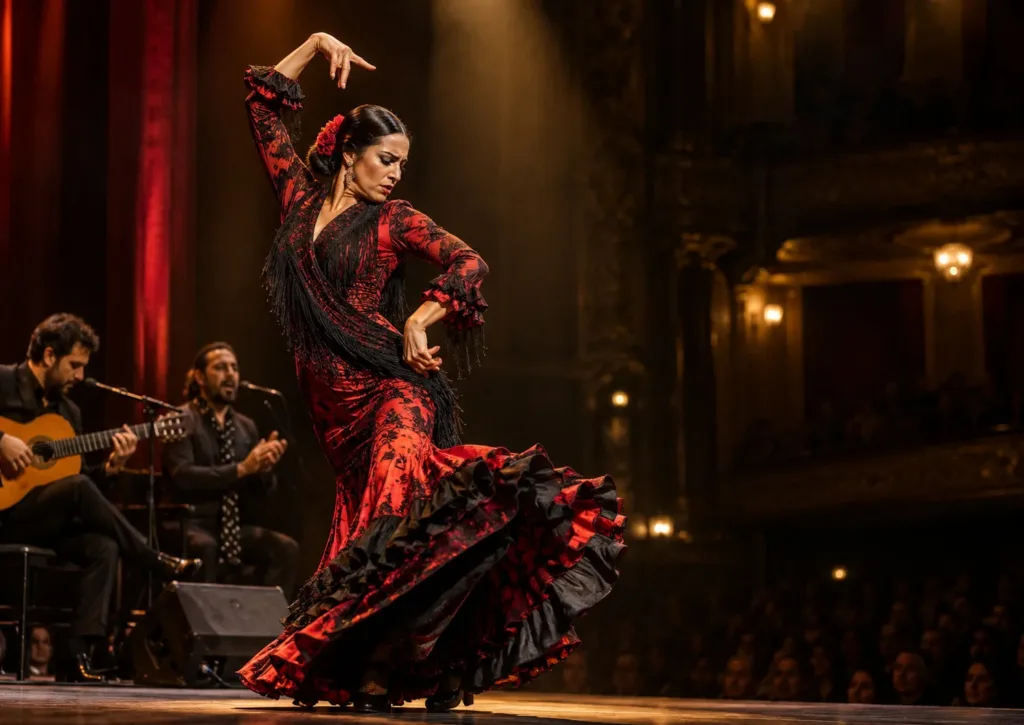
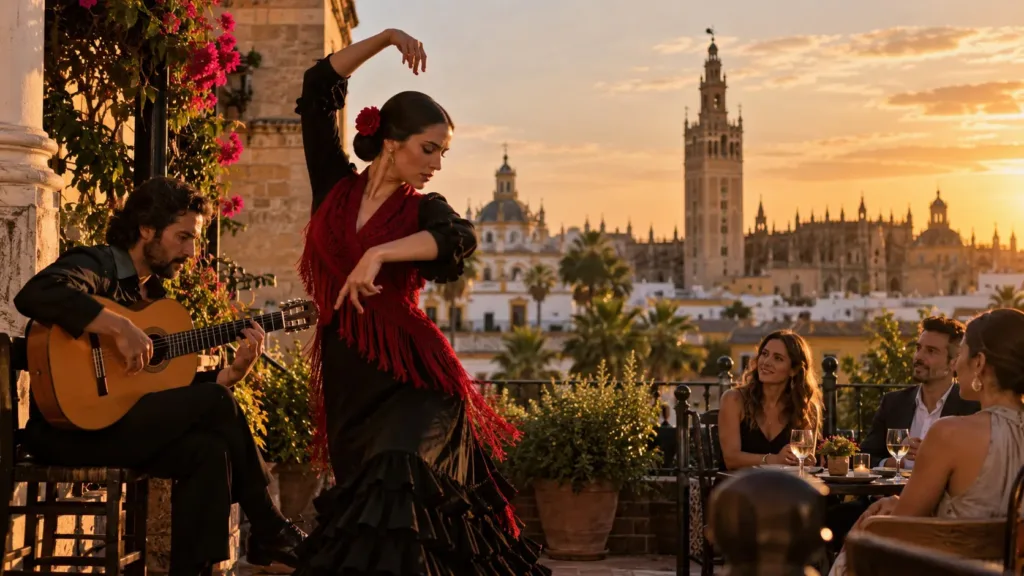
A tablao is not an exact substitute for a Biennial production. They are different formats. In a theatre you may see a work with dramaturgy, scenery, a fixed repertoire or a large company. In a tablao, by contrast, the value usually lies in proximity, changing line-ups, the interaction between cante, dance and guitar, and the feeling of watching flamenco only a few metres from the artists.
That difference is precisely why combining both can be so rewarding. If you have a Biennial ticket on Friday but none on Saturday, a tablao night can give you another perspective. And if you arrive in Seville without managing to get any official tickets, a good tablao means the trip can still have a central flamenco experience rather than becoming simply a conventional sightseeing visit.
On our flamenco in Seville page you can compare shows and check options available on different dates. During periods of high demand, we also recommend booking in advance.
The Biennial and the tablao are not competing experiences
This is worth stressing because it helps you plan a better trip. The Biennial has the dimension of a festival, a space for creation and a major cultural event. The tablao is an established format for presenting flamenco. You can enjoy both without one diminishing the other.
For a first-time visitor to Seville, the combination can actually be particularly instructive. At the Biennial you see how flamenco expands into contemporary theatre, large-scale production, research and concert formats. At the tablao you recognise more immediately the dialogue between guitar, cante and dance, the compás and the spontaneous response of the ensemble.
If your priority is to “see a lot of flamenco” over two or three days, you do not need to stack up three major productions. A mix of Biennial, tablao and parallel activities can create a more complete and less exhausting experience.
An alternative plan for a night without tickets
Imagine travelling to Seville for a performance that ultimately sells out. Instead of treating the night as lost, you can build a very simple alternative plan.
In the afternoon, visit one of the exhibitions or activities associated with the Biennial. Then leave time to walk through the city centre or Triana and have dinner without rushing. Afterwards, choose a tablao with a compatible schedule. If there is a free outdoor activity or a later encounter, see whether you can add it without turning the evening into a race.
The key is the same as with the official programme: do not try to do everything. Flamenco needs attention. Two well-chosen experiences usually offer more than chaining together activities with no time to absorb them.
What we do not recommend doing when a performance is sold out
We do not recommend paying any price through a channel you cannot verify. Nor do we recommend organising an entire trip around the possibility of finding a miraculous ticket at the door.
Be wary of screenshots as the only proof, newly created social-media profiles, sellers pressuring you to transfer money immediately, or supposed tickets whose origin you cannot verify. If you use a channel other than the official one, make sure you understand exactly who is responsible if something goes wrong and what validity the ticket has.
It is also a bad idea to leave every decision until the last minute. The fact that your first choice is sold out does not mean you should wait until your second and third choices sell out too.
How to plan the Biennial if you have not bought any tickets yet
If you are reading this guide at the end of August or already in September, start with the actual dates of your trip. Open the full programme and mark every possible performance during those days, not only the ones you already knew about.
Then classify them by interest: essential, very interesting and possible. Check availability starting with the essential choices. If there are no tickets left, move to the next category rather than delaying the decision for days.
Next, book at least one established flamenco experience for the free night if flamenco is an important reason for your trip. That gives you certainty. Finally, add one or two parallel activities and leave some space simply to enjoy Seville.
Do not forget distances. Although many venues are in relatively central areas, others require travel. Check start times too. During the Biennial there are afternoon shows, evening performances, matinées and late-night events; an itinerary that looks possible on paper can be uncomfortable in practice.
If you are coming to Seville for just one day
With only one day, your priority should be to secure one experience. If you find an official performance that interests you and tickets are available, book it. Do not spend too long comparing.
If the performance that motivated your trip is sold out, look for another official event on the same date. If none fits, book a tablao and use the rest of the day for a parallel activity or a visit connected with flamenco and the city.
The worst option for a one-day visit is to book nothing and assume you will sort everything out when you arrive.
If you are coming for a weekend
A weekend lets you build a much richer combination. A balanced formula would be one Biennial performance, a tablao on another night and a parallel activity during the day.
If you manage to get tickets for two genuinely different official performances, that can also be worthwhile: for example, dance and guitar, or cante and contemporary creation. The important thing is that they are not two choices made purely on popularity, but on contrast.
If you are staying several days
With three or more nights, you do not need to worry so much about one particular sold out. The programme is broad enough to build your own route. You can devote one night to a major production, another to a more intimate venue, another to a tablao, and leave the parallel activities for daytime.
This approach often comes closer to the spirit of the Biennial: not simply chasing names, but understanding how flamenco fills the city and takes on different forms.
The 2026 Biennial can also be experienced before 9 September
If you arrive a few days before the official opening, there will already be flamenco connected to the parallel programme. La noche azul opens on 2 September, and the Flamenco a pie de calle cycle begins on 3 September with free performances until capacity is reached at different points around Seville. This can be very useful for travellers whose dates do not line up exactly with an official performance.
It also shows something important: the Biennial experience extends beyond the calendar of the major theatres. The atmosphere begins earlier and spreads through exhibitions, neighbourhoods, squares and institutions.
What if tickets are still available but I do not know the artist?
Buy with curiosity, but do a little research first. The Biennial is one of the best places to discover names that may not yet appear in mainstream headlines. An essential part of its cultural role is precisely to bring established figures into dialogue with new generations.
Look at the type of performance, the artist’s career, the venue and the concept of the work. If those elements interest you, do not dismiss a show simply because you do not know the name. Many enthusiasts remember from each edition precisely the performance they chose almost by chance.
An opportunity to move beyond the most obvious programme
The sold outs have a positive side: they force you to look at the entire programme. When the most high-profile performances attract all the attention, it is easy to overlook recitals, encounters, tributes and proposals that better reflect flamenco’s true diversity.
The 24th Biennial brings together cante, dance, guitar, tradition, avant-garde work, memory, heritage and new creation. A trip built only around two major names can be fantastic, but it is not necessarily the only way — or always the best way — to experience it.
If you can no longer find a ticket for what you originally wanted, use that setback as an invitation to explore.