Flamenco Biennial

Seville Flamenco Biennial 2026 side events: exhibitions, cinema, street flamenco and more

Biennial 2026 side events: much more than the shows

The 24th Seville Flamenco Biennial takes place from 9 September to 3 October 2026, but its cultural activities extend beyond those dates and the main stages. Under the name “Otras perlas” (Other Pearls), the Biennial brings together exhibitions, cinema, street flamenco, family activities, urban art projects and events organised with Seville’s cultural institutions.

This means you can experience the Biennial without going into a theatre every day. Some activities are free, others complement the main programme, and several begin before the official opening or continue after the festival has ended.

This guide brings together the most relevant side events of 2026 and explains what is worth seeing, when it takes place and how to fit it into a visit to Seville.

What “Otras perlas” includes in 2026

The side programme is far more than a minor addition. The Biennial uses it to connect flamenco with other forms of expression and other audiences: heritage, photography, documentary cinema, family activities, urban spaces and partner programmes run by universities, foundations and cultural organisations.

The main strands for 2026 include La noche azul, the series Flamenco a pie de calle, the sung opening proclamation Ecos Primitivos, the family workshop Tirititrán, the urban art project Sala de revelado and the partner programme Sevilla se deja ver.

The practical benefit is important: staying in Seville for several days allows you to combine an official evening performance with exhibitions, cinema or free activities during the day.

Quick answer: the Biennial 2026 side events come together under the programme “Otras perlas” and include the free exhibition La noche azul, performances in Flamenco a pie de calle, the sung opening proclamation Ecos Primitivos, family workshops with Tirititrán, urban art projects such as Sala de revelado and the associated cultural programme Sevilla se deja ver, with cinema, exhibitions, talks and other activities.

Last updated: 5 September 2026.

For specifically free things to do, also see our guide to the Seville Flamenco Biennial 2026 for free. To plan your whole festival visit, see our complete guide to the Biennial 2026.

At a glance: side events at the Biennial 2026

Activity Date Venue / area What it offers
La noche azul 2 September–22 November Real Fábrica de Artillería Major exhibition on Ópera Flamenca; free admission
Flamenco a pie de calle From 3 September Various neighbourhoods and venues Public performances and flamenco outside theatres
Sala de revelado From 3 September Urban route through Seville Photography and sound exploring Biennial artists’ creative processes
Ecos Primitivos 9 September, 20:30 Plaza de San Francisco Immersive sung opening proclamation with singing and dance
Tirititrán 11–13 September CaixaForum Sevilla Family activity introducing flamenco rhythm
Flamencas 8, 15, 22 and 29 September Fundación Tres Culturas Film series dedicated to women in flamenco
Sevilla se deja ver During the Biennial Various institutions Cinema, exhibitions, talks and associated cultural activities

Dates and times may be added or updated during the festival. For last-minute free activities, it is also worth checking the official channels of the Biennial and each participating institution.

La noche azul: the major exhibition of the Biennial 2026

The most ambitious side event of this edition is “La noche azul. Ópera Flamenca en la colección de Carlos Martín Ballester”. You can visit it from 2 September to 22 November in the Nave de Grabados at the Real Fábrica de Artillería, so it remains open well beyond the end of the Biennial.

Curated by Carlos Martín Ballester and Zaida Hernández-Úrculo, the exhibition brings together 328 objects relating to the Ópera Flamenca phenomenon: posters, shellac records, gramophones, photographs and documents. The exhibition helps explain how, between the 1920s and 1950s, flamenco became mass entertainment connected to theatres, bullrings, radio and the recording industry.

Admission is free, subject to capacity. To explore the exhibition in more depth, see our dedicated guide to La noche azul and the era of Ópera Flamenca.

Why it is worth visiting even when you are seeing several shows

The exhibition offers something a Biennial performance cannot provide on its own: historical context. Seeing a contemporary production after exploring posters, recordings and photographs from a century ago helps you understand how much flamenco has changed and which elements remain alive.

It is also a particularly useful option for the middle of the day. You can visit the Real Fábrica de Artillería and keep the evening for an official performance, a tablao or a street event.

Its run until November also makes it one of the few “Otras perlas” activities available to visitors arriving in Seville after 3 October. In that case, see our guide to where to keep seeing flamenco in Seville after the Biennial.

Flamenco a pie de calle: the Biennial moves beyond theatres

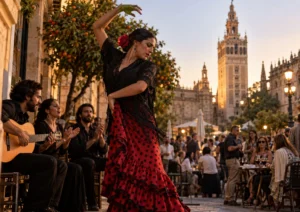
One of the clearest aims for 2026 is to bring flamenco to neighbourhoods and everyday spaces. The series Flamenco a pie de calle began even before the official opening.

On 3 September, Polígono Sur hosted La noche de las gitanas, an ensemble production connected to the memory and flamenco culture of Roma women. On 4 September, brothers Diego and Hugo Aguilar presented Cuestión de tiempo at the Monasterio de San Jerónimo, a dance piece about memory, identity and family heritage.

On 5 September, Plaza Virgen del Pilar in La Barzola hosts the second Festival Macarena Flamenca, dedicated to José el de la Tomasa. These events show that the cultural life of the Biennial 2026 does not begin on the 9th: activities spread across the city from early September.

A Biennial spread more widely across Seville

The appeal of Flamenco a pie de calle is not simply that many of its events are open to everyone. It also changes visitors’ mental map: flamenco is not confined to the monumental centre or the major venues.

Polígono Sur, San Jerónimo, Macarena and other locations introduce you to neighbourhoods with distinct identities. For visitors spending several days in Seville, these activities are a good opportunity to step off the usual tourist trail and understand that the city’s flamenco culture does not belong to just one neighbourhood.

For a roundup of free options, see our article on free performances and activities at the Biennial 2026, which we update with confirmed events.

Sala de revelado: “The invisible is flamenco too”

In September, the Biennial added a particularly interesting urban art project: “Sala de revelado”. The project began on 3 September on Calle San Jacinto in Triana and is designed as a route through different parts of the city, from Triana to Nervión via Calle Feria.

Through photography and sound, it reveals what happens before the curtain rises: rehearsals, research, repetition, experimentation and the development of productions.

The Biennial’s official photographer, Laura León, has documented creative processes involving artists such as Manuel Liñán, Ana Morales, Andrés Marín, David Coria, Patricia Guerrero, the Ballet Flamenco de Andalucía and Rosario La Tremendita. It is a different way to engage with the Biennial without entering a performance venue.

Flamenco in the streets without having to find a stage

This initiative is different from Flamenco a pie de calle. Here, the aim is not necessarily to attend a complete performance, but to encounter the creative process in urban spaces.

That makes it a particularly flexible activity for visitors: you may come across it while walking through neighbourhoods already on your itinerary. The Biennial specifically wants flamenco to reach people who were not looking for a scheduled event.

The idea fits an edition that aims to reveal the less visible side of creation. When you later see those same artists on stage, it becomes easier to appreciate all the work behind a production.

Ecos Primitivos: a sung opening proclamation in Plaza de San Francisco

The opening on 9 September will feature one of the most distinctive events in the entire side programme. At 20:30, Plaza de San Francisco hosts “Ecos Primitivos. Cante en Altura · Danza en Tierra”, conceived as the Biennial’s sung opening proclamation and co-organised with Fundación Cajasol.

Artistic direction is by Segundo Falcón. The voices of Segundo Falcón, Esperanza Fernández, Pedro El Granaíno, Rafael de Utrera and María Terremoto are positioned on balconies around the square, while Ana Morales occupies the central space with her dancing.

The urban architecture thus becomes part of the dramaturgy: an audience surrounding the action, voices from above and dance at street level. This opening is designed to be experienced as a collective event rather than a conventional front-facing performance.

How to fit the proclamation into the first night of the Biennial

Its location in Plaza de San Francisco makes the proclamation easy to combine with other plans in the centre. The cathedral, Plaza Nueva, Avenida de la Constitución and the area around the Town Hall are just a few minutes away on foot.

For planning the first few days specifically, also see our article on what the opening of the Flamenco Biennial 2026 will be like and the article The Biennial starts before 9 September, which brings together the earlier events.

The practical advice is to arrive with time to spare. Since this is an event in a public space, your experience depends greatly on finding a position from which you can hear and see the relationship between the balconies, the square and the dancing.

Tirititrán: experience flamenco rhythm as a family

The Biennial 2026 also includes an activity designed specifically for families. “Come and experience flamenco rhythm as a family with Tirititrán” takes place at CaixaForum Sevilla on 11, 12 and 13 September, with different sessions and time slots.

The workshop, led by Raúl Martínez, uses alegrías to introduce children and adults to the twelve-beat rhythmic cycle through body percussion, rhythm games and direct participation.

The activity is free and lets you experience flamenco from within: not just watching or listening, but feeling the rhythm and taking part. For families travelling to Seville during the Biennial, this could be one of the most accessible and distinctive side events.

The Biennial can also be a day out with children

A festival of this size need not be exclusively a night-time or adult experience. The CaixaForum workshop introduces flamenco through play and rhythm, with no prior knowledge required.

Travelling families should check the official agenda each day, as access conditions, sessions and capacity can vary by activity. For performances in theatres and tablaos, also check the specific conditions before booking.

The combination can work very well: a family workshop during the day, a walk around Seville and a performance suited to your group in the afternoon or evening.

“Sevilla se deja ver”: cinema, exhibitions and activities at cultural institutions

Alongside activities produced directly by the Biennial, there is a partner programme called “Sevilla se deja ver”. The city’s universities, foundations and cultural organisations extend the festival with exhibitions, screenings, talks and gatherings.

Cinema is one of its clearest strands. The Fundación Tres Culturas del Mediterráneo organises the series “Flamencas” on 8, 15, 22 and 29 September, with documentaries dedicated to women who have contributed to flamenco’s creation, preservation and international profile.

This kind of programming approaches flamenco through memory, reflection and audiovisual work, making it particularly interesting for anyone wishing to go beyond the stage performance.

Why you should also check the institutions’ agendas

The partner programme is the most scattered part of the Biennial. Not everything happens in the usual theatres or follows the same format as ticket sales for the main shows.

For a stay of several days, it is therefore worth consulting the participating institutions’ agendas as well as the Biennial website. You may find a talk, screening or exhibition that fits neatly between two performances.

This programme also turns the city into a kind of expanded festival: visitors can begin the day with heritage or cinema and finish it with live singing, dancing or guitar.

How to plan a day of side events and flamenco

To make the most of the Biennial without overloading your day, a good strategy is to plan one daytime activity and one main flamenco experience.

For example, you can visit La noche azul in the morning or afternoon, take a break in the centre and then attend an official performance. Another option is to choose a screening in Flamencas and round off the evening at a tablao.

When the official programme for that date does not suit your plans or is sold out, see our guide Biennial sold out: where to see flamenco today in Seville or the article Flamenco tonight in Seville during the Biennial.

Do not try to do everything

The Biennial lasts several weeks, and its side programme overlaps with dozens of shows. Trying to fit in too many activities can turn a cultural experience into a race around the city.

Prioritise according to your interests: history for La noche azul; public space for Flamenco a pie de calle and Sala de revelado; families for Tirititrán; cinema and reflection for Sevilla se deja ver; and a collective experience for Ecos Primitivos.

Then leave time to walk, have dinner and enjoy Seville. During the Biennial, flamenco is also in the city’s atmosphere, not just the next event on the agenda.

Which activities are free?

An important part of the side programme aims to make the Biennial accessible to more people. La noche azul offers free admission subject to capacity; Tirititrán is presented as a free activity; and many events in public spaces let you experience flamenco without buying a theatre ticket.

However, “side event” does not automatically mean “free activity”. The partner programme may include events with different conditions depending on the organising institution. Always check the individual listing before setting out.

To keep these two search needs distinct, our guide Flamenco Biennial 2026 for free specifically brings together free things to do, while this page provides an overview of the entire side programme.

Frequently asked questions about the Biennial 2026 side events

They are activities that complement the Biennial’s main performances: exhibitions, cinema, events in public spaces, family activities, gatherings, talks and cultural projects throughout Seville. Many come together under the “Otras perlas” programme.

The Biennial has a dedicated side-events section on its official website. Since the agenda may receive additions and changes, it is worth checking it during your visit.

Many are, particularly some street events, La noche azul and family activities such as Tirititrán. However, conditions are not necessarily the same for every event, so check each individual listing.

The exhibition runs from 2 September to 22 November 2026 in the Nave de Grabados at the Real Fábrica de Artillería. It continues well beyond the official dates of the Biennial.

Yes. The Flamenco a pie de calle programme brings events to different neighbourhoods and spaces in Seville. The Biennial also develops urban art projects such as Sala de revelado and other open events connected to its side programme.

It is the sung opening proclamation of the Biennial 2026, directed by Segundo Falcón and scheduled for 9 September at 20:30 in Plaza de San Francisco. It combines five voices from the balconies with Ana Morales’s dancing in the centre of the square.

Yes. At CaixaForum, Tirititrán offers a family introduction to flamenco rhythm through body percussion, rhythm games and participation. It is scheduled for 11, 12 and 13 September.

Yes. As part of Sevilla se deja ver, Fundación Tres Culturas presents the Flamencas series on 8, 15, 22 and 29 September, featuring documentaries about women who have been fundamental to flamenco’s history and profile.

Yes. La noche azul opened on 2 September, and Flamenco a pie de calle began on the 3rd. The Biennial’s cultural activities therefore start before the festival’s official opening date.

You can enjoy exhibitions, cinema and activities in public spaces and, to finish the day with live flamenco, compare the tablaos available in Seville for that same evening.

The Biennial also happens beyond the stage

The 2026 side programme confirms an important idea: the Seville Biennial is not just a succession of performances. For several weeks, flamenco enters museums, foundations, squares, neighbourhoods, cinema screens and family spaces.

During your stay in Seville for the festival, make time for some of these “Otras perlas”. An exhibition, screening or street activity can give you a different perspective on flamenco and perfectly complement an evening of singing, dancing and guitar.

Book online: the key to securing your seat

In many cities, flamenco tablaos sell out easily, especially on weekends and during peak season. That’s why, if your dates are set, the most important thing is to book online.

Direct recommendation: book online through our website to guarantee your seat and arrive with everything confirmed. If you already have your destination, go straight to your city to see available options and clear recommendations.

Flamenco Sevilla | Tablaos Flamencos

Seville

Flamenco Madrid | Tablaos Flamencos

Madrid

Flamenco Barcelona | Tablaos Flamencos

Barcelona

Flamenco Granada | Tablaos Flamencos

Granada

Flamenco Córdoba | Tablaos Flamencos

Cordoba

Flamenco Málaga | Tablaos Flamencos

Malaga

Flamenco Valencia | Tablaos Flamencos

Valencia

Flamenco Jerez | Tablaos Flamencos

Jerez

Find out more about this with your favorite AI:

Did you like this article? Share it!:

Tags: agenda flamenca, Bienal 2026, Bienal de Flamenco, festivales flamencos, flamenco en Sevilla, sevilla

Article published by:

Related articles

Flamenco in Seville this weekend: what to see before the Biennial
What to do in Seville during the Flamenco Biennial 2026