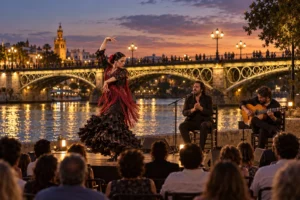
Flamenco Biennial

What to see at the Seville Flamenco Biennial, 14–20 September 2026

What to see at the Seville Flamenco Biennial, 14–20 September 2026

The second week of the Seville Flamenco Biennial 2026, from Monday 14 to Sunday 20 September, changes the festival’s pace. After the first big weekend, the programme branches out: the Real Alcázar hosts three consecutive nights of singing and traditional flamenco; the three late-night performances originally scheduled at Hotel Triana move to Muelle de la Sal; the Lope de Vega welcomes two highly distinctive singing recitals; and the weekend brings together guitar, orchestra, matinées, emerging talent and several one-off evenings.

Across seven days there are 20 official performances. You cannot combine them all. Indeed, much of this week’s appeal lies in choosing: Israel Fernández overlaps with Ana Morales and Macarena López; Rancapino Chico clashes with the tribute to Isabel Bayón; Xerezanías means choosing against José del Tomate; and the weekend again offers performances at competing times.

This guide organises the programme for 14–20 September 2026 and suggests what to choose according to your interest in singing, guitar, dance, traditional flamenco, contemporary creation or an experience particularly connected to Seville.

14–20

September 2026

Monday to Sunday

20 official performances

Singing · dance · guitar · one-off evenings · matinées

Alcázar · Muelle de la Sal · Maestranza · Lope de Vega · Turina · Alameda · Central · San Luis · Artillería

At a glance: to narrow this week down to a few highlights, Monday 14 offers three very different directions with Israel Fernández, Ana Morales and Macarena López; Tuesday 15 pits Rancapino Chico’s singing against a one-off evening dedicated to Isabel Bayón; Wednesday 16 contrasts the Jerez gathering of Xerezanías with José del Tomate’s guitar; Thursday 17 allows you to combine Arcángel with Mujeres Gitanas at Muelle de la Sal; Friday 18 stands out for Antonio Reyes and the evening dedicated to Peña El Pozo de las Penas; Saturday 19 brings together Alejandro Hurtado, María Marín, Cañizares with the ROSS and Andalucía en el tiempo; and Sunday 20 again features Alejandro Hurtado, Manuel de la Luz & Manuel Imán, José Mercé and the Andalusian Young Flamenco Artists Circuit Gala.

Last updated: 5 September 2026. Times and programme checked against the official schedule of the 24th Biennial. Venue update: the performances on 17, 18 and 19 September originally scheduled at Hotel Triana will take place at Muelle de la Sal, keeping their dates and 23:00 start times. Ticket availability may change: always check each show’s official listing before finalising your plans.

The week when the Biennial spreads across Seville

From 14 to 20 September, the Biennial stops feeling like a succession of isolated major premieres and begins to reveal its full structure. On Monday, Tuesday and Wednesday, the Real Alcázar becomes a major focus for flamenco singing with Israel Fernández, Rancapino Chico and the Jerez gathering of Xerezanías. From Thursday, the spotlight also shifts to Muelle de la Sal, the new venue for three consecutive one-off evenings originally announced for Hotel Triana.

Meanwhile, the Lope de Vega, Alameda, Teatro Central, Turina, San Luis de los Franceses, Real Fábrica de Artillería and Teatro de la Maestranza maintain very different programming strands. It is an ideal week to discover that the Biennial offers not one flamenco, but many ways of approaching it.

From traditional roots to large-scale productions in a single week

In just a few days you can move from Rancapino Chico’s singing to a contemporary dance production by Ana Morales; from José del Tomate’s solo guitar to a symphonic concert by Cañizares with the Royal Seville Symphony Orchestra; or from the intimacy of San Luis de los Franceses to the late-night atmosphere at Muelle de la Sal.

The key is not to try to see everything. Overlapping times mean building your own Biennial. This guide therefore distinguishes between compatible performances, risky combinations and options that require a clear choice.

Full Biennial programme for 14–20 September 2026

Date Time Venue Artist / show Format
Mon. 14 21:30 Real Alcázar Israel Fernández — De oro y marfil Flamenco singing
Mon. 14 22:00 Real Fábrica de Artillería Ana Morales — Rapsodia. Fantasía subterránea World premiere
Mon. 14 22:30 Teatro Alameda Macarena López — Sobre todas las cosas World premiere
Tue. 15 21:30 Real Alcázar Rancapino Chico — Pizarra World premiere
Tue. 15 22:30 Teatro Central David Lagos, Miguel Ortega, Antonio Campos, Inma Rivero and José Luis Ortiz Nuevo — Epílogo de un cante que se hizo baile. Suite de cantes One-off evening · tribute to Isabel Bayón
Wed. 16 21:30 Real Alcázar Luis El Zambo, Dolores Agujetas, Antonio de la Malena, Manuel Valencia and Las Tatas de Jerez — Xerezanías One-off evening
Wed. 16 22:30 Teatro Alameda José del Tomate — Sonanta 3.0 Guitar
Thu. 17 20:00 Teatro Lope de Vega Arcángel — La copla del cante One-off evening
Thu. 17 23:00 Muelle de la Sal Remedios Amaya, La Fabi, Montse Cortés and Josemi Carmona — Mujeres Gitanas One-off evening
Fri. 18 19:00 Espacio Turina Juan Requena — Requeneando Guitar
Fri. 18 20:00 Teatro Lope de Vega Antonio Reyes — Seis cuerdas, seis One-off evening
Fri. 18 23:00 Muelle de la Sal 75th anniversary of Peña El Pozo de las Penas — Uvitas negras One-off evening
Sat. 19 12:00 San Luis de los Franceses Alejandro Hurtado + Enrique Solinís — Devenir de la guitarra Special matinée
Sat. 19 19:00 Espacio Turina María Marín — Las tres Marías World premiere
Sat. 19 20:00 Teatro de la Maestranza Cañizares & ROSS — Cañizares sinfónico One-off evening
Sat. 19 23:00 Muelle de la Sal El Boquerón, Carmen de la Jara, Curro Lucena, Jaime “El Parrón”, Joselete de Linares, José Sorroche, Paqui Corpas, El Pecas and Romerito de Jerez — Andalucía en el tiempo One-off evening
Sun. 20 12:00 San Luis de los Franceses Alejandro Hurtado + Enrique Solinís — Devenir de la guitarra Special matinée
Sun. 20 19:00 Espacio Turina Manuel de la Luz & Manuel Imán — Manos que hablan One-off evening
Sun. 20 20:00 Teatro de la Maestranza José Mercé — Toquen a rebato One-off evening
Sun. 20 22:30 Teatro Alameda Andalusian Young Flamenco Artists Circuit Gala Young flamenco artists

Tip: do not treat this table as an itinerary. Several performances overlap or leave too little time to change venues. The daily selection below is designed to avoid impossible plans.

Monday 14: three different Biennials within just one hour

Monday presents one of the week’s clearest choices. At 21:30, Israel Fernández brings De oro y marfil to the Real Alcázar. For anyone prioritising singing, the voice and an evening in one of this edition’s most distinctive historic settings, it is the natural choice.

Half an hour later, at 22:00, Ana Morales gives the second performance of Rapsodia. Fantasía subterránea at the Real Fábrica de Artillería. This dance creation was conceived for a distinctive industrial space and represents the evening’s most contemporary direction.

At 22:30, Macarena López premieres Sobre todas las cosas at the Teatro Alameda, an opportunity to explore a younger generation of dance within the Biennial.

What to choose on Monday

Israel Fernández for singing and a night-time experience at the Alcázar. Ana Morales for stage creation, artistic exploration and contemporary dance. Macarena López to discover something new and follow the renewal of flamenco dance.

We do not recommend trying to combine two of the three. Their start times are too close and the venues are separate. Monday is a night to choose one performance carefully and enjoy it without watching the clock.

For more about the Alcázar, see our guide to flamenco at the Real Alcázar during the Biennial 2026.

Tuesday 15: Rancapino Chico or a one-off tribute to Isabel Bayón

At 21:30 at the Real Alcázar, Rancapino Chico presents Pizarra, a world premiere. It is an appealing choice for anyone seeking an evening focused on singing, tradition and artistic personality in the Alcázar setting.

An hour later, the Teatro Central hosts Epílogo de un cante que se hizo baile. Suite de cantes, a one-off evening dedicated to Isabel Bayón with David Lagos, Miguel Ortega, Antonio Campos, Inma Rivero and José Luis Ortiz Nuevo.

More than a conventional performance, this second event brings together voices and memories around a fundamental figure of Seville’s flamenco dance.

Two ways of listening to flamenco’s memory

Tuesday contrasts not so much tradition and modernity as two ways of looking back. Rancapino Chico does so through his own recital; the Central evening through tribute and collective creation.

Attending both is unrealistic because of the timing. For singing by a particular artist, choose the Alcázar. For one-off evenings and productions that belong specifically to a Biennial, the Central has special appeal.

You can also consult our calendar of one-off evenings at the Biennial 2026.

Wednesday 16: Jerez takes over the Alcázar

Wednesday’s event at the Real Alcázar is one of the week’s most compelling gatherings of flamenco singers. Xerezanías brings together Luis El Zambo, Dolores Agujetas, Antonio de la Malena, Manuel Valencia and Las Tatas de Jerez for a one-off evening with Jerez at its symbolic heart.

For singing, rhythm, artistic lineages and a gathering hard to repeat outside the Biennial, this is one of our clearest recommendations for 14–20 September.

22:30: José del Tomate and a guitar alternative

At 22:30 at the Teatro Alameda, José del Tomate presents Sonanta 3.0. The timing prevents you from watching it in full after Xerezanías, so Wednesday again requires a choice of artistic language.

For a guitar-focused week, José del Tomate belongs on your list. For a singing evening unlikely to reunite this line-up in this setting, we would prioritise Xerezanías.

For more context on both approaches, see our guides to singing at the Biennial 2026 and guitar at the Biennial.

Thursday 17: Arcángel opens the evening at the Lope de Vega

Arcángel presents La copla del cante at 20:00 at the Teatro Lope de Vega. The production explores the historical relationship between flamenco and copla, a Spanish song tradition visited by many 20th-century artists and the starting point here for a one-off evening.

It is a good choice for singing in a grand theatre without opting for a conventional recital. The ensemble includes guitar, backing vocals and rhythmic handclapping, percussion, keyboards, flute, harmonica and violin.

23:00: Mujeres Gitanas opens the Muelle de la Sal series

Three hours later begins one of the week’s most anticipated sequences: the late-night performances moved from Hotel Triana to Muelle de la Sal. The first brings together Remedios Amaya, La Fabi, Montse Cortés and Josemi Carmona under the title Mujeres Gitanas.

Arcángel followed by Muelle de la Sal is, on paper, one of the week’s more reasonable combinations, but it is not a guaranteed connection: allow for the actual running time, leaving the Lope de Vega and reaching the new riverside venue, rather than Hotel Triana.

For the background to the original venue, see our guide to the three Biennial evenings originally planned in the historic communal courtyard.

Friday 18: Juan Requena or Antonio Reyes

Friday begins at 19:00 at Espacio Turina with Juan Requena and Requeneando. An hour later, Antonio Reyes presents Seis cuerdas, seis at the Lope de Vega, a one-off evening placing the singer opposite six guitars and making accompaniment central to the concept.

Their start times make the two performances incompatible. For guitar enthusiasts following Turina’s programme, Juan Requena is the natural choice. For singing in an exceptional format built around different guitarists, Antonio Reyes is especially appealing.

23:00: 75 years of Peña El Pozo de las Penas

The second night at Muelle de la Sal celebrates the 75th anniversary of Peña El Pozo de las Penas with Uvitas negras. The line-up brings together Itoly de Los Palacios, Juan El Distinguido, Nene Escalera, Miguel Ortega, José Ángel Carmona, Juanelo, Anabel de Vico and Manuel Orta, accompanied by guitarists Niño Fraile and Salvador Gutiérrez.

Manuel Curao’s direction reinforces the gathering’s sense of shared memory and its direct connection to flamenco club culture. It could provide an excellent conclusion after an afternoon of guitar or Antonio Reyes, provided the running time and journey leave enough margin.

Saturday 19: the week’s fullest day

Saturday allows you to experience the Biennial from noon until after midnight. At 12:00 at San Luis de los Franceses, Alejandro Hurtado presents Devenir de la guitarra with Enrique Solinís. The programme covers granaína, alegrías, farruca, seguiriya, zapateado and taranta; the dialogue with a musician associated with early music fits this Baroque setting particularly well.

At 19:00 at Turina, María Marín premieres Las tres Marías. An hour later, at the Maestranza, Cañizares joins the Royal Seville Symphony Orchestra for Cañizares sinfónico.

Cañizares with the ROSS or María Marín: another necessary choice

Although the performances start an hour apart, combining them is unrealistic. Anyone attending María Marín at 19:00 should not plan to be seated at the Maestranza at 20:00.

Cañizares sinfónico is one of the week’s largest-scale productions, including the Concierto Al-Ándalus, dedicated to the memory of Paco de Lucía, and the Concierto Mediterráneo, dedicated to Joaquín Rodrigo. María Marín, by contrast, offers a world premiere in a more intimate setting.

At 23:00, Andalucía en el tiempo closes the series at Muelle de la Sal with singers from different Andalusian provinces and guitarists Eduardo Rebollar and Antonio Carrión. It is an evening explicitly conceived as a geographical portrait of flamenco singing.

Sunday 20: another opportunity for the matinée

Devenir de la guitarra returns to San Luis de los Franceses at 12:00. For those unable to attend on Saturday, Sunday offers the same opportunity to hear Alejandro Hurtado with Enrique Solinís in one of the entire Biennial’s most distinctive spaces.

The special matinées also offer a different way to experience the festival: they separate the concert from the evening and allow time to enjoy Seville between performances, without an impossible succession of start times.

19:00, 20:00 and 22:30: guitar, José Mercé and a new generation

At 19:00 at Turina, Manuel de la Luz and Manuel Imán present Manos que hablan, a one-off evening centred on the dialogue between two guitars and two artistic journeys. At 20:00 at the Teatro de la Maestranza, José Mercé presents Toquen a rebato, one of this edition’s major singing events.

The two performances overlap and you must choose. For more about José Mercé, read our article on Toquen a rebato at the Biennial 2026.

At 22:30, the Teatro Alameda hosts the Andalusian Young Flamenco Artists Circuit Gala, an ideal opportunity to end the week looking towards performers who may lead future editions.

Four suggested itineraries for 14–20 September

The best way to make the most of this week is to choose an area of interest and leave room to adapt your plans to availability.

1. Singing and tradition

Mon.: Israel Fernández

Tue.: Rancapino Chico

Wed.: Xerezanías

Thu.: Arcángel

Fri.: Antonio Reyes

Sun.: José Mercé

The most direct route for anyone wanting the voice at the heart of the week.

2. Guitar

Wed.: José del Tomate

Fri.: Juan Requena

Sat.: Alejandro Hurtado or Cañizares

Sun.: Manuel de la Luz & Manuel Imán

Four very different ways of hearing flamenco guitar, from recital to symphonic format.

3. Unrepeatable evenings

Tue.: Tribute to Isabel Bayón

Thu.: Mujeres Gitanas

Fri.: Uvitas negras

Sat.: Andalucía en el tiempo

The route most closely tied to the one-off evening concept and the Biennial’s exceptional character.

4. Discovery

Mon.: Macarena López

Fri.: Juan Requena

Sat.: María Marín

Sun.: Young Flamenco Artists Gala

For those looking beyond the most obvious names to discover new voices and artistic languages.

For your first Biennial

You do not need an encyclopaedic week. For a first experience, we would combine a major name, a historic venue and a one-off evening. For example: Israel Fernández at the Alcázar, an evening at Muelle de la Sal and José Mercé at the Maestranza.

These three experiences already reveal three very different festival scales: historic intimacy, a late-night flamenco gathering and a grand theatre.

When an official performance is sold out, remember that flamenco continues every night outside the festival programme. Our guide to where to see flamenco in Seville during the Biennial brings together year-round alternatives.

For those who already know flamenco well

This week offers exactly what often interests enthusiasts who look beyond the biggest headlines: hard-to-repeat gatherings, encounters between generations and formats created specifically for the Biennial.

Xerezanías, the tribute to Isabel Bayón, the three evenings moved to Muelle de la Sal, Seis cuerdas, seis and Devenir de la guitarra are good examples. Rather than choosing by fame, it makes sense to choose by distinctiveness: which performance would be hardest to see again outside Seville and these dates?

For dance lovers

Monday brings together this week’s two most obvious dance choices. Ana Morales takes Rapsodia. Fantasía subterránea to the Real Fábrica de Artillería and Macarena López premieres Sobre todas las cosas at the Teatro Alameda.

These work on different scales: an established creator in a strongly site-specific project and a new-generation production in a more intimate theatre. For a dance-focused Biennial trip, mark Monday 14 from the start.

Complete your selection with our guide to dance at the Biennial 2026.

For Seville as well as flamenco

The Real Alcázar, San Luis de los Franceses, Muelle de la Sal and the Real Fábrica de Artillería allow the venue itself to become part of the experience. A recital in a conventional theatre is very different from a matinée in a Baroque church or a night of singing beside the Guadalquivir. The three evenings initially planned in Hotel Triana’s communal courtyard will now take place at Muelle de la Sal.

For a trip combining heritage and the Biennial, we would prioritise at least one performance in these settings. Our guide to the Biennial’s most spectacular venues can help you decide.

Reasonable combinations

  • Arcángel 20:00 + Muelle de la Sal 23:00: reasonable provided the first performance ends with sufficient margin and you leave promptly.
  • Antonio Reyes 20:00 + Muelle de la Sal 23:00: possible in principle, but not guaranteed without knowing the actual running time.
  • Alejandro Hurtado 12:00 + an evening performance: a comfortable, recommended combination.
  • An afternoon performance + Muelle de la Sal 23:00: usually the most logical structure for Thursday, Friday and Saturday.
  • José Mercé 20:00 + Young Artists Gala 22:30: potentially too tight; check running time and travel before planning it.

Combinations we would avoid

  • Israel Fernández 21:30 + Ana Morales 22:00: incompatible.
  • Ana Morales 22:00 + Macarena López 22:30: incompatible.
  • Rancapino Chico 21:30 + Isabel Bayón tribute 22:30: not recommended.
  • Xerezanías 21:30 + José del Tomate 22:30: incompatible.
  • Juan Requena 19:00 + Antonio Reyes 20:00: incompatible.
  • María Marín 19:00 + Cañizares 20:00: incompatible.
  • Manuel de la Luz & Manuel Imán 19:00 + José Mercé 20:00: incompatible.

At the Biennial, it is better to leave a performance off your plan than miss half of one in practice. Allow time to enter calmly, leave the venue and move through a city that remains lively at night in September.

Our selection for just four performances

Israel Fernández at the Real Alcázar for the combination of singing and setting; Xerezanías for its unrepeatable Jerez gathering; one of the three evenings at Muelle de la Sal for the atmosphere and one-off evening concept; and José Mercé at the Teatro de la Maestranza as Sunday’s grand finale.

For a stronger guitar focus, we would replace one or two of these choices with Alejandro Hurtado at San Luis and Cañizares with the ROSS. For dance, Monday should centre on Ana Morales or Macarena López.

Frequently asked questions about the Biennial, 14–20 September

The official programme includes 20 performances between Monday 14 and Sunday 20 September, counting both performances of Devenir de la guitarra by Alejandro Hurtado and Enrique Solinís at San Luis de los Franceses.

Monday features Israel Fernández with De oro y marfil at the Real Alcázar at 21:30, Ana Morales with Rapsodia. Fantasía subterránea at the Real Fábrica de Artillería at 22:00 and Macarena López with Sobre todas las cosas at the Teatro Alameda at 22:30.

Muelle de la Sal is the new venue for three consecutive one-off evenings, with the original dates and times unchanged: Mujeres Gitanas on Thursday 17, Uvitas negras on Friday 18 and Andalucía en el tiempo on Saturday 19, all at 23:00.

José Mercé presents Toquen a rebato on Sunday 20 September 2026 at 20:00 at the Teatro de la Maestranza.

The main guitar events include José del Tomate on Wednesday 16, Juan Requena on Friday 18, Alejandro Hurtado with Enrique Solinís on Saturday 19 and Sunday 20, Cañizares with the Royal Seville Symphony Orchestra on Saturday 19, and Manuel de la Luz with Manuel Imán on Sunday 20.

Yes. Alejandro Hurtado, with Enrique Solinís, presents Devenir de la guitarra on Saturday 19 and Sunday 20 at 12:00 in the Church of San Luis de los Franceses.

Saturday 19 and Sunday 20 each have four performances. Saturday’s venues are San Luis, Turina, Maestranza and Muelle de la Sal; Sunday’s are San Luis, Turina, Maestranza and Teatro Alameda.

In some cases, yes, especially by combining a matinée with an evening performance or an earlier show with Muelle de la Sal at 23:00. However, many events overlap. We do not recommend combining performances starting only 30 or 60 minutes apart in different venues.

The safest approach is to visit the official Biennial programme, open the show’s listing and follow its official ticket sales channel. Availability may change as the dates approach.

Book online: the key to securing your seat

In many cities, flamenco tablaos sell out easily, especially on weekends and during peak season. That’s why, if your dates are set, the most important thing is to book online.

Direct recommendation: book online through our website to guarantee your seat and arrive with everything confirmed. If you already have your destination, go straight to your city to see available options and clear recommendations.

Flamenco Sevilla | Tablaos Flamencos

Seville

Flamenco Madrid | Tablaos Flamencos

Madrid

Flamenco Barcelona | Tablaos Flamencos

Barcelona

Flamenco Granada | Tablaos Flamencos

Granada

Flamenco Córdoba | Tablaos Flamencos

Cordoba

Flamenco Málaga | Tablaos Flamencos

Malaga

Flamenco Valencia | Tablaos Flamencos

Valencia

Flamenco Jerez | Tablaos Flamencos

Jerez

Find out more about this with your favorite AI:

Did you like this article? Share it!:

Tags: Flamenco Biennial, Flamenco Biennial 2026, Flamenco events calendar, Flamenco festivals, flamenco in Seville, Seville

Article published by:

Related articles

What to do in Seville during the Flamenco Biennial 2026
Flamenco Biennial: Noches Únicas move from Hotel Triana to Muelle de la Sal