Flamenco Biennial

Seville Flamenco Biennial 2026 for free: shows and free activities

How to enjoy the Seville Flamenco Biennial 2026 for free

The Seville Flamenco Biennial 2026 is not limited to major ticketed performances in theatres and historic venues. The fringe programme of the 24th Biennial also includes free street flamenco shows, film screenings, a family workshop and activities with free admission, some of them even before the official opening on 9 September.

For anyone wishing to experience the Biennial without buying a ticket for every performance, this programme offers a particularly appealing opportunity: between 3 and 29 September 2026 there are confirmed free activities and events with free admission in various parts of Seville.

However, “free” does not always mean the same thing. Sometimes you can simply turn up until capacity is reached; in other cases you must obtain an invitation or book in advance. This guide brings together only activities confirmed as free and explains how to attend each one.

Bienal de Flamenco de Sevilla 2026 gratis: espectáculos y actividades gratuitas

Quick answer: are there free shows at the Biennial 2026?

Yes. The Seville Flamenco Biennial 2026 fringe programme includes confirmed free events. Highlights include the four “Flamenco a pie de calle” shows from 3 to 6 September, the sung opening proclamation on 9 September in Plaza de San Francisco, the family workshop Tirititrán at CaixaForum and four screenings in the film series Flamencas.

The key is admission: the street shows offer free admission until capacity is reached; Tirititrán and the film series require free advance booking. Always check the organisers’ latest information before travelling.

Calendar of confirmed free activities

This is a practical calendar of activities which, according to the information published so far, have confirmed free admission. Some dates fall before the official start of the Biennial, which runs from 9 September to 3 October.

Date Activity Venue Admission
3 September · 21:30 La noche de las gitanas Parque Pepa La Calzona · Polígono Sur Free until capacity is reached
4 September · 21:30 Cuestión de tiempo · Brothers Diego and Hugo Aguilar Monasterio de San Jerónimo Free until capacity is reached
5 September · 21:30 II Festival Macarena Flamenca Plaza Virgen del Pilar · La Barzola Free until capacity is reached
6 September · 21:30 Nazareno y Olivares Museo de Artes y Costumbres Populares Free until capacity is reached
8 September · 20:30 La reina de la copla · Flamencas film series Fundación Tres Culturas Free with advance booking
9 September · 20:30 Ecos Primitivos. Cante en altura, danza en tierra · sung opening proclamation Plaza de San Francisco Event in a public space
11–13 September Tirititrán · family workshop CaixaForum Sevilla Free with booking
15 September · 20:30 Maestros contemporáneos · Flamencas film series Fundación Tres Culturas Free with advance booking
22 September · 20:30 Carmen Linares. Cantar con verdad · Flamencas film series Fundación Tres Culturas Free with advance booking
29 September · 20:30 Flamencas, mujeres, fuerza y duende Fundación Tres Culturas Free with advance booking

Flamenco a pie de calle: four free nights before the Biennial

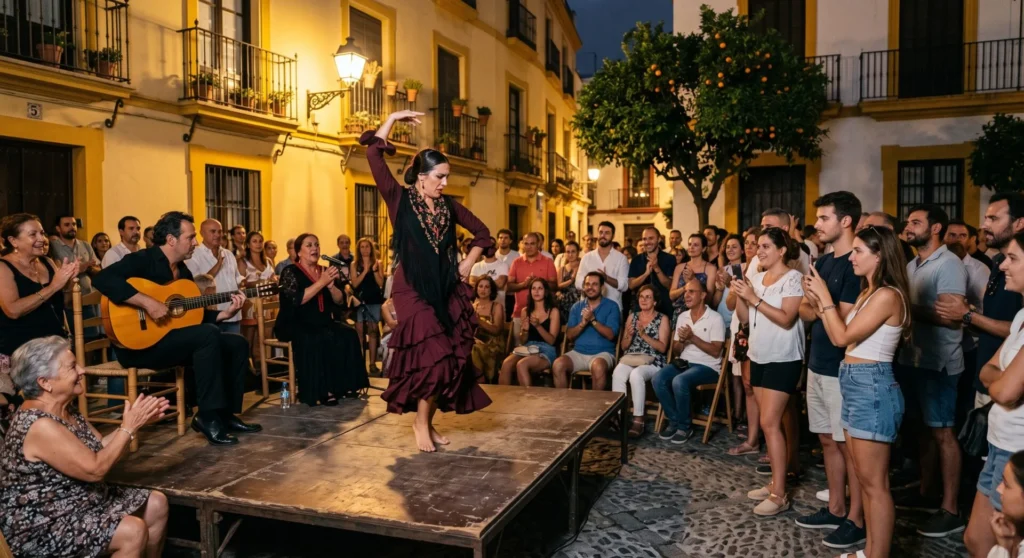
One of the most appealing ways to enjoy the Biennial without a ticket is Flamenco a pie de calle. There are four shows on consecutive evenings, all at 21:30, in different neighbourhoods and venues across Seville from 3 to 6 September.

The organisers announce free admission until capacity is reached. These performances take place before the Biennial’s official opening, so flamenco events linked to the festival begin several days before 9 September.

What you need to know

As no numbered seat is reserved, we recommend arriving early. Free admission can attract high demand, especially for line-ups featuring well-known artists.

These four performances are also a good way to discover a Biennial that extends beyond the major theatres: the festival moves into public spaces and brings flamenco to very different neighbourhoods and locations across the city.

3 September: La noche de las gitanas

The first free event takes place on Thursday 3 September at 21:30 around Calle Arquitecto José Galnares, next to Parque Pepa La Calzona in Polígono Sur.

La noche de las gitanas brings together female singers and dancers in a line-up including Herminia Borja, Mara Rey, Zamara Carrasco and Manuela Vargas, accompanied by guitarists and palmas handclapping. It opens this journey through the Biennial’s street programme and connects the festival with one of Seville’s neighbourhoods with the strongest flamenco identity.

4 September: Cuestión de tiempo

On Friday 4 September at 21:30, the series moves to Monasterio de San Jerónimo. Brothers Diego and Hugo Aguilar present Cuestión de tiempo, a production bringing dance into a distinctive historic setting.

5 September: Macarena Flamenca

On Saturday 5 September at 21:30 , the programme features the II Festival Macarena Flamenca in Plaza Virgen del Pilar, La Barzola. This edition pays tribute to José de la Tomasa and brings together artists including Potito, Antonio Reyes, Remedios Reyes, Manuel de la Tomasa and Manuela Amador Carrasco.

6 September: Nazareno y Olivares

On Sunday 6 September, also at 21:30, the Museo de Artes y Costumbres Populares, in Plaza de América in Parque de María Luisa, hosts Nazareno y Olivares, a stage journey exploring Fosforito’s life and artistic world, with artists including Enrique Garcés, Bernardo Miranda, Alejandro Hurtado and Yolanda Osuna.

9 September: sung opening proclamation in Plaza de San Francisco

The Biennial’s opening day includes one of its most prominent events in central Seville. On Wednesday 9 September at 20:30, Plaza de San Francisco hosts Ecos Primitivos. Cante en altura, danza en tierra, a sung opening proclamation directed and performed by Segundo Falcón.

The line-up brings together Segundo Falcón, Esperanza Fernández, Pedro El Granaíno, Rafael de Utrera and María Terremoto, with dance by Ana Morales. The event’s concept places the audience around the performance in the square, making it an opening celebration directly connected with the city.

Unlike the four Flamenco a pie de calle shows, which the organisers explicitly describe as offering free admission until capacity is reached, here it is more prudent to describe it as an event in a public space with no paid admission announced. Check any specific admission instructions published by the Biennial as the date approaches.

Tirititrán: a free family flamenco workshop at CaixaForum

The free programme also includes an activity designed especially for families. Tirititrán is a participatory introduction to flamenco rhythm and the cajón, recommended for families with children aged 7 and over.

It takes place at CaixaForum Sevilla from 11 to 13 September and lasts approximately 1 hour and 15 minutes. The activity is free, but you need to book a ticket. CaixaForum states that bookings become available the day before each session.

Tirititrán session times

Friday 11: 17:30 and 19:00.
Saturday 12: 11:30, 13:00, 17:00 and 18:30.
Sunday 13: 11:30, 13:00 and 17:00.

Children under 16 must be accompanied by an adult, who also needs their own free ticket. If you are interested in this activity, do not leave booking until the last minute.

Free flamenco films: the Flamencas series

The fringe programme also includes the audiovisual series Flamencas, with four screenings on Tuesdays 8, 15, 22 and 29 September at the Fundación Tres Culturas del Mediterráneo.

The screenings are free, but require advance booking. For anyone wishing to extend their Biennial experience beyond the stage, this documentary series offers an insight into flamenco figures, cultural memory and creativity.

The four screenings

8 September · 20:30: La reina de la copla, by Paco Millán.

15 September · 20:30: Maestros contemporáneos, by Tere Peña and Alfonso García.

22 September · 20:30: Carmen Linares. Cantar con verdad, by Gemma Soriano and Hortensia Vélez.

29 September · 20:30: Flamencas, mujeres, fuerza y duende, by Marcos Medina and Jonathan González.

Free does not always mean no booking required

This is probably the most useful point in the whole guide. The Biennial offers several forms of free admission, and understanding the difference helps avoid missing an activity because you arrive without the necessary booking.

  • Free admission until capacity is reached: this is the system announced for the four Flamenco a pie de calle shows. You do not buy a ticket, but space is limited.
  • Free with advance booking: this applies to the Flamencas film series and Tirititrán. Admission costs nothing, but you still need to secure a place.
  • Activity in a public space: the sung opening proclamation takes place in Plaza de San Francisco. We recommend checking the official admission instructions a few days beforehand.

The best strategy is simple: arrive early for events without booking, and secure your place as soon as bookings open for those that require it.

Other fringe activities: check their admission conditions

The Biennial has also announced exhibitions, meetings, recitals, talks and other fringe events. These include La noche azul. Ópera flamenca en la colección de Carlos Martín Ballester, at the Real Fábrica de Artillería, alongside projects such as Montelirio, Naquerar, events at peñas and other “Sevilla se deja ver” initiatives.

However, not all published event listings yet state unequivocally that admission is free. For that reason, we have not included them in this page’s main calendar as confirmed free activities. If the Biennial updates its admission conditions, this guide can be expanded.

This distinction matters: inclusion in the fringe programme does not automatically mean an event is free.

Combining the free programme with ticketed Biennial shows

The free programme works very well alongside the major performances. For example, you could start experiencing the Biennial on 3 September with Flamenco a pie de calle, several days before the official opening, then book one or two paid performances that particularly interest you.

If you are still organising your trip, see our complete guide to the Seville Flamenco Biennial 2026, which brings together dates, venues and essential information about the festival.

If the show you want is sold out

High demand has left many performances without available tickets. If your first choice is sold out, you can read our guide to what to see when Biennial tickets are sold out and combine the free activities with tablaos and other alternatives.

You can also check the schedule of Noches Únicas at the Biennial 2026 if you are looking for special productions in the main programme.

Tips for enjoying the Biennial for free

If your priority is to attend as many activities as possible without paying for admission, these four recommendations are particularly useful:

1. Start before 9 September. The four street shows take place from 3 to 6 September, and the first documentary in the Flamencas series is on 8 September.

2. Distinguish free admission from free advance booking. These are different systems, and an activity with no admission charge can still run out of places.

3. Arrive early for the street shows. “Until capacity is reached” means admission is not guaranteed once the venue is full.

4. Check the official programme. The Biennial may publish new instructions, timetable changes or admission conditions as each activity approaches.

Frequently asked questions about the free Biennial 2026 programme

Yes. The fringe programme includes street performances with free admission, free film screenings, family activities and other events in public spaces.

The four confirmed Flamenco a pie de calle shows are La noche de las gitanas on 3 September, Cuestión de tiempo on 4 September, the II Festival Macarena Flamenca on 5 September and Nazareno y Olivares on 6 September. All start at 21:30.

The organisers announce free admission until capacity is reached. There is no paid ticket, but arriving early is recommended.

Yes. It is a free family activity at CaixaForum Sevilla from 11 to 13 September, although you need to book a place. Bookings open the day before each session.

Yes. The four screenings scheduled for 8, 15, 22 and 29 September are free with advance booking at Fundación Tres Culturas.

No. Although the official Biennial begins on 9 September, several free fringe activities take place earlier. Flamenco a pie de calle starts on 3 September, and the film series has its first screening on 8 September.

Not necessarily. The fringe programme includes many activities, and their published admission conditions vary. This guide treats an activity as free only when we have been able to confirm free admission or open access.

The main reference is the official Seville Flamenco Biennial website and its “Otras Perlas” fringe activities section. Check it before attending.

Book online: the key to securing your seat

In many cities, flamenco tablaos sell out easily, especially on weekends and during peak season. That’s why, if your dates are set, the most important thing is to book online.

Direct recommendation: book online through our website to guarantee your seat and arrive with everything confirmed. If you already have your destination, go straight to your city to see available options and clear recommendations.

Flamenco Sevilla | Tablaos Flamencos

Seville

Flamenco Madrid | Tablaos Flamencos

Madrid

Flamenco Barcelona | Tablaos Flamencos

Barcelona

Flamenco Granada | Tablaos Flamencos

Granada

Flamenco Córdoba | Tablaos Flamencos

Cordoba

Flamenco Málaga | Tablaos Flamencos

Malaga

Flamenco Valencia | Tablaos Flamencos

Valencia

Flamenco Jerez | Tablaos Flamencos

Jerez

Find out more about this with your favorite AI:

Did you like this article? Share it!:

Tags: Flamenco Biennial, Flamenco Biennial 2026, Flamenco events calendar, Flamenco festivals, flamenco in Seville, Seville

Article published by:

Related articles

Unique Nights of the Seville Flamenco Biennial 2026: full schedule, artists and tickets
The Blue Night: the Biennial exhibition on the era of Flamenco Opera