History of flamenco

Seville’s vanished flamenco tablaos: venues that form part of its history

Seville’s story is also told through the tablaos that no longer exist

Some places disappear from the map but live on in a city’s memory. In Seville, this is true of former theatres, cafés cantantes, entertainment halls and also flamenco tablaos that have disappeared that for years provided work, training, encounters and exposure for generations of artists.

Some names already belong to the great history of Seville’s flamenco. Cortijo El Guajiro, La Cochera, La Trocha and Las Brujas are no longer part of the city’s performance circuit, but they help explain how the profession became established, how performance spaces changed and how flamenco engaged with tourism while remaining a daily training ground for singers, dancers and guitarists.

More than a list of closed venues

Discussing vanished tablaos is not about collecting old names. What matters is reconstructing the role each venue played, which artists performed on its stage, which parts of Seville it occupied and which aspects of its model survive on today’s stages.

Historical terminology was not always precise either. In the 1950s, terms such as entertainment hall, terrace, cortijo, Andalusian arts show and tablao coexisted. Some researchers see venues such as El Guajiro as a transition between the old variety halls and the modern tablao, where flamenco became the venue’s principal purpose.

Quick answer: among Seville’s most significant lost tablaos and flamenco venues are Cortijo El Guajiro, opened in 1952 and the direct predecessor of El Patio Sevillano; La Cochera, a key stage around 1970 for figures such as Manuela Carrasco and Los Bolecos; La Trocha, founded in the late 1960s and later based on Ronda de Capuchinos; and Las Brujas, active in the final decades of the 20th century and associated with artists and teachers such as José Galván. Their premises disappeared or changed use, but their influence lives on in the professional history of Seville’s flamenco.

Before the tablao: from cafés cantantes to a new model

To understand the importance of these venues, we need to go back a little further. During the 19th century, the cafés cantantes of Seville helped bring flamenco out of private settings and individual celebrations, turning it into professional entertainment with contracted artists and a regular audience.

Over time, that model lost ground. Flamenco moved through theatres, salons, roadside inns, variety halls and establishments where it shared the bill with other music and stage acts. After the Spanish Civil War, and especially from the 1950s onwards, another type of venue began to take hold: the tablao.

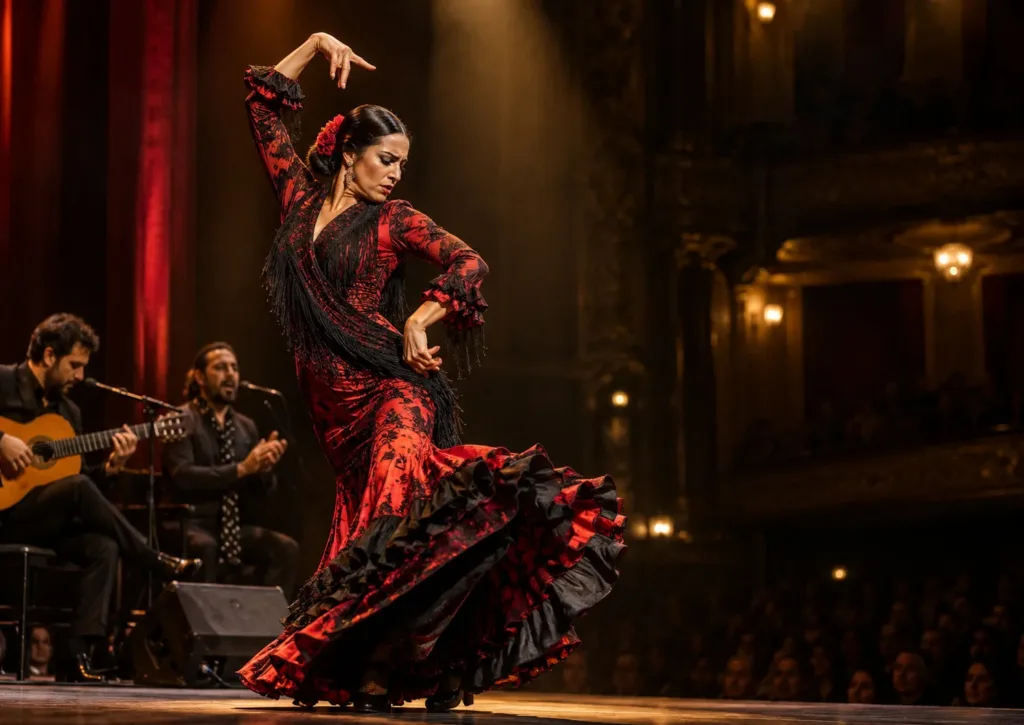
Its defining difference was flamenco’s central role. Singing, dancing and guitar ceased to be just another attraction during an evening and became the heart of the experience.

A new economy for flamenco

The tablao enabled many artists to work night after night. That regularity mattered enormously: it provided income, demanded repertoire development, taught musicians to accompany dance and offered experience before very different audiences.

It also coincided with the growth of tourism. Seville began receiving visitors seeking a cultural image of Andalusia, and flamenco became one of its major attractions. That relationship created tensions and stereotypes, but also helped sustain large performing ensembles and continuous professional activity.

The history of the tablao therefore cannot be reduced to entertainment for tourists. For decades it was simultaneously a business, a school, a stage and a place for passing on knowledge.

Cortijo El Guajiro: a pioneering venue in Los Remedios

One essential name is Cortijo El Guajiro. It opened in 1952 in Los Remedios, on land approximately where the Resitur complex stands today. The site had been associated with a riding school and was transformed into an open-air venue featuring Andalusian arts shows, catering to a Seville welcoming increasing numbers of tourists.

Contemporary records and later studies place it at a decisive moment. El Guajiro retained features of the entertainment hall, but flamenco already played the leading role. It is therefore often presented as a pioneer of Seville’s tablaos and a link between earlier performance models and the tablao as we understand it today.

Its ensemble included essential figures: Matilde Coral, El Farruco, Manuela Vargas, Rafael El Negro and other artists who would shape dance in the following decades.

The stage where the profession began to change

El Guajiro’s importance is not explained solely by the stars who appeared there. The way it operated reveals a profound change in the profession. Audiences attended a venue increasingly identified with flamenco, artists could perform repeatedly, and the programme helped create a repertoire familiar to visitors and enthusiasts.

It was also a social gathering place. Personalities from entertainment, culture and public life sat at its tables, while young artists trained on its stage before gaining international recognition.

The Cortijo physically disappeared, but its history did not end when that location closed. In fact, it gave rise to one of the longest business lineages in Seville’s flamenco.

El Patio Andaluz: from El Guajiro to Plaza del Duque

In 1956, the company associated with El Guajiro opened El Patio Andaluz on Plaza del Duque, right in central Seville. The move also reflected the consolidation of the format: flamenco was drawing closer to the city’s commercial and tourist heart and becoming part of an increasingly professional nightlife scene.

Figures such as Cristina Hoyos, Milagros Mengíbar and Chano Lobato continued to perform there. The venue maintained artistic continuity with the previous era and strengthened a way of presenting flamenco through large ensembles and regular performances.

This historic Patio Andaluz on Plaza del Duque should not be confused with later establishments bearing similar names or with today’s El Palacio Andaluz. It represents a specific chapter in the history that would lead to El Patio Sevillano.

A tablao can disappear without its history disappearing

In 1973, the company moved again and adopted the name El Patio Sevillano. This continuity makes El Guajiro and El Patio Andaluz special cases in this list: their venues and names disappeared, but the business and artistic lineage survived.

It is a good example of why tablao history should not be told solely through opening and closing dates. Sometimes a project changes neighbourhood, name, format or building while retaining part of its identity.

Here, memories of El Guajiro even form part of the historical account of today’s Patio Sevillano, which recognises 1952 as the beginning of its journey.

La Cochera: a daily school for great flamenco dancers

If one lost tablao appears repeatedly in the biographies of Seville’s artists, it is La Cochera Show. Its activity is particularly well documented around 1970, and several flamenco sources explicitly describe it as a venue that no longer exists.

Its prestige becomes clear when we look at who worked there. Farruco, Matilde Coral and Rafael El Negro, who formed the legendary trio Los Bolecos, shared the stage with José Galván, Manuela Carrasco, Concha Vargas and other major figures in dance.

For the young Manuela Carrasco, La Cochera was one of her first professional stages in Seville. There she could watch and work alongside Los Bolecos before embarking on a career that would make her one of flamenco dance’s great figures.

Why tablaos offered training no academy could provide

La Cochera helps explain a central idea: the tablao taught things impossible to learn through lessons alone. Every night, performers had to listen to the singer, respond to the guitar, adjust a verse, sustain an escobilla footwork passage or change a llamada cue according to what was happening.

Repetition did not mean routine. On the contrary, it refined the conventions of improvisation. An artist working in a tablao for months accumulated hundreds of hours of real stage experience.

That is one reason so many veteran professionals describe tablaos as true schools. La Cochera disappeared, but many who worked there took that learning into companies, festivals, flamenco biennials and international stages.

La Trocha: from a tavern on Calle Imperial to a legendary tablao

The story of La Trocha began very differently. In 1969, a group of friends met in a tavern on Calle Imperial to sing, dance and spend time together. The owner, Manuel Bernal Prieto, named the venue La Trocha, and that atmosphere also gave rise to the group Los de la Trocha.

Success allowed the project to grow. Eventually, the tablao moved to Ronda de Capuchinos, where it expanded and became a well-known venue in Seville’s nightlife. Flamenco artists and groups associated with sevillanas performed there, combining professionalism, a social atmosphere and continuous programming.

Paco Toronjo’s presence at the venue in 1978 is documented, for example, during a period when La Trocha also attracted well-known figures from Seville society.

When a city gives its old stages a new use

Years later, artists who had started there remembered La Trocha as their first professional venue. In one interview, a recollection placed the former Ronda de Capuchinos venue in a building later converted into a bingo hall.

This is a small but revealing detail. Many historic tablaos left neither a building preserved as a museum nor a plaque explaining what happened there. They simply changed use, were refurbished or disappeared beneath another commercial activity.

Reconstructing their history therefore depends on photographs, programmes, newspaper advertisements, artists’ testimonies and archives. Seville’s flamenco memory is scattered across materials rarely gathered in one place.

Las Brujas: a key name in a more recent era

Closer to our own time is Tablao Flamenco Las Brujas, on Calle Gonzalo Bilbao. Its history belongs mainly to the final decades of the 20th century and the early 21st, when Seville combined traditional tablaos with an increasingly diverse range of halls, cultural centres and shows designed for very different audiences.

Las Brujas was associated with José Galván as its director and appears in the careers of numerous artists. Dancers and guitarists who later developed international careers worked there, and Rafael Ojeda, “Falete”, has recalled his time at the venue and how he eventually became involved in running it before it closed.

The disappearance of Las Brujas shows that the history of Seville’s tablaos is not only a matter of the 1950s, 1960s or 1970s.

Tablaos disappear, but professional networks continue

When a venue closes, its artists do not disappear with it. They move to other stages, form companies, open schools, direct new venues or work at festivals and theatres. In this way, experience accumulated in a tablao spreads throughout the flamenco ecosystem.

Las Brujas is a good example of that transmission. Names associated with the venue connect with other tablaos in Seville, Madrid and Barcelona and with companies that have toured Europe, Asia and the Americas.

The history of a tablao is therefore also the history of the professional relationships it helps create.

Other names on Seville’s old flamenco map

Directories and guides from previous decades record more establishments that no longer belong to the regular circuit under those names. They include Casa Carmen, La Gitanilla, Puerta de Triana, Soniquete and El Cortijo, alongside halls and taverns that offered flamenco in different formats. Not all had the same historical significance or operated exactly like a classic tablao, and in several cases far less documentation survives.

This guide therefore does not claim to be a definitive inventory. Seville has had dozens of venues where artists sang, played and danced professionally, some for decades and others for brief periods. The very difficulty of reconstructing them shows how much of flamenco history still depends on private archives, oral memory and scattered documentation.

Four venues that explain a transformation

Venue Documented period Location Why it matters
Cortijo El Guajiro From 1952 Los Remedios A pioneering venue and the direct predecessor of El Patio Sevillano.
La Cochera Around 1970 Seville A stage school for Los Bolecos, Manuela Carrasco, José Galván and other artists.
La Trocha From 1969 Calle Imperial, then Ronda de Capuchinos It grew from a tavern atmosphere into a professional tablao and an emblematic Seville nightlife venue.
Las Brujas Late 20th and early 21st centuries Gonzalo Bilbao, 10 It connected a later generation of artists with daily tablao work.

A fifth name that bridges the story: El Patio Andaluz

El Patio Andaluz deserves its own category because it was not a wholly independent project. It continued El Guajiro on Plaza del Duque from 1956 and preceded the adoption of the name El Patio Sevillano in 1973.

That sequence —El Guajiro → El Patio Andaluz → El Patio Sevillano— sums up several decades of urban and tourism-related change. The show moves location, the city changes and the business adapts its name, while artistic and family continuity remains.

It is probably Seville’s best example of how a tablao can have several lives without losing its lineage.

What these tablaos left to Seville’s flamenco

Steady work. The possibility of performing every night helped professionalise careers and sustain full ensembles.

Stage training. The tablao demanded listening, improvisation and responsiveness. That daily practice trained generations of performers.

Encounters between generations. Young artists shared the stage with established figures and absorbed conventions that were rarely written down.

International exposure. Many performers moved from tablaos into companies and tours around the world.

A relationship with tourism. Seville made flamenco part of its cultural identity for visitors, a relationship that remains decisive for the sector.

What else is lost when a tablao closes

A closure means more than losing a room with seats. A meeting place, a technical team, a roster of artists, a rehearsal routine and a particular way of relating to audiences disappear.

Material memory is lost too: posters, photographs, dressing rooms, floors, bars, decorations and corners associated with hundreds of nights. When a building changes use, many of those traces are removed without anyone cataloguing them.

It would therefore be valuable for Seville to treat the memory of its flamenco venues as part of its cultural heritage. Not all can be physically preserved, but they can be documented before their last witnesses are gone.

Centro Flamenco de Sevilla: a recent chapter that also belongs to this memory

Closures, relocations and transformations remain part of the sector. A much more recent example is the Centro Flamenco de Sevilla, founded and directed by Miguel Ortiz. Its history belongs to a different era of the city, but it shares an essential quality with the old tablaos: it was much more than somewhere to watch a show; it served as a meeting point for artists, enthusiasts and visitors and created its own community around live flamenco.

Centro Flamenco de Sevilla is especially interesting for understanding the contemporary evolution of the model. At a time when digital sales, direct relationships with visitors and tourism promotion already played a decisive role, Miguel Ortiz’s project combined these new tools with continuous programming and the closeness between artists and audiences that has historically defined the finest flamenco venues.

Its importance should not be measured only by how long it remained open. It also lies in the artists who performed on its stage, the audiences it brought together and the professional relationships it created. That is why Centro Flamenco de Sevilla deserves its own place in this memory: it demonstrates that a city’s flamenco history is also built by recent projects capable of leaving a mark that lasts after they close.

From memory to today’s stages

Seville today offers a very wide range of flamenco. Historic tablaos, intimate venues, cultural centres, theatres and new projects coexist, reinterpreting the format while retaining the closeness between audiences and artists.

Anyone wishing to move from history to experience can consult our guide to where to see authentic flamenco in Seville or explore the directory of flamenco tablaos with current options in the city and across Spain.

Knowing the venues that have disappeared helps us see today’s with greater context: behind every stage lies a professional tradition built night after night over generations.

A history made of stages, artists and memory

Seville’s vanished tablaos do not form a closed museum. Their artists continued dancing, singing and playing elsewhere; their ways of working passed to new generations, and some of their businesses became projects that still exist.

Remembering El Guajiro, La Cochera, La Trocha and Las Brujas helps explain that flamenco history is also written through addresses, dressing rooms and nights of work. Places that were once everyday settings now help explain why Seville remains one of flamenco’s great cities.

Frequently asked questions about Seville’s vanished tablaos

Cortijo El Guajiro, opened in 1952, is often cited as a pioneering flamenco tablao venue in Seville. Some academic studies describe it more precisely as a transition between earlier entertainment halls and the modern tablao, because it retained features of both models.

It was in Los Remedios, on land approximately where the Resitur complex stands today. The site had been associated with a riding school and was adapted to offer Andalusian arts and flamenco shows.

No. El Patio Sevillano continues the historical lineage begun by Cortijo El Guajiro in 1952. What disappeared were the earlier venues and names of El Guajiro and El Patio Andaluz before the relocation and name change in 1973.

La Cochera was an important place of work and learning around 1970. Figures such as Farruco, Matilde Coral, Rafael El Negro, Manuela Carrasco and José Galván worked there together. Its ensemble shows the standard Seville’s tablaos could reach as professional dance schools.

La Trocha grew out of a tavern on Calle Imperial in the late 1960s and later moved to larger premises on Ronda de Capuchinos. That second location is the one most often associated with the tablao in artists’ and enthusiasts’ memories.

Tablao Flamenco Las Brujas was at Calle Gonzalo Bilbao, 10. It operated in a more recent era than El Guajiro, La Cochera or La Trocha and appears in the careers of artists associated with José Galván and Seville’s late-20th-century flamenco scene.

Not exactly. Cafés cantantes were fundamental during the 19th and early 20th centuries in professionalising flamenco before a regular audience. The tablao became established later, particularly from the 1950s, with a format more clearly centred on singing, dancing and guitar.

Generally not as flamenco venues, because they closed, were transformed or changed use. In some cases, such as the lineage of El Guajiro and El Patio Andaluz, the artistic project continued under another name and in another location. Their memory survives mainly in archives, photographs, testimonies and artists’ biographies.

Book online: the key to securing your seat

In many cities, flamenco tablaos sell out easily, especially on weekends and during peak season. That’s why, if your dates are set, the most important thing is to book online.

Direct recommendation: book online through our website to guarantee your seat and arrive with everything confirmed. If you already have your destination, go straight to your city to see available options and clear recommendations.

Flamenco Sevilla | Tablaos Flamencos

Seville

Flamenco Madrid | Tablaos Flamencos

Madrid

Flamenco Barcelona | Tablaos Flamencos

Barcelona

Flamenco Granada | Tablaos Flamencos

Granada

Flamenco Córdoba | Tablaos Flamencos

Cordoba

Flamenco Málaga | Tablaos Flamencos

Malaga

Flamenco Valencia | Tablaos Flamencos

Valencia

Flamenco Jerez | Tablaos Flamencos

Jerez

Find out more about this with your favorite AI:

Did you like this article? Share it!:

Tags: flamenco in Seville, Flamenco tablaos in Seville, History of flamenco, Seville, Seville tablaos

Article published by:

Related articles

The origin of the flamenco tablao: from cafés cantantes to today’s stages
What is flamenco duende: meaning, Lorca and how to recognize it