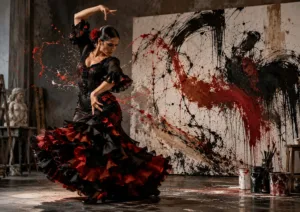
What “duende” means in flamenco
In everyday Spanish, “tener duende” means having a special charm or appeal. In flamenco, the expression takes on a more intense meaning: it points to a performance capable of creating an extraordinary emotional experience.
The Royal Spanish Academy specifically records the expression “tener duende” with the meaning of possessing charm or appeal. Flamenco usage starts from that semantic territory but goes further. When an aficionado says that a singer “has duende”, they are not usually saying that the artist is pleasant, elegant or charismatic. They mean a particular ability to make singing, dance or guitar acquire a truth that does not seem reducible to technique.
Duende therefore works as a borderline concept. It gives a name to something that can be clearly perceived but is difficult to measure: the electricity of a perfectly placed silence, the tension of a vocal phrase, an unexpected entrance, a resolution that seems inevitable, a lyric sung as though it had just happened, or an instant when stage and audience seem to breathe together.
The performance does not need to be solemn. Duende can appear in a seguiriya, but also in bulerías. It can be dark, festive, restrained, fierce, intimate or luminous. What matters is not the mood but the quality of presence with which the artist turns a learned language into a living experience.