History of flamenco

Cafés cantantes in Seville: history, venues and their role in the development of flamenco

Cafés cantantes in Seville: the stages that transformed flamenco

Any account of the history of flamenco in Seville must pause at the cafés cantantes. During the second half of the 19th century and the first decades of the 20th, these establishments changed the way singers, dancers and guitarists worked, created a stable audience, encouraged artists to circulate between cities and helped turn a repertoire that was still taking shape into a professional show with its own rules, hierarchies, stars and performance spaces.

They were not, however, a sudden invention, nor did they all operate in the same way. Before flamenco cafés reached their golden age there were dance academies, salons, café-concerts, theatres and entertainment venues where bolero-school dances, songs, comic numbers, popular music and performances that gradually began to be called “flamenco” coexisted.

Seville was one of the great laboratories of this process. Around names such as Silverio Franconetti and Manuel Ojeda “El Burrero”, and venues such as the Salón del Recreo, Café de Silverio, Café del Burrero and the later Salón Novedades, flamenco acquired a public and professional dimension that would prove decisive to its evolution.

This article reconstructs that history from historical newspapers, academic research and flamenco studies, while distinguishing well-documented facts from some traditional claims that now require qualification.

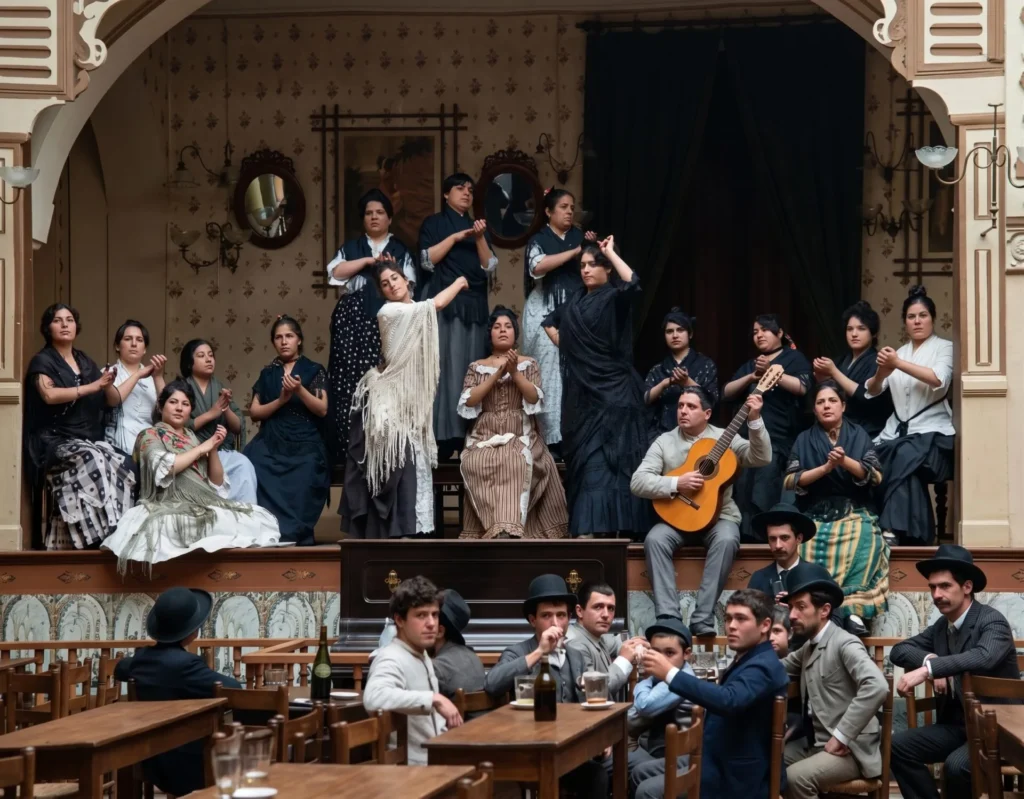
Café Cantante | Reproducción por Miguel Ortiz

Quick answer

The cafés cantantes in Seville were entertainment establishments offering drinks and live performances that played a fundamental role in the consolidation of flamenco during the 19th and early 20th centuries. Not all were devoted exclusively to flamenco, but the most influential professionalised the artists, created stable ensembles, developed a hiring market and encouraged competition and the exchange of repertoires.

Among the essential names are the Café de Silverio, opened on Calle Rosario in 1881; the Café del Burrero, first on Calle Tarifa and, from 1888, on Sierpes; and the Salón Novedades, opened in 1897 beside La Campana. Their legacy can be traced in later flamenco tablaos, although the café cantante and the tablao are not exactly the same historical institution.

What cafés cantantes really were

The term café cantante may suggest a kind of 19th-century flamenco tablao, but the reality was more diverse. Broadly speaking, they were places for socialising and entertainment where drinks were combined with musical and stage performances. Their programmes could include songs, national dances, the bolero school, variety acts and, increasingly, flamenco singing and dance.

Research by Miguel Ortiz and Mercedes Gómez-García Plata on the cafés of Seville and Madrid highlights precisely this character as an urban leisure industry. Musical performance ceased to be merely an occasional activity and became part of an organised business: there were schedules, entrepreneurs, contracted artists, advertising, competition between venues and customers able to compare one programme with another.

The venues usually had a room with tables, drinks service and a platform or stage. Surviving iconography shows mirrors, paintings, posters and costumbrista decoration. The stage space was relatively small and brought artists and spectators very close together, a proximity that would later also become characteristic of the flamenco tablao.

But it would be wrong to imagine an exclusively “deep flamenco” programme from day one. Specialisation was gradual. Flamenco gained ground within a far more heterogeneous entertainment offer until some entrepreneurs realised that singing, dance and guitar could sustain a programme on their own and attract a loyal audience.

Before the cafés: academies, salons and dance shows

The cafés cantantes did not emerge in a vacuum. By the mid-19th century Seville already had dance academies and salons where masters of the bolero school organised performances for Sevillians and travellers. These spaces were decisive because they brought together practices that had previously been scattered among fiestas, popular dances, theatres and private gatherings.

Research into the Sevillian school of dance shows that during the 1860s the so-called flamenco dances became increasingly prominent in these salons. The boundary between academy, dance hall, café-concert and café cantante was not always clear: some venues changed name, owner and orientation several times, and the same establishment could combine teaching during the day with performances at night.

This continuity helps explain why it is risky to look for an exact date for the “birth” of the flamenco café cantante. What occurred was a gradual transformation of Seville’s urban leisure culture until it created a space increasingly specialised in artists who were already recognised as flamenco performers.

Los Lombardos: was it really Seville’s first café cantante?

One of the most frequently repeated stories places the origin of Seville’s cafés cantantes in the Café de los Lombardos. Fernando el de Triana mentioned it decades later in Arte y artistas flamencos, and José Blas Vega incorporated it into the classic historiography of the genre.

Later research, however, requires this claim to be qualified. Gómez-García Plata, working with contemporary Seville newspapers and José Luis Ortiz Nuevo’s research, notes that the establishment opened in 1847 operated in connection with the Teatro de San Fernando and that its earliest advertisements do not yet display the characteristics later associated with a specialised flamenco café.

The more cautious formulation, therefore, is not to claim that Los Lombardos was “Seville’s first flamenco tablao”, but to regard it as one of the early precedents of the culture of cafés and entertainment that would eventually lead to the flamenco café cantante.

There is also an example of why sources must be handled carefully: some modern accounts have associated the venue with artists born decades after its supposed first period. Flamenco memory is extraordinarily rich, but it does not always function as an exact documentary chronology.

The Salón de Oriente and a key date: 21 April 1866

The documentation surrounding the Salón de Oriente, also associated with the name Salón Barrera and the Barrera family of dance masters, is much firmer. On 21 April 1866 an advertisement was published in Seville for a “grand concert of local dances with flamenco songs and dances”.

That advertisement is highly significant because it shows how the word flamenco was beginning to function publicly as the name of a specific kind of singing and dance, replacing or coexisting with earlier expressions such as “Andalusian songs”, “local dances” or “in the Gypsy style”.

It does not mean that flamenco was born that day. It does show that by the mid-1860s Seville audiences could recognise a stage offering described as flamenco and that entrepreneurs considered the word attractive enough to use in advertising.

The Salón de Oriente therefore represents the bridge between dance academies and the era of the major professional cafés that would dominate the following decades.

Silverio Franconetti and the birth of a flamenco industry

If there is one figure inseparable from the professionalisation of flamenco in Seville’s cafés, it is Silverio Franconetti. Rather than “inventing” flamenco or opening the first entertainment venue with singing, his importance lies in understanding the genre as an organised professional show.

Artist and entrepreneur

Silverio combined two decisive qualities: he was a singer of enormous prestige and, at the same time, understood the business logic of entertainment. This allowed him to select artists, design programmes and use his own name as a guarantee of quality.

A repertoire to listen to

Having a great singer as an entrepreneur helped increase the importance of singing in venues where dance could initially be the main attraction. Audiences also began to attend specifically to hear styles and compare performers.

A network of artists

Performers from different Andalusian cities appeared on his stages. This mobility encouraged the exchange of repertoires, variants and approaches, reducing the isolation of strictly local traditions.

In the 1870s Silverio appears linked to the management and programming of Seville venues such as the Salón del Recreo. In 1878 he also opened a summer café cantante on the Alameda de Hércules, documented in the press. Shortly afterwards, in 1881, he parted company with Manuel Ojeda and opened the venue on Calle Rosario that would become permanently associated with his name.

The bibliography even disputes some biographical details about Silverio—including his exact year of birth—which suggests that the history of the cafés should not be built around non-essential biographical dates. What is beyond doubt is that he died in 1889 and that by then his influence on the professional configuration of flamenco was already extraordinary.

The Café del Burrero: competition, entertainment and legend

Manuel Ojeda Rodríguez, known as El Burrero, was another of the period’s great entrepreneurs. According to biographical tradition, the nickname came from his youthful connection with the sale of donkey’s milk. His career crossed Silverio’s at the former Salón del Recreo on Calle Tarifa.

The venue’s names vary according to period and source: Salón del Recreo, Café de la Escalerilla, Café de Manuel Ojeda and finally Café del Burrero. What matters is that after the two entrepreneurs separated in 1881, Ojeda kept his own establishment and became Silverio’s main competitor.

In 1888 El Burrero moved to number 11 Calle Sierpes, to a larger venue with access to nearby streets. It became enormously famous there and remained until around 1897.

Artists associated with its stages include names such as Fosforito el Viejo, El Canario, Concha La Carbonera, La Peñaranda, Gabriela Ortega and other key performers of the period.

The most famous photograph of a café cantante

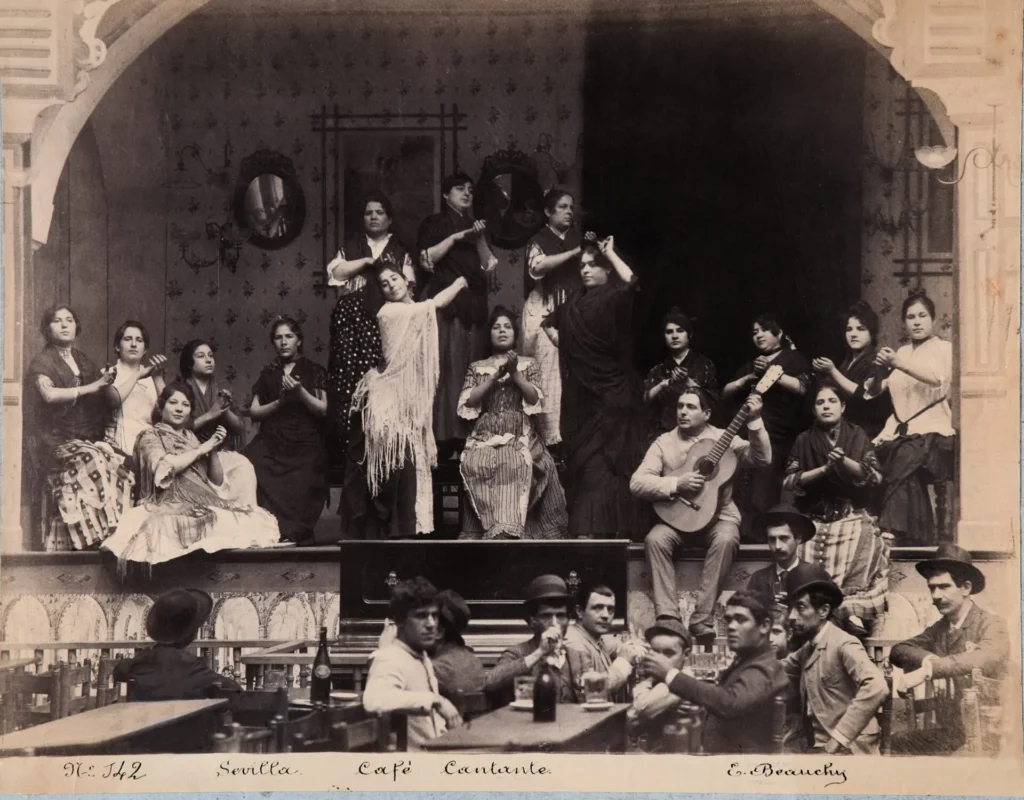
The Café del Burrero also has exceptional documentary importance thanks to the photographs of Emilio Beauchy Cano. The celebrated image simply entitled Café Cantante shows a large ensemble of artists on a platform, with the audience seated at tables.

For a long time the photograph was automatically dated to 1881 or 1888. Current photographic research is more cautious: Beauchy Photo places the known set of copies in the 1880s and acknowledges that the exact date remains open, although examples are known to have been sold before 1891.

The image is valuable not only for the possible identities of its subjects. It allows us to observe the physical organisation of the venue, the predominance of women in the dance ensemble, the guitar as accompaniment, the raised platform, tables, drinks and the proximity between performance and clientele.

It is probably the visual representation that has most powerfully fixed in our imagination what a 19th-century flamenco café cantante looked like.

Cafés cantantes en Sevilla: historia, locales y papel en el desarrollo del flamenco

The Café de Silverio on Calle Rosario

After ending his partnership with Ojeda, Silverio opened in 1881 a new café at number 4 Calle Rosario, in the heart of Seville. This is the establishment that should properly be identified as the great Café de Silverio of his mature period.

Its reputation was based on the quality of its cast and the artistic authority of its owner. Antonio Machado y Álvarez, Demófilo, knew Silverio personally and found in that environment decisive information for his Colección de cantes flamencos, published in 1881, one of the foundational works of flamenco studies.

Artists associated with the café’s circle include Antonio Chacón, La Serneta, La Parrala, La Macarrona, La Malena and numerous singers and dancers who would become part of flamenco’s historical canon.

The rivalry with El Burrero also fuelled genuine competition for the best artists and for audiences. More than a picturesque anecdote, that competition is one of the keys to the period’s aesthetic evolution: anyone wishing to retain their clientele needed to offer stars, novelties and memorable performances.

An important correction: Silverio did not found the Salón Novedades of 1897

Some modern publications have mixed two different chronologies and attribute to Silverio a supposed “Café Novedades” at La Campana before 1889. That claim does not fit the available documentation on the great Salón Novedades known to history.

The La Campana establishment was founded in 1897 by Fernando González de la Serna y Pino, eight years after Silverio’s death. Contemporary sources and later studies present it precisely as an initiative intended to recover the artistic space left by the cafés of Silverio, El Burrero and other historic venues.

There may have been confusion between different establishments, commercial names or earlier programmes, but it is not rigorous to present the Novedades of 1897 as a second Silverio venue.

This distinction matters because it shows how oral history and bibliographic repetition can end up merging different venues and dates.

The Salón Novedades: the great café of the next generation

Opened in 1897 near La Campana, Novedades belongs to a phase after Silverio. It represents the continuation of the café cantante model at a time when flamenco was fully professionalised and new forms of urban entertainment were beginning to grow.

Location

It was installed at number 7 of the former Calle Santa María de Gracia, on the corner near Martín Villa and La Campana. For decades, the building formed part of the landscape of one of Seville’s busiest points.

Artists

Figures such as Manuel Torre, La Coquinera, La Niña de los Peines and other artists who link the classic café era with flamenco of the first third of the 20th century appeared on its stage.

End

The building disappeared in 1923. Its demolition was documented in photographs and was perceived by part of Sevillian society as the loss of a place laden with popular and flamenco memory.

The importance of Novedades also helps correct an overly simple view of history: the cafés cantantes did not end when Silverio died, nor were they suddenly replaced by theatres. The process was gradual, and during the first decades of the 20th century cafés, salons, music halls, theatres, variety shows and new forms of entertainment coexisted.

Other cafés cantantes, salons and flamenco venues in Seville

Reducing Seville’s story to Silverio, El Burrero and Novedades would leave out a much broader network of establishments. City guides, newspapers and specialist bibliography mention numerous venues that, with varying intensity and longevity, hosted flamenco performances.

Café Filarmónico

Active around the Alameda and Amor de Dios, it appears in documentation from the 1870s as one of the establishments that incorporated flamenco shows. The press even contrasted the sparse attendance at classical music concerts with the packed “philharmonic-flamenco” salons.

Café de Variedades and Salón de Variedades

Across different periods and locations near the Alameda, these spaces show the continuity between variety entertainment, dance and flamenco. In the 20th century the Salón de Variedades formed part of the area’s nightlife until the 1930s.

Café del Arenal and Café de la Marina

The area near the Arenal and present-day García de Vinuesa also had cafés linked to entertainment. Their documentation is less abundant than that of the major names, but they help us understand the geographical breadth of the phenomenon.

Café Teatro Suizo

Located on Calle Sierpes, it was an important 19th-century entertainment venue. Its programming was not exclusively flamenco, but it formed part of the ecosystem of cafés, theatres and salons in which Seville’s performance culture developed.

The cafés of Los Cagajones and Las Triperas

Flamenco tradition remembers these popular names in connection with areas of the centre that have since been transformed. They are examples of establishments whose histories are reconstructed from artists’ memories, newspapers and scattered references.

Kursaal, Ideal Concert, Olimpia and El Tronío

By the 20th century, venues such as the Kursaal, Ideal Concert, Salón Olimpia and El Tronío show the evolution towards café-concerts and variety venues that prolonged flamenco’s presence in Seville’s nightlife while the business model was changing.

Why the cafés cantantes were decisive in professionalising flamenco

The great transformation was not only artistic. The cafés created an economic structure capable of turning flamenco into sustained professional work for a growing number of performers.

Before this period, a singer or dancer might perform at private fiestas, roadside inns, taverns, family celebrations or occasional shows. The café cantante introduced the possibility of working regularly before an audience that indirectly paid for the show through consumption and, in certain periods, through tickets or other commercial formulas.

A stable relationship between entrepreneur and artist thus emerged. Flamenco ensembles were formed, salaries negotiated, stars advertised and sessions scheduled. A performer’s success could raise their fee and prompt a rival café to try to hire them.

The expansion of the railway and improved communications also facilitated circulation between Seville, Cádiz, Jerez, Córdoba, Málaga and Madrid. Professional artists no longer depended exclusively on their immediate surroundings and could build careers in different cities.

This mobility had a profound artistic effect: styles associated with particular families or areas began to be heard outside their places of origin. Performers learned from one another, and audiences began to recognise repertoires, schools and individual personalities.

Flamenco singing: from interlude to centre stage

In the early salons, dance had enormous visual appeal. Singing could appear as accompaniment or between dance numbers. The café period encouraged audiences also to learn to listen to the singer as the main attraction.

Figures such as Silverio, Chacón, Juan Breva and Fosforito could draw aficionados in their own right. Comparison between artists created an increasingly specialised audience attentive to styles, sung sections, melodic variants and interpretative personality.

This development should not be understood as an absolute “fixing” of the palos. Flamenco remained oral and changeable. But the public repetition of repertoires and competition helped many forms become more clearly recognisable and some personal styles become models transmitted to later generations.

Dance: the wooden stage changes technique

Dance historiography regards the café era as one of its most decisive periods of consolidation. The new wooden stage made footwork more audible and allowed the development of zapateado with a precision and theatrical impact difficult to achieve in other spaces.

Studies by Juan Zagalaz and Javier Cachón-Zagalaz summarise a broad consensus: during these years rhythms became more disciplined, stage conventions consolidated and professionalisation increased. Dance gradually became more independent from singing and acquired an artistic personality of its own.

This period is also credited with consolidating visual and stylistic elements that would become emblematic of flamenco dance, although exact dates vary according to the authors. Soleá, alegrías and tangos repeatedly appear in the sources; later, farruca, garrotín and other styles would gain importance.

The guitar: from accompaniment to a specialised profession

The guitar acquired an increasingly defined role as an essential flamenco instrument. The café cantante needed guitarists capable of accompanying different singers and dancers, adapting to varied repertoires and responding in real time to calls, endings and changes in dynamics.

This professional demand encouraged the specialisation of the flamenco accompanist. The instrument developed its own accompaniment resources and, progressively, broader instrumental spaces through falsetas and solos.

The period links to figures such as Paco de Lucena and other guitarists who prepared the way for the great evolution of flamenco guitar during the 20th century. The guitar ceased to be merely harmonic support and became one of the three fundamental languages of flamenco performance.

Female dancers and singers: leading figures with unequal pay

Women were absolutely central to the visual and artistic success of the cafés cantantes. Period iconography shows ensembles with numerous female dancers, and historiography indicates that women greatly outnumbered men in dance.

Names such as La Macarrona, La Malena, Concha La Carbonera, La Serneta, La Parrala, Gabriela Ortega and La Coquinera form part of the history of these stages. Through them, styles, stage resources, ways of moving the arms and torso and an aesthetic that profoundly influenced later dance were developed.

Professionalisation did not, however, eliminate inequalities. Sources studied by historians remind us that women’s salaries could be far lower than those of the leading male singers. A frequently cited reference for the 1890s places Chacón and Juan Breva among the highest paid, while even a figure such as La Macarrona earned considerably less.

Women artists also had to endure strong moral stigma. Night work, contact with customers and the association of certain cafés with prostitution and nightlife generated prejudices that particularly affected female dancers and singers.

A new audience: aficionados, gentlemen, travellers and the curious

The cafés cantantes broadened flamenco’s audience. Popular aficionados, workers, members of the bourgeoisie, young people from wealthy families, travellers and foreigners attracted by the Romantic image of Andalusia all attended.

This social mixture was not always harmonious. The cafés were embedded in nightlife, and some became the scene of fights, theft, prostitution, excessive alcohol consumption and other incidents frequently exploited by the press. The death of El Canario in 1885 beside the summer refreshment venue linked to El Burrero contributed enormously to the dark legend surrounding these environments.

But it would be a mistake to reduce them to marginal or violent places. At the same time, they were first-rate artistic centres, visited by writers, journalists, photographers and travellers. That outside gaze helped document flamenco and spread it beyond its original circuits.

The press was also fundamental. Advertisements revealed programmes, artists’ names and schedules; reports and crime stories recorded the venues’ everyday life. Much of what we know today about 19th-century flamenco comes precisely from those newspaper pages.

An approximate chronology of Seville’s cafés cantantes

The dates should be read as reference points in a complex evolution: many venues changed name, owner or activity, and some chronologies remain disputed.

1847 · Los Lombardos

An early precedent of café and entertainment culture. Its status as the first specialised flamenco café cannot be regarded as proven.

1866 · Salón de Oriente

A Seville advertisement uses the expression “flamenco songs and dances”, showing that the new designation was already functioning publicly.

1881 · Silverio and El Burrero

The separation of the two entrepreneurs opens a period of intense rivalry: Silverio inaugurates his great café on Calle Rosario while Ojeda maintains his own business.

1897 · Salón Novedades

A new generation of cafés takes over at La Campana and extends the life of the model into the first quarter of the 20th century.

Why the cafés cantantes disappeared

There was no single cause or day on which they all closed. The model gradually lost its central position as the city, legislation and the entertainment industry changed.

In 1908 a ministerial order required certain night performances to end by midnight, a measure connected with repeated complaints about noise, disturbances and public morality. It was a blow to the business, but did not mean the immediate closure of every establishment.

At the same time, theatres, café-concerts, cinema and variety entertainment were growing. Audiences had more leisure options and flamenco artists began to find opportunities on larger stages.

Technology brought another change. Early phonographic recordings and, later, records allowed people to hear artists outside the venue. Flamenco was also beginning to become a recorded industry.

During the 1910s and 1920s, large-scale flamenco performance increasingly moved towards theatres, bullrings and larger touring productions. The so-called Ópera Flamenca did not arise overnight, but as part of this business transformation. Some cafés and salons survived into the 1920s and even the 1930s, but by then within a different leisure ecosystem.

From the café cantante to the flamenco tablao

The tablaos that became established in the mid-20th century inherited several features of the cafés cantantes: proximity between audience and artists, shows organised around ensembles, a combination of singing, dance and guitar, professional hiring and the possibility of accompanying the performance with drinks or food.

But they are not exactly the same thing. The café cantante belonged to a very specific urban leisure culture in which flamenco coexisted with other forms of entertainment and with the social codes of the 19th century. The modern tablao emerged in a different tourist, recording and theatrical context.

Even so, the genealogy is clear. Without the professionalisation begun in the cafés, it would be difficult to explain the figure of the flamenco entrepreneur, the stable artistic ensemble, the hierarchy of artists, the structure of a performance or the very idea of listening to flamenco in a specialised venue.

For this reason, cafés cantantes should not be studied as a vanished curiosity. They constitute one of the chapters that best explains how flamenco moved from dispersed social and stage practices to a modern artistic profession.

Seville as a laboratory of modern flamenco

Seville’s role was not exclusive: Cádiz, Jerez, Málaga, Granada, Córdoba, Madrid and other cities also developed essential circuits. But the Andalusian capital brought together an extraordinary combination of artists, entrepreneurs, audiences, travellers, press and performance spaces.

The concentration of cafés in the city centre and the Alameda, the railway connection with other flamenco centres and Seville’s enormous appeal to visitors helped the city function as a major professional marketplace.

In its cafés, Gypsy and non-Gypsy artists, performers from different provinces, bolero-school masters and new flamenco generations came into contact. That constant interaction accelerated borrowing, rivalries and stylistic transformations.

Rather than claim that “flamenco was born in the cafés”, it is historically more accurate to say that in the cafés cantantes flamenco acquired much of the professional, theatrical and public form with which it entered the 20th century.

Frequently asked questions about Seville’s cafés cantantes

It was an entertainment establishment offering drinks and musical or dance performances. In Andalusia and Madrid many incorporated flamenco and some eventually specialised in singing, dance and guitar, although not all offered exclusively flamenco repertoire.

There is no completely settled answer. Flamenco tradition has cited the Café de los Lombardos, opened in 1847, but research in the historical press indicates that in its first period it cannot, without qualification, be considered a specialised flamenco café. The academies and salons of the following decades show a gradual transition towards the fully flamenco model.

The great Café de Silverio at number 4 Calle Rosario opened in 1881 after the professional separation of Silverio Franconetti and Manuel Ojeda “El Burrero”. Silverio had previously managed and programmed other venues and in 1878 also opened a summer café cantante on the Alameda.

Manuel Ojeda’s establishment was first connected with the former Salón del Recreo on Calle Tarifa, at the corner with Amor de Dios. In 1888 the Café del Burrero moved to number 11 Calle Sierpes, where it remained until around 1897.

Not the Salón Novedades at La Campana that became famous at the end of the 19th century. That establishment was founded in 1897 by Fernando González de la Serna y Pino, eight years after Silverio’s death. Some modern publications mix different chronologies and venues.

Because they created a stable professional circuit. They enabled many artists to earn regular pay, encouraged competition and exchange between performers from different cities, formed specialist audiences and contributed to the technical and stage consolidation of singing, dance and guitar.

Among many others, performers associated with these stages include Silverio Franconetti, Antonio Chacón, Juan Breva, Fosforito el Viejo, El Canario, La Serneta, La Parrala, Concha La Carbonera, La Macarrona, La Malena, Gabriela Ortega, Manuel Torre and La Niña de los Peines, although they did not all appear in the same venues or decades.

Their decline was gradual. A ministerial order in 1908 restricted night-time activity, while the growth of theatres, variety entertainment, cinema and new forms of spectacle displaced the model. Many closed during the 1910s and 1920s, although some related salons survived into the 1930s.

Not exactly. The modern tablao inherited fundamental features of the café cantante—proximity, a professional artistic ensemble, singing, dance and guitar—but belongs to a later historical context and is usually far more specialised in flamenco.

Most of the major venues disappeared or radically changed use. Photographs, engravings, newspaper advertisements and documents survive and allow them to be reconstructed. Emilio Beauchy’s celebrated photographic series of the Café del Burrero is one of the most important visual records.

Sources and references for further research

The history of the cafés cantantes contains contradictions in dates, names and locations. For this article, priority has been given to academic studies, historical newspapers and specialist research that make it possible to check flamenco tradition against documentary evidence.

Book online: the key to securing your seat

In many cities, flamenco tablaos sell out easily, especially on weekends and during peak season. That’s why, if your dates are set, the most important thing is to book online.

Direct recommendation: book online through our website to guarantee your seat and arrive with everything confirmed. If you already have your destination, go straight to your city to see available options and clear recommendations.

Flamenco Sevilla | Tablaos Flamencos

Seville

Flamenco Madrid | Tablaos Flamencos

Madrid

Flamenco Barcelona | Tablaos Flamencos

Barcelona

Flamenco Granada | Tablaos Flamencos

Granada

Flamenco Córdoba | Tablaos Flamencos

Cordoba

Flamenco Málaga | Tablaos Flamencos

Malaga

Flamenco Valencia | Tablaos Flamencos

Valencia

Flamenco Jerez | Tablaos Flamencos

Jerez

Find out more about this with your favorite AI:

Did you like this article? Share it!:

Tags: Café de Silverio, Café del Burrero, cafés cantantes, flamenco dance, flamenco guitar, flamenco in Seville, flamenco singing, history of flamenco, Salón Novedades, Seville, Silverio Franconetti

Article published by:

Related articles

What is flamenco? Origins, characteristics and essential elements