History of flamenco

The origin of the flamenco tablao: from cafés cantantes to today’s stages

The flamenco tablao did not appear overnight

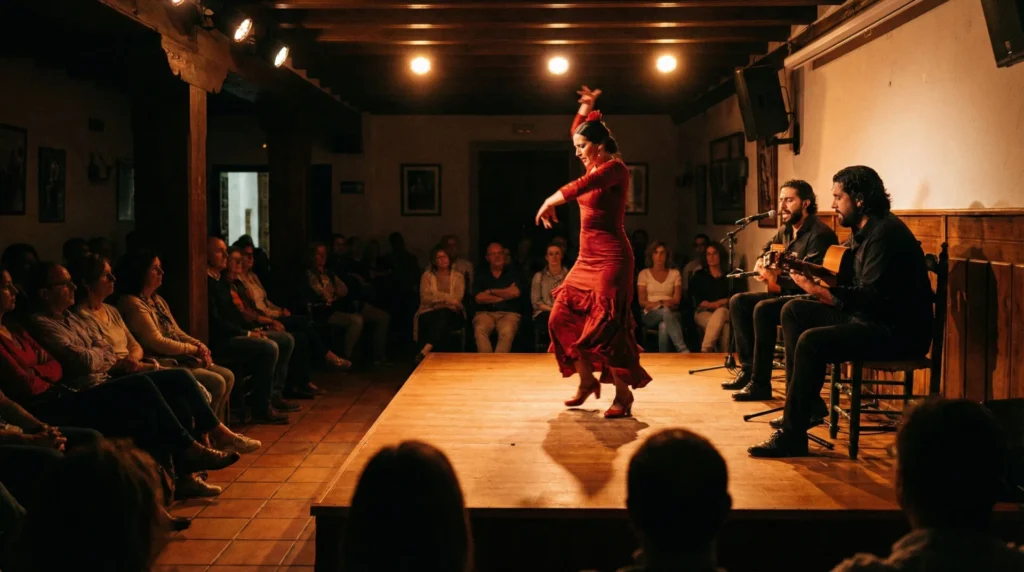
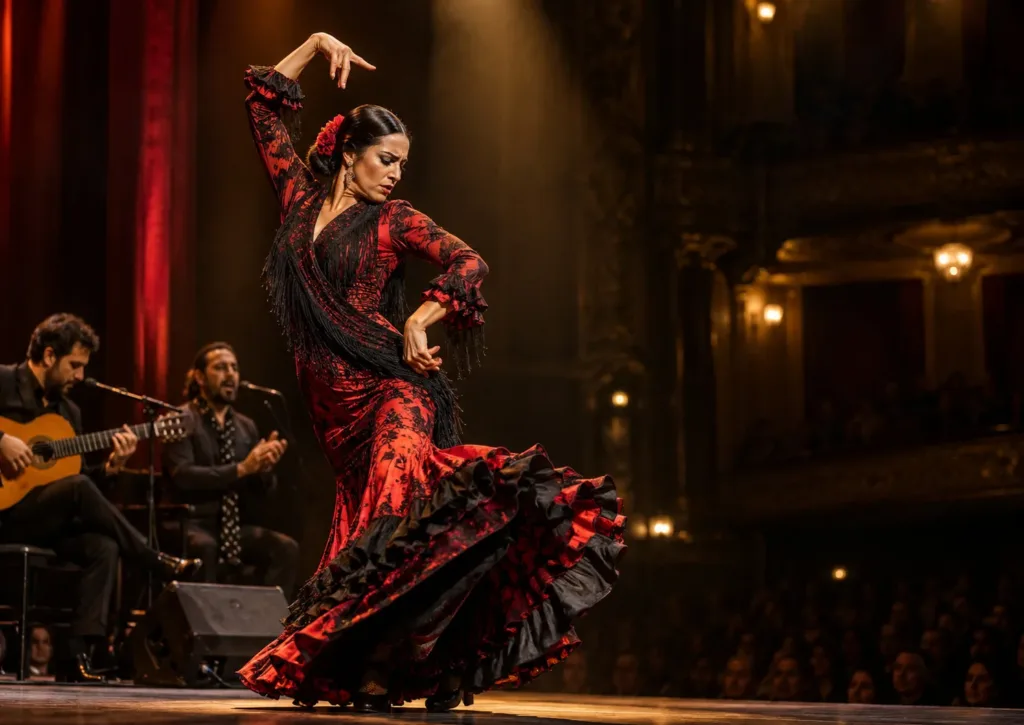
When we think of a flamenco tablao today, we picture an intimate room, a wooden stage, singers, dancers and guitarists, with the audience just a few metres away. That format seems inseparable from flamenco, but it is relatively recent. The modern tablao became established in the mid-twentieth century, inheriting a long chain of performance spaces that had begun much earlier.

Understanding the origins of the flamenco tablao requires looking at private gatherings, dance academies, salons, cafés cantantes, theatres, colmaos and the large productions of the so-called Ópera Flamenca era. Each contributed something: intimacy, professionalisation, the artistic ensemble, the wooden stage, regular employment, the relationship with audiences or the ability to make flamenco a professional occupation.

The result was evolution rather than an abrupt replacement. Nineteenth-century cafés cantantes were not yet tablaos in today’s sense, and the tablaos of the 1950s were not simply copies of those cafés. Several decades of social, artistic and business changes separated them, transforming how flamenco was seen and heard.

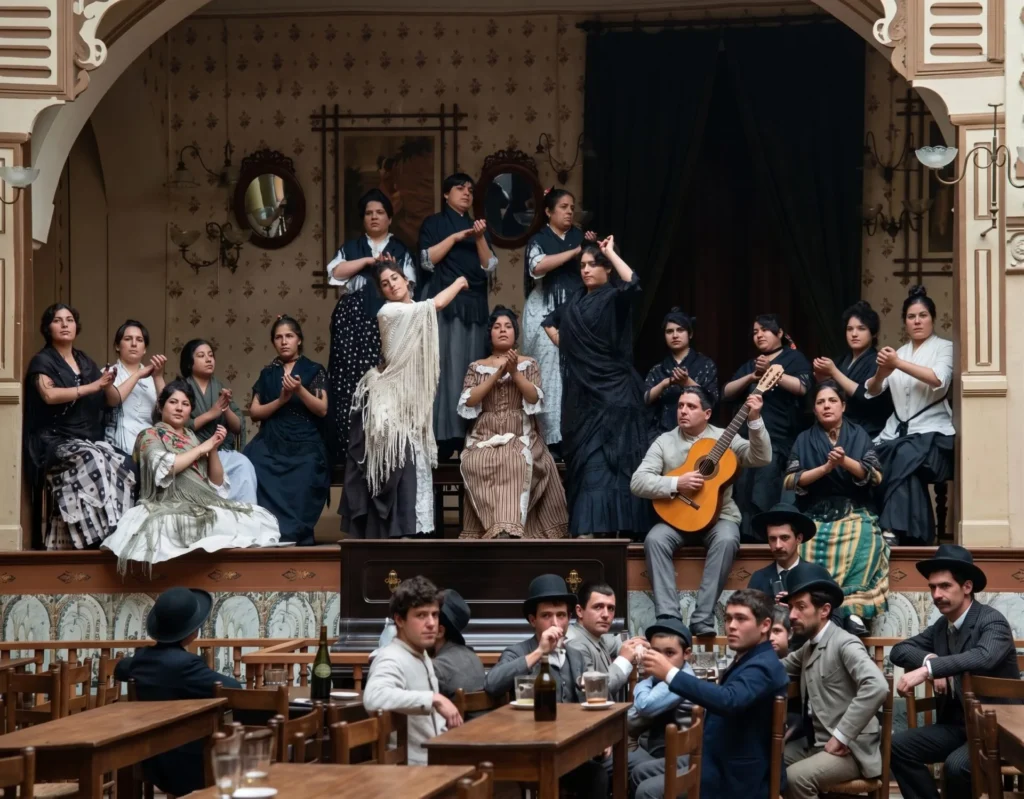
Café Cantante | Reproducción por Miguel Ortiz

The short answer

The modern flamenco tablao emerged in the mid-twentieth century as a direct heir to the nineteenth-century cafés cantantes, although theatres, café-concert venues, colmaos and the Ópera Flamenca era came between the two models. Cafés cantantes had professionalised artists and created regular ensembles; the tablao revived that closeness between audiences and artists in a setting much more specifically dedicated to flamenco.

The Community of Madrid dates the opening of Zambra to 1954, identifying it as the first flamenco tablao to open in Spain. Corral de la Morería opened in 1956 and Torres Bermejas in 1960. From those years onwards, the model spread and became one of the major settings for professional flamenco work, creation and transmission.

Before the tablao: parties, roadside inns, salons and academies

Flamenco was not born inside one particular type of venue. During the nineteenth century, the forms that would come to be recognised as flamenco developed in very different settings: family gatherings, private parties, roadside inns, taverns, dance salons, academies and theatrical performances.

Andalusian cities such as Seville, Cádiz, Jerez and Málaga already had a vibrant world of popular dance, music and entertainment. The escuela bolera coexisted with dances considered local, Andalusian songs and singing styles that gradually acquired a more distinct flamenco identity.

The decisive step came when these practices began moving beyond occasional settings into an urban entertainment industry. Artists no longer depended solely on someone organising a party: they could be hired, advertised in the press and presented regularly to an audience.

Cafés cantantes: the tablao’s great predecessor

During the second half of the nineteenth century, Spain saw the spread of cafés cantantes, establishments combining drinks with performances. Not all were exclusively devoted to flamenco, but some in Andalusia and Madrid became essential centres for singing, dancing and guitar.

The Andalusian Flamenco Institute cites José Blas Vega’s classic chronology, placing the great era of cafés cantantes approximately between 1847 and 1920. They consolidated professional performance, increased the number of artists, fostered individual schools of singing and gave the guitar an increasingly defined role as essential accompaniment.

They also developed a working structure that will sound surprisingly familiar to anyone who knows today’s tablaos: promoters, schedules, casts, guest artists, dance ensembles, wages, rivalry between venues and audiences who followed their favourite performers.

In Seville, names such as Silverio Franconetti and Manuel Ojeda ‘El Burrero’ symbolise that transformation. Silverio was both artist and entrepreneur, and his career is closely associated with organising flamenco as a professional performance with an identifiable programme.

To explore this period further, we have separately reconstructed the history of Seville’s cafés cantantes, with their venues, artists, photographs and timelines.

What the tablao inherited from cafés cantantes

The link between the two models is not that they were identical, but that the tablao adopted a range of theatrical and professional approaches developed over decades.

A stage close to the audience

Audiences sit a short distance from the performers. This proximity allows them to notice breaths, llamadas, closings, jaleos and expressive details that can be lost in a large theatre.

An artistic ensemble

The cafés helped establish the presence of several artists able to alternate during a performance. The tablao made that organisation one of its defining features.

Ongoing professional work

Flamenco stopped depending exclusively on occasional appearances. Regular contracts allowed many singers, dancers and guitarists to build careers by performing night after night.

Singing, dance and guitar in dialogue

Daily interaction between disciplines encouraged an approach based on listening, responding and improvising within familiar structures. The show is not a sequence of isolated turns: it is an artistic conversation.

Between cafés cantantes and tablaos: an often-forgotten period

Saying that cafés cantantes disappeared and were immediately replaced by tablaos oversimplifies history. Several decades separated the decline of one and the rise of the other, during which flamenco adapted to different stages.

The early twentieth century saw the growth of café-concert venues, music halls, theatres, colmaos and variety venues. In Madrid, for example, establishments such as Los Gabrieles and Villa Rosa were part of a nightlife where flamenco coexisted with dining, conversation and other entertainment.

At the same time, flamenco productions grew in scale. During the so-called Ópera Flamenca era, from the 1920s onwards, many leading figures moved into theatres, bullrings and major tours. This was almost the opposite direction to the future tablao: larger audiences, greater distance and a business structure designed to move shows from city to city.

Sound recording, radio and later cinema also changed the relationship between artists and audiences. Flamenco no longer had to remain tied to a single physical setting in order to spread.

Yet the need for a small, permanent, specialist venue did not disappear. That role would regain importance in the 1950s.

Where does the word ‘tablao’ come from?

The word helps explain the space itself. Tablao comes from tablado and developed a specific meaning for both the stage used for flamenco singing and dancing and the venue where those performances take place.

Wood is not merely decorative. In flamenco dance, the floor is part of the music: footwork needs a responsive surface that projects sound and allows rhythmic nuances to be controlled. The image of the wooden platform therefore came to name the whole venue.

Today, Andalusia’s Flamenco Act defines the tablao in clear institutional terms: a public establishment legally authorised to host performances associated with flamenco art. A word born from a platform came to name an entire cultural institution.

The 1950s: the birth of the modern tablao

The clearest institutional reference identifies a turning point in Madrid. The Community of Madrid considers that Zambra, opened in 1954, was the first flamenco tablao inaugurated in Spain. Other venues that would become symbols of the genre followed shortly afterwards.

In 1956 , Corral de la Morería opened. In 1960 , Torres Bermejas followed. Other major Madrid venues joined them and, in parallel, the model developed in cities such as Seville, Barcelona, Granada and Málaga, as well as other major flamenco destinations.

The growth at that particular time was no coincidence. Spain was entering a period of tourism expansion, international travel was increasing and flamenco had enormous power as a form of cultural representation. The tablao offered something that suited this context perfectly: an intense, relatively short, recognisable performance accessible to visitors.

But reducing the tablao to a tourism invention would be a mistake. For artists, it was above all a new source of steady employment and a daily artistic laboratory.

Qué es un tablao flamenco y cómo elegir el adecuado (guía práctica)

How the tablao changed the artistic model

The mid-twentieth-century tablao did more than revive the look of the café cantante. It created its own way of working.

A performance could bring together several male and female dancers, singers, guitarists and handclappers. Each artist had to be ready to accompany others, perform a solo, respond to last-minute changes and adapt to the character of the rest of the ensemble.

The format encouraged artists to rotate between venues. A leading performer might spend a season in one venue and then move to another, while younger artists shared the stage with established professionals. That circulation made tablaos nodes in a national flamenco network.

It also strengthened the importance of non-verbal communication. A tablao show uses familiar structures and repertoires, but much of its artistic tension depends on mutual attention: a dancer’s llamada, a rise in the singing, a falseta, an unexpected closing or a silence can change the course of the performance.

That ability to react is one reason the tablao became such a demanding school.

The tablao as a ‘university of flamenco’

An idea often repeated within the profession is that the tablao is a university of flamenco. Not because it replaces formal training, but because it makes artists learn under real performance conditions.

A dancer may perform hundreds of times a year with different guitarists and singers. A guitarist learns to accompany widely varying styles, speeds and personalities. A singer needs to understand dance, interpret signals and sustain a performance even when the approach changes in the moment.

The National Association of Flamenco Tablaos of Spain specifically champions these spaces as places for performance, creation and transmission, as well as their capacity to provide ongoing work for a significant part of the artistic profession.

This dimension explains why many major artists have worked in tablaos at different stages of their careers. Even when they later fill theatres, festivals or concert halls, the small-room experience leaves a technical imprint that is difficult to reproduce elsewhere.

Tablaos, tourism and authenticity: a more complex relationship than it seems

Tourism helped consolidate the tablao, but that does not make the format a simplified version of flamenco.

International visitors have been a very important part of tablao audiences since the mid-twentieth century. That demand supported frequent performances and a professional infrastructure that would have been difficult to sustain at the same intensity with local audiences alone.

The key is to distinguish a focus on tourists from artistic quality. A tablao can receive mostly travellers while maintaining an outstanding cast, traditional repertoires and a strong capacity for improvisation. Equally, catering to local audiences does not in itself guarantee a better artistic offering.

Authenticity depends on the approach to the performance, the artists’ quality and freedom, respect for flamenco’s codes and staging that does not turn the genre into a caricature.

That is why, when discussing what a flamenco tablao is, it helps to separate its history from the prejudices sometimes attached to the word ‘tourist’.

Café cantante and tablao: similar, but not the same

The café cantante belonged to nineteenth-century urban leisure

It could combine flamenco with other musical acts, dancing, variety entertainment and café services. Specialisation developed gradually and unevenly.

The tablao emerged in a different historical context

It appeared in a twentieth-century Spain shaped by recording, radio, tourism and a more modern understanding of evening entertainment.

The tablao is much more specialised

Although it may offer food or drinks, its commercial and artistic identity is built around flamenco.

Both share proximity

The small scale and closeness between audience and artists form the main thread of continuity. That intimacy changes both how people listen and how artists perform.

Both are spaces for professionalisation

The café cantante created a steady market in the nineteenth century. The tablao again offered daily work to several generations of flamenco artists during the second half of the twentieth century and continues to do so today.

From a regular ensemble to a rotating cast

The first tablaos could develop very close relationships with particular artists and ensembles. Over time, many venues have adopted more flexible systems, combining resident artists, weekly rotations and guest performers.

This has increased the variety within each season. A spectator returning over several evenings can encounter different combinations, while artists work with different colleagues, keeping alive the adaptability that defines the format.

The result combines business planning with considerable room for artistic spontaneity.

The flamenco tablao today: tradition, technology and global audiences

The stage retains a very old logic, but almost everything around it has changed.

Today’s tablaos use online reservations, advance ticket sales, capacity management, international marketing, professional lighting and acoustic treatment, welcoming audiences from across the world. The experience begins long before entering the room: visitors compare times, formats, locations and reviews on their phones.

Even so, the core remains recognisable: a relatively small space, artists sharing a stage and an audience close enough to sense the physical effort of dance, the breath of singing and the natural sound of the guitar.

There is also a wide range of formats. Some tablaos offer show-only tickets, others include a drink and others combine flamenco with dinner or tapas. If your main aim is to listen and watch with full concentration, a performance without food service during the show generally offers fewer distractions.

Digitalisation has also helped tablaos compete as cultural products without necessarily changing their artistic content. In our article on the digitalisation of Seville’s flamenco tablaos , we explore how online booking, sales channels and digital communication have changed the sector.

The tablao as living heritage

In 2010, UNESCO inscribed flamenco on the Representative List of the Intangible Cultural Heritage of Humanity. Protecting flamenco is not only a matter of preserving recordings or documents: it needs spaces where it can continue to be practised and passed on.

Andalusian legislation expressly recognises families, peñas, tablaos, academies, conservatoires and universities among the settings that contribute to this transmission. This matters because it places the tablao within a cultural ecosystem, rather than treating it solely as an entertainment business.

Its value lies precisely in not functioning as a museum. Every evening begins again. Artists may repeat a palo, but not an identical interpretation. The ensemble changes, the audience changes, the energy changes and the way the performance unfolds changes.

That combination of continuity and risk explains why, more than seventy years after the modern model emerged, the tablao remains one of the most characteristic places to encounter live flamenco.

A basic timeline: from the café cantante to today’s tablao

Dates help organise a process that was much more gradual and varied.

Second half of the nineteenth century · The rise of cafés cantantes

A professional circuit develops with contracted artists, ensembles, regular programmes and established audiences.

1847–1920 · The classic café cantante chronology

José Blas Vega placed the great era of these establishments within this period, although the boundaries vary by city and venue.

The 1920s and 1930s · Theatres and Ópera Flamenca

Flamenco reaches larger audiences in theatres, bullrings and tours while remaining present in other nightlife settings.

1954 · Zambra

The Community of Madrid identifies it as the first flamenco tablao inaugurated in Spain.

1956 · Corral de la Morería

It opens in Madrid and becomes one of the format’s major international reference points.

1960 · Torres Bermejas

Another historic Madrid tablao, later associated with major flamenco figures.

Second half of the twentieth century · The model expands

Tablaos become established in Madrid, Andalusia, Barcelona and other destinations, providing continuous work for several generations of artists.

2010 · Flamenco joins the UNESCO list

International inscription strengthens recognition of flamenco as living cultural heritage.

2023 · Andalusia’s Flamenco Act

Andalusian legislation expressly recognises tablaos among the spaces associated with practising and passing on flamenco.

Frequently asked questions about the origins of the flamenco tablao

The tablao became established as a modern format in the mid-twentieth century. The Community of Madrid dates the opening of Zambra to 1954, identifying it as the first flamenco tablao inaugurated in Spain. The model expanded rapidly during the 1950s and 1960s.

Yes, but they did not immediately replace them. Tablaos inherited intimacy, artistic ensembles and professional employment from cafés cantantes, but several decades separated them, also shaped by theatres, colmaos, café-concert venues, variety entertainment and Ópera Flamenca.

The Community of Madrid identifies Zambra, opened in Madrid in 1954, as the first flamenco tablao inaugurated in Spain. Historic venues including Corral de la Morería, opened in 1956, and Torres Bermejas, in 1960, followed.

The word comes from ‘tablado’. It refers to the wooden stage for singing and dancing and, by extension, a venue specialising in flamenco performances. Wood also plays an essential acoustic role in footwork.

No. The café cantante belonged to nineteenth-century leisure culture and could offer other genres alongside flamenco. The tablao emerged in the twentieth century and is much more specialised in singing, dance and guitar, although both share closeness between artists and audiences.

No. Tourism was decisive in their growth and sustainability, especially from the mid-twentieth century onwards, but tablaos also became essential places for professional artists to work, learn and create.

They provide ongoing work and opportunities to share the stage with different performers. This pace demands command of repertoires, accompaniment, dance codes and improvisation, which is why the tablao is traditionally considered a great practical school of flamenco.

Yes. The model remains fully active in cities including Madrid, Seville, Granada, Barcelona, Málaga and Jerez, as well as other destinations. Management, technology and booking channels have changed, but the closeness of the stage and the dialogue between singing, dance and guitar remain central.

No. Tablaos may offer show-only tickets, a drink, tapas or dinner. Dining can be part of the experience, but it does not define a tablao. What matters is its live flamenco programme.

At Tablaos Flamencos, we bring together venues and shows in different Spanish cities. Explore our selection of flamenco tablaos in Spain and compare locations, times and ticket options before booking.

Sources and references

For this guide, we have prioritised institutional sources and specialist documentation on the history and transmission of flamenco.

Book online: the key to securing your seat

In many cities, flamenco tablaos sell out easily, especially on weekends and during peak season. That’s why, if your dates are set, the most important thing is to book online.

Direct recommendation: book online through our website to guarantee your seat and arrive with everything confirmed. If you already have your destination, go straight to your city to see available options and clear recommendations.

Flamenco Sevilla | Tablaos Flamencos

Seville

Flamenco Madrid | Tablaos Flamencos

Madrid

Flamenco Barcelona | Tablaos Flamencos

Barcelona

Flamenco Granada | Tablaos Flamencos

Granada

Flamenco Córdoba | Tablaos Flamencos

Cordoba

Flamenco Málaga | Tablaos Flamencos

Malaga

Flamenco Valencia | Tablaos Flamencos

Valencia

Flamenco Jerez | Tablaos Flamencos

Jerez

Find out more about this with your favorite AI:

Did you like this article? Share it!:

Tags: cafés cantantes, Flamenco dance, Flamenco guitar, Flamenco singing, Flamenco tablaos, History of flamenco, Silverio Franconetti

Article published by:

Related articles

Flamenco in film: movies, documentaries and short films to discover the art of flamenco
Seville’s vanished flamenco tablaos: venues that form part of its history