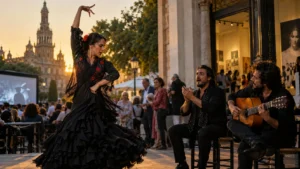
Flamenco Biennial

Flamenco in Seville this weekend: what to see before the Biennial

The weekend just before the Biennial is already full of flamenco

The 24th Seville Flamenco Biennial officially begins on Wednesday 9 September 2026, but anyone in the city this weekend does not have to wait until then. Between Friday 4 and Sunday 6 September there are three free flamenco events linked to the Biennial’s pre-programme, as well as exhibitions and experiences open during the day.

In fact, it is one of the most interesting weekends to arrive in Seville before the main theatre programme begins. There is less pressure on tickets, several events are free until capacity is reached, and the programme is spread across neighbourhoods and heritage venues that are very different from one another.

What you can see from 4 to 6 September

Friday 4: Cuestión de tiempo, by Hermanos Aguilar, at the Monastery of San Jerónimo.

Saturday 5: 2nd Festival Macarena Flamenca, a tribute to José de la Tomasa, in Plaza Virgen del Pilar in La Barzola.

Sunday 6: Nazareno y Olivares, a tribute to Fosforito, at the Museum of Popular Arts and Customs.

All three events begin at 21:30 and are announced with free admission until capacity is reached. During the day you can also visit the exhibition La noche azul and, from Saturday, the new Sala de revelado of the Biennial at the Royal Artillery Factory.

Quick answer: if you’re looking for flamenco in Seville this weekend, from 4 to 6 September 2026, the best plan is to make the most of the three free performances before the Biennial: Hermanos Aguilar on Friday, Macarena Flamenca on Saturday and the tribute to Fosforito on Sunday. During the day you can complete the route with La noche azul and the Sala de revelado at the Royal Artillery Factory. If you prefer to secure a time and a seat, Seville’s tablaos also maintain their usual programme.

Last updated: 4 September 2026. For free-admission activities, it is advisable to arrive early because entry depends on available capacity.

A transitional weekend

This weekend acts as a bridge between Seville’s year-round flamenco scene and the city that, from 9 September, fully enters Biennial mode. The major productions at the Maestranza, Lope de Vega, Teatro Central or Espacio Turina have not yet begun, but the parallel programme is already occupying neighbourhoods, squares and heritage venues.

That makes for a different atmosphere: less concentrated around the major theatres and more spread throughout the city. It is also a good opportunity to combine free flamenco + heritage + tablao without having to string together several official performances on the same day.

Friday 4: Cuestión de tiempo, Hermanos Aguilar

21:30 · Monastery of San Jerónimo · Free admission until capacity is reached

On Friday the Biennial’s pre-programme moves to the Monastery of San Jerónimo with Cuestión de tiempo, a piece created and performed by Diego and Hugo Aguilar.

The work revolves around memory, identity, family heritage and the way time transforms relationships. It is organised into five acts —Lembranza, Albor, Confluencia, Soler and Umbral— and starts from a very physical idea of transmission: family history remains present in the bodies of those who dance.

This is not a proposal conceived solely as a dance exhibition. The Aguilar brothers present an introspective stage work, with the artists’ father appearing as a symbol of origin and continuity.

Why go: because it lets you begin the weekend with a contemporary creative work in a heritage venue very different from the Biennial’s main theatres.

Saturday 5: 2nd Macarena Flamenca Festival

21:30 · Plaza Virgen del Pilar, La Barzola · Free admission until capacity is reached

On Saturday the focus moves to the Macarena district with the second edition of Macarena Flamenca, a festival launched in 2025 which this year pays tribute to José de la Tomasa for his career and his importance in passing on Seville’s cante traditions.

The bill brings together several generations and artistic profiles. The announced singers include Potito, Antonio Reyes, Remedios Reyes and Manuel de la Tomasa, with guitars by Manuel Herrera, Nono Reyes and Julio Romero, as well as palmas and accompaniment. The dance section features Manuela Amador Carrasco, with cante by Emilio Molina and Manuel Tañé and guitar by Luis Amador.

Why it may be Saturday’s big plan: because it brings together a broad line-up, takes place outdoors in a neighbourhood with a strong flamenco identity and works as a festival in its own right, not simply as a single isolated performance.

Sunday 6: Nazareno y Olivares, tribute to Fosforito

21:30 · Museum of Popular Arts and Customs · Free admission until capacity is reached

On Sunday the weekend closes at Plaza de América in María Luisa Park, with a proposal dedicated to one of the fundamental figures of 20th-century cante: Antonio Fernández Díaz, Fosforito.

Nazareno y Olivares looks back over his life and work through a combination of spoken word, music and dance. Announced participants include Enrique Garcés, Bernardo Miranda, Alejandro Hurtado and Yolanda Osuna.

The venue adds a great deal to the plan. The Museum of Popular Arts and Customs occupies the Mudéjar Pavilion in Plaza de América, so the performance lets you end an afternoon in María Luisa Park with a flamenco event connected to memory and historical repertoire.

Ideal for: those who prefer cante, guitar, storytelling and a heritage tribute over a proposal focused exclusively on dance.

What to do during the day before the performances

The fact that all three main performances begin at 21:30 leaves practically the whole day free. That makes it possible to build very complete days without rushing.

On Friday you can spend the afternoon in the centre and then travel to San Jerónimo. On Saturday it makes sense to explore Macarena, Feria, Alameda or the northern part of the city before heading to La Barzola. On Sunday, meanwhile, María Luisa Park itself, Plaza de España and Plaza de América let you organise the whole late afternoon just minutes from the performance.

In addition, throughout the weekend there is one especially recommended stop for anyone who wants to delve deeper into flamenco history and creative processes: the Royal Artillery Factory.

La noche azul: an exhibition for understanding Flamenco Opera

Since 2 September, the Royal Artillery Factory has hosted the exhibition La noche azul. Ópera Flamenca en la colección de Carlos Martín Ballester.

The exhibition brings together 328 items including posters, shellac records, gramophones, photographs and historical documents to explain how, about a century ago, flamenco moved from cafés cantantes to major theatres, bullrings, radio and the early recording industry.

Admission is free. The announced official opening hours are 10:00 to 20:00 Monday to Saturday and 10:00 to 14:00 on Sundays. That makes it especially easy to fit in on Saturday or Sunday before any of the evening performances.

From Saturday: the new Sala de revelado

The Biennial has also launched a travelling installation under the slogan “What is invisible is also flamenco”. The Sala de revelado shows rehearsal, research and creative processes that normally remain outside the public eye.

After travelling through Triana, El Prado/Nervión and Calle Feria, the installation is based from Saturday 5 September at the Royal Artillery Factory. There it expands the experience with documentary photographs, testimonies, audio material, podcasts and interviews related to the creative processes of Biennial artists.

The combination is especially logical: visiting La noche azul and the Sala de revelado in the same building lets you explore two sides of flamenco — historical memory and contemporary creation — before going out to see a performance at night.

If you prefer to secure a place: tablaos throughout the weekend

The three major pre-Biennial events on Friday, Saturday and Sunday are free until capacity is reached. That has an obvious advantage, but also a limit: it is not the same as having a guaranteed seat.

If you arrive late, are travelling on a very tight schedule or simply prefer to book in advance, Seville’s tablaos maintain their usual programme throughout the weekend. There are options around Las Setas, Santa Cruz, Arenal, Plaza Nueva, the historic centre and Triana, usually with formats of around one hour.

It can also be a good complement: exhibition or daytime activity, free event at 21:30 and a tablao on another day. There is no need to try to do everything on the same night.

Which plan to choose depending on your interests

  • Dance and contemporary creation: Hermanos Aguilar, Friday 4.
  • Cante festival with a broad line-up: Macarena Flamenca, Saturday 5.
  • History of cante and tribute to an essential figure: Fosforito, Sunday 6.
  • History and documentary heritage: La noche azul.
  • Contemporary creative processes: Sala de revelado.
  • Reserved time and regular performance: tablao.

If you can only choose one night, the decision depends more on the kind of flamenco you are looking for than on any absolute ranking. These are very different proposals, and precisely that diversity is one of the attractions of the weekend before the Biennial.

Quick schedule: flamenco in Seville from 4 to 6 September 2026

Day Plan Time Venue Admission
Friday 4 Hermanos Aguilar — Cuestión de tiempo 21:30 Monastery of San Jerónimo Free until capacity is reached
Saturday 5 2nd Macarena Flamenca Festival 21:30 Plaza Virgen del Pilar, La Barzola Free until capacity is reached
Sunday 6 Nazareno y Olivares — Tribute to Fosforito 21:30 Museum of Popular Arts and Customs Free until capacity is reached
Saturday 5 La noche azul + Sala de revelado 10:00–20:00 Royal Artillery Factory Free
Sunday 6 La noche azul + Sala de revelado 10:00–14:00 Royal Artillery Factory Free

How to organise the weekend without rushing

A good strategy is to reserve each evening for one main event and use the day to explore the city. There is no need to turn the weekend into a marathon.

Friday: historic centre in the afternoon + San Jerónimo at 21:30.

Saturday: Artillery Factory in the morning or early afternoon + Macarena and Alameda + Macarena Flamenca Festival at night.

Sunday: Artillery Factory in the morning + María Luisa Park and Plaza de España in the afternoon + tribute to Fosforito at 21:30.

For the free events, our recommendation is to arrive with time to spare. At an event without numbered tickets, arriving early matters much more than at a reserved show.

And afterwards: the Biennial officially begins on the 9th

The weekend is not the end of this pre-programme. On Tuesday 8 the film series continues Flamencas and on Wednesday 9 September the official opening arrives with the Pregón Cantado in Plaza de San Francisco.

From then on the scale changes: the major performances begin and the programme expands across the edition’s main venues. If you are staying in Seville for more days, it is worth moving from this weekend guide to our complete Biennial guide and to the specific article about the first official weekend, which already covers the shows from 9 September onwards.

The Biennial has not officially begun yet, but Seville is already in flamenco mode

The weekend of 4 to 6 September offers an especially attractive combination: three free evening performances, two daytime cultural proposals at the Royal Artillery Factory and the full regular programme of the tablaos.

If you are going to be in Seville on these days, there is no need to wait until 9 September to start experiencing the Biennial. The city is already showing part of what is to come: dance, cante, memory, heritage, creation and flamenco in the streets.

Frequently asked questions about flamenco in Seville this weekend

On Friday 4 Hermanos Aguilar perform Cuestión de tiempo at the Monastery of San Jerónimo; on Saturday 5 the 2nd Macarena Flamenca Festival takes place in Plaza Virgen del Pilar; and on Sunday 6 there is Nazareno y Olivares, a tribute to Fosforito, at the Museum of Popular Arts and Customs. All three events begin at 21:30.

Yes. The performances on 4, 5 and 6 September are announced with free admission until capacity is reached, so it is advisable to arrive early.

The 24th Flamenco Biennial officially runs from 9 September to 3 October 2026. However, several parallel activities and performances begin before the 9th.

Cuestión de tiempo, by Hermanos Aguilar, at 21:30 in the Monastery of San Jerónimo. It is a dance and contemporary creation piece focused on memory, identity and family heritage.

The 2nd Macarena Flamenca Festival takes place at 21:30 in Plaza Virgen del Pilar in La Barzola and pays tribute to José de la Tomasa. The bill includes, among others, Potito, Antonio Reyes, Remedios Reyes, Manuel de la Tomasa and Manuela Amador Carrasco.

At 21:30 there is Nazareno y Olivares at the Museum of Popular Arts and Customs, a proposal dedicated to Fosforito’s life and work through music, spoken word and dance.

Yes. The Royal Artillery Factory hosts the free exhibition La noche azul and, from Saturday 5, also the Sala de revelado, dedicated to showing the creative processes of Biennial artists.

The exhibition’s official hours are 10:00 to 20:00 Monday to Saturday and 10:00 to 14:00 on Sundays. Admission is free.

Yes. Seville’s tablaos maintain their usual programme throughout the weekend. It is a recommended alternative if you want to secure a place, choose a specific time or combine one of the Biennial’s pre-events with another flamenco show.

The pre-programme continues on 8 September and the Biennial officially begins on the 9th. From then on the major productions, premieres and series begin at Seville’s main venues.

Book online: the key to securing your seat

In many cities, flamenco tablaos sell out easily, especially on weekends and during peak season. That’s why, if your dates are set, the most important thing is to book online.

Direct recommendation: book online through our website to guarantee your seat and arrive with everything confirmed. If you already have your destination, go straight to your city to see available options and clear recommendations.

Flamenco Sevilla | Tablaos Flamencos

Seville

Flamenco Madrid | Tablaos Flamencos

Madrid

Flamenco Barcelona | Tablaos Flamencos

Barcelona

Flamenco Granada | Tablaos Flamencos

Granada

Flamenco Córdoba | Tablaos Flamencos

Cordoba

Flamenco Málaga | Tablaos Flamencos

Malaga

Flamenco Valencia | Tablaos Flamencos

Valencia

Flamenco Jerez | Tablaos Flamencos

Jerez

Find out more about this with your favorite AI:

Did you like this article? Share it!:

Tags: agenda flamenca, Bienal 2026, Bienal de Flamenco, festivales flamencos, flamenco en Sevilla, sevilla, tablaos de Sevilla

Article published by:

Related articles

Flamenco tonight in Seville during the Biennial