Flamenco Biennial

El mundo por montera at the 2026 Biennial: who is taking part and what we will see at the Maestranza

The Biennial’s major gala comes to the Maestranza arena

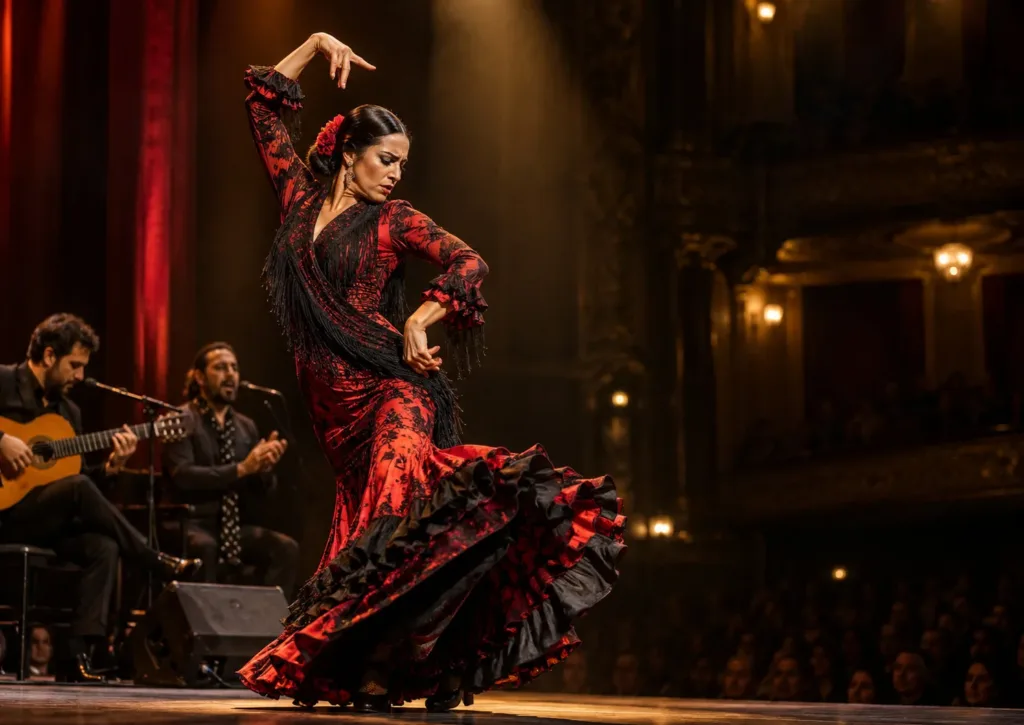
El mundo por montera takes place on Thursday 10 September 2026 at 9:30 pm in the Plaza de Toros de la Real Maestranza de Caballería de Sevilla. The Biennial presents it as a Unique Night and as one of the major events of its 24th edition: a show conceived specifically to bring several generations of cante, baile and guitar playing together in the same space.

The line-up is exceptional: José Mercé, José el de la Tomasa, Martirio, Arcángel, La Tremendita, Ángeles Toledano, El Perrete and Manuel de la Tomasa, together with the Ballet Flamenco de Andalucía with Patricia Guerrero. But the key is that this will not be a succession of independent recitals. The artistic direction by Andrés Marín and Luis Ybarra shapes the evening as a complete work, divided into nine passages and a final romería that revisit the flamenco of a century ago from a contemporary perspective.

Essential information

  • Show: El mundo por montera.
  • Date: Thursday 10 September 2026.
  • Time: 9:30 pm.
  • Venue: Plaza de Toros de la Real Maestranza de Caballería de Sevilla.
  • Artistic direction: Andrés Marín and Luis Ybarra.
  • Format: gala / Unique Night in nine passages and a final romería.
  • Tickets: from €25 according to the Andalusian Cultural Agenda.
  • Context: the centenary of 1926 and the rise of Ópera Flamenca.

Quick answer: El mundo por montera will bring José Mercé, José el de la Tomasa, Martirio, Arcángel, La Tremendita, Ángeles Toledano, El Perrete, Manuel de la Tomasa and the Ballet Flamenco de Andalucía with Patricia Guerrero to the Real Maestranza on 10 September. It will not be a festival of isolated numbers: the programme is built as a nine-passage show moving through caña, bambera, cantiñas, granaína, petenera, ida y vuelta styles, soleá and seguiriya before ending in a collective fandangos celebration. The idea is to look at the flamenco of 1926 from 2026, without literally reproducing it.

This is not a festival inside a bullring

A line-up with so many names might suggest a conventional gala: one artist comes on, performs a number, leaves and makes way for the next. The Biennial itself has stressed that this is not the structure of El mundo por montera.

The production has a script, an aesthetic concept and a shared architecture. Andrés Marín signs the aesthetic concept; Marín and Luis Ybarra share artistic direction, script and programme; Benito Jiménez contributes to the stage space and lighting design; and Cachito Valles takes charge of the visual dimension and the creation of props.

It is therefore best to go expecting a stage creation rather than simply a concentration of major names. The artists appear within a journey designed so that different styles, generations and sound worlds can enter into dialogue with one another.

A contemporary look at Ópera Flamenca

The starting point is the flamenco of a hundred years ago, when shows grew in scale and reached theatres, cinemas and bullrings. That period mixed cante, baile, guitar and entertainment formats that may seem surprising today, such as saxophone battles, cuplés and variety shows.

El mundo por montera does not try to reconstruct a 1926 performance as if it were a museum piece. Its intention is to revisit that expansive energy through contemporary flamenco. That is why, in the same evening, the soleá of José el de la Tomasa, the seguiriya of José Mercé, the experimentation of La Tremendita, Martirio’s universe, the Ballet Flamenco de Andalucía and a saxophone duo can all coexist.

This relationship between memory and creation connects directly with La noche azul, the Biennial exhibition devoted to the era of Ópera Flamenca.

Who sings in El mundo por montera

The cante line-up brings together very different profiles:

  • José Mercé, one of the great Jerez voices of recent decades.
  • José el de la Tomasa, a bearer of deep Sevillian cante memory.
  • Martirio, whose career crosses flamenco, copla, jazz and song.
  • Arcángel, a cantaor with immense knowledge and wide experience in creative projects.
  • La Tremendita, cantaora, composer, producer and multi-instrumentalist.
  • Ángeles Toledano, one of the standout voices of the new generation.
  • El Perrete, especially connected with Extremaduran cantes and traditional repertoire.
  • Manuel de la Tomasa, a young representative of one of cante’s great family dynasties.

The make-up of the line-up allows very different ways of understanding flamenco to be heard within a single work. If you want to place these names within the full programme, see our guide to cante at the 2026 Biennial.

Baile, guitars, saxophones and compás

Dance will have a central role through the Ballet Flamenco de Andalucía with Patricia Guerrero. The official listing also names dancer Eduardo Leal in one of the passages, while the open rehearsal on 4 September showed that same fragment performed by Patricia Guerrero with Andrés Marín. At the time of this guide, the programme page still lists Eduardo Leal for that number, so we do not consider a cast change confirmed until the organisation updates the final listing.

The main guitarists are Manolo Franco, Alfredo Lagos and David de Arahal. One of the passages also features José Luis Medina and Jesús Rodríguez. The saxophones are played by Juan Jiménez and Alfonso Padilla; Daniel Suárez is on percussion and El Oruco and Abel Harana on palmas. A Biennial note published on 4 September also mentions El Chupete as part of the percussion and palmas accompaniment.

The programme of El mundo por montera: nine passages and a final celebration

The Biennial has already published the structure of the gala. Rather than simply reproducing the artistic notes, it is more useful to understand the role each part plays within the journey.

I. El ole, the saxophones and the echo of Pastora

The evening begins with an image that directly evokes the expansive atmosphere of Ópera Flamenca: a saxophone battle. Juan Jiménez and Alfonso Padilla open that soundscape, accompanied by Manolo Franco and the palmas of El Oruco and Abel Harana.

The reference to Pastora inevitably leads to La Niña de los Peines, one of the central figures of the period. The opening works as a statement of intent: historical flamenco is not locked away in a display case, but is crossed by instrumentation that recalls the popular, urban and spectacular character of those years.

II. Generation of ’27: caña, bambera, Levante and cantiñas

The second passage brings together Ángeles Toledano, El Perrete and Manuel de la Tomasa. The announced repertoire combines a three-voice caña, bambera, airs from the Levante and cantiñas, with David de Arahal and Alfredo Lagos on guitar.

Here the focus is the relationship between poetry and cante in the cultural environment of the Generation of ’27. The intergenerational purpose is also clear: three young voices engage with historical material without necessarily imitating forms from a century ago.

III. El cerco y la luna: granaína y media

This is the fragment chosen by the Biennial for the open rehearsal on 4 September. The title starts from the image of a halo around the moon as an omen and develops around granaína y media, one of the cantes that Antonio Chacón decisively helped bring into the concert sphere.

The official show listing credits Patricia Guerrero and Eduardo Leal in the dance, accompanied by the saxophones of Juan Jiménez and Alfonso Padilla and the guitars of José Luis Medina and Jesús Rodríguez. However, the public rehearsal was performed by Guerrero and Andrés Marín. The most prudent approach is to treat the programme listing as the planned cast until an update is published.

The combination is especially interesting: the saxophone, associated here with the bustle of large shows in the 1920s, pulls back to coexist with a cante of great suspension and inwardness.

IV. La mano aquí: Vallejo, Catalina and the Ballet Flamenco de Andalucía

The fourth passage belongs to the Ballet Flamenco de Andalucía and is built around two milestones from 1926: the award of the second Llave de Oro del Cante to Manuel Vallejo and the release of the rumba Catalina.

This is not simply about citing Vallejo. The choreography explores how dance can celebrate and reread a moment when cante was reaching mass audiences and new forms of circulation.

V. La Tremendita and a petenera taken into another territory

The fifth part is reserved for Rosario La Tremendita, who appears on vocals and bass, with Manolo Franco on guitar. The title of the passage, Tremenda petenera. Vuelta a un mundo nuevo, perfectly anticipates the approach.

The petenera retains all its historical weight but enters the language of an artist used to working with new textures, instruments and structures. It is probably one of the moments where it will be clearest that the gala does not aim to reproduce the past, but to make it productive in the present.

VI. Arcángel and the cantes de ida y vuelta

Arcángel leads a passage devoted to the idas y vueltas, with Manolo Franco and Alfredo Lagos on guitar, Daniel Suárez on percussion and El Oruco and Abel Harana on palmas.

The very idea of ida y vuelta fits a gala about circulation: music travels, changes and returns. Arcángel’s voice, equally at home in traditional repertoire and research-based projects, is especially well suited to this part of the journey.

VII. Martirio: flamenco operas, cuplés and variety shows

El mundo en una peineta will be the territory of Martirio, accompanied by Alfredo Lagos, Daniel Suárez and the compás of El Oruco and Abel Harana.

It is one of the most natural pairings in the entire production. For decades, Martirio’s career has worked with copla, flamenco, song, jazz and a distinctive iconography in which the peineta is almost a visual signature. In a work that recovers the ecosystem of cuplés and variety shows, her presence is not peripheral: it represents a line of continuity between those hybrid forms and contemporary creation.

VIII. José el de la Tomasa por soleá

After several passages of expansion and mixture, the programme draws inward with the soleá of José el de la Tomasa, accompanied by David de Arahal. The explicit reference to the Alameda de Hércules takes the show towards a deeply Sevillian memory.

It is one of the moments where voice, time and transmission will probably matter more than outward spectacle. The Biennial thus places rooted cante at the centre of the narrative, not as a nostalgic counterpoint, but as one of the forces that supports everything else.

IX. José Mercé por seguiriyas

The last of the nine passages is entrusted to José Mercé, with David de Arahal on guitar, and will be devoted to the seguiriyas. The choice connects with the cantaor’s own Jerez lineage and with the memory of Paco la Luz, one of his ancestors and a fundamental figure in the transmission of siguiriya styles.

Placing Mercé at this point in the programme provides a dense culmination before the final shift in register. You can read more about his presence in this edition in our guide to José Mercé at the 2026 Biennial and his show Toquen a rebato.

Final romería: the triumph of the fandangos

After the seguiriya, the gala does not end in introspection. The closing section will be a collective romería por fandangos, with all the participants.

The choice has a very specific historical intention. At the 1922 Concurso de Cante Jondo in Granada, fandangos were excluded because they were considered too closely linked to folklore. Just a few years later, however, they became enormously popular and one of the great engines of mass-audience flamenco.

Ending with fandangos turns that hierarchy on its head: what was once rejected for not seeming sufficiently “jondo” becomes a shared celebration. It is one of the programme’s smartest ideas because it sums up the argument of the whole evening: the history of flamenco does not move in a straight line, and the popular can also become tradition.

Why 1926 is so important to this gala

The show uses 1926 as its point of observation because several decisive events came together that year.

  • Pepe Marchena entered the commercial circuits of what became known as Ópera Flamenca through Vedrines.
  • Manuel Vallejo received the second Llave de Oro del Cante.
  • Vallejo also released the rumba Catalina.
  • Manuel Centeno had won the second Copa Pavón.
  • The electrical recording process was beginning to become widespread, a decisive transformation for the record industry and the dissemination of cante.

Flamenco was entering a new scale of audience. Bullrings, theatres and cinemas could bring together thousands of spectators, while recordings carried voices far beyond the places where they had been captured.

From intimacy to mass spectacle

Ópera Flamenca has been debated for decades. For some, it represented a commercialisation that displaced certain cantes; for others, it was a period of enormous creativity and expansion that produced essential artists, styles and recordings.

El mundo por montera avoids a simplistic reading. It does not argue that everything before was purer or that popular success automatically destroyed the art. On the contrary, it uses the tension between intimacy and spectacle to explain how flamenco could grow while still preserving smaller spaces of transmission.

That debate remains current. The gala lets us see how a virtually bare soleá, a large dance ensemble, saxophones, bass, percussion and a bullring prepared for thousands of people can coexist today.

The Real Maestranza is more than just a spectacular venue

The choice of the Plaza de Toros de la Real Maestranza has historical meaning. A century ago, bullrings were among the spaces able to turn flamenco into a spectacle for large audiences. Bringing this 1926 rereading into Seville’s arena returns the genre to one of the architectural formats that helped drive its expansion.

The Maestranza also forces us to think differently about stage scale. It is not a conventional proscenium theatre: the arena, the distance, the height of the stands and the circular character of the space all shape how cante and baile are perceived.

The bullring is also one of the most distinctive venues of the entire edition. We have included it in our selection of the most spectacular venues of the 2026 Seville Flamenco Biennial.

One night only

The Biennial classifies El mundo por montera as a Unique Night. That means the meeting of artists, the script and the relationship with this space are conceived as a one-off event within the edition.

It should not be confused with the official opening of the festival. The 24th Biennial begins on 9 September in Plaza de San Francisco with the sung opening Ecos primitivos. Cante en altura, danza en tierra. The Maestranza gala follows the next day as the first major night of the general programme.

For the other events in this format, see the full calendar of Unique Nights at the 2026 Biennial.

Tickets, time and how to attend

The gala is scheduled for Thursday 10 September 2026 at 9:30 pm. The Andalusian Cultural Agenda lists prices from €25. The official Biennial listing still provides access to ticket sales.

The Plaza de Toros de la Real Maestranza is located at Paseo de Cristóbal Colón, 12, Seville, beside the river and just a few minutes on foot from the Cathedral, El Arenal and Puerta de Jerez.

Because this is a large-scale production with a single performance, we recommend not leaving your purchase until the last moment. Availability and seating sections may change as the date approaches.

You can also see our general guide to tickets, prices and discounts for the 2026 Biennial.

What to do before and after

The location makes it easy to combine the gala with a walk through the city centre and El Arenal. If you are coming specifically for the Biennial, allow enough time to arrive without rushing, find the correct entrance and take your seat before the show begins.

The following day, 11 September, the programme continues with Antonio Rey at Espacio Turina, Sara Baras at Teatro de la Maestranza and La Tremendita at Teatro Central, among other proposals. To organise those first days, we have prepared a specific guide to what to see during the first weekend of the 2026 Biennial.

And if you want to plan the whole trip, see the general guide to the 2026 Seville Flamenco Biennial.

What we recommend watching for during El mundo por montera

1. The change of scale

Listen to how cante adapts to a space designed for thousands of people. The very history the show commemorates is about that leap from small settings to mass venues.

2. The role of the saxophones

They are not an eccentric decoration. They act as a direct reference to the musical atmosphere of the 1920s and appear both in expansive moments and in the inward atmosphere of the granaína.

3. The dialogue between generations

The line-up does not set “old” against “new”. José Mercé, José el de la Tomasa, Ángeles Toledano, El Perrete and Manuel de la Tomasa occupy different positions within a chain of transmission that is still alive.

4. The transformation of the palos

Petenera, cantes de ida y vuelta, soleá, seguiriya and fandangos appear with different dramatic functions. The gala offers a rare opportunity to see how a style can retain its identity while also changing according to who performs it and the context in which it is placed.

5. The closing fandangos

This is probably the historical key that is easiest to overlook. The programme ends by celebrating precisely a cante that the 1922 Granada Competition had excluded because it was considered unsuitable for its idea of jondo.

6. Staging as part of the argument

Andrés Marín and Luis Ybarra have not simply assembled a line-up. The lighting, the use of the arena, the dance ensemble, changes in instrumentation and the order of the artists are all part of the argument about how flamenco became a major performing art.

Practical summary

Question Answer
When is it? Thursday 10 September 2026 at 9:30 pm.
Where? Plaza de Toros de la Real Maestranza de Caballería de Sevilla.
Who is singing? José Mercé, José el de la Tomasa, Martirio, Arcángel, La Tremendita, Ángeles Toledano, El Perrete and Manuel de la Tomasa.
Who is dancing? Ballet Flamenco de Andalucía with Patricia Guerrero; the listing for one passage also includes Eduardo Leal.
Who is directing? Andrés Marín and Luis Ybarra.
How many parts are there? Nine passages and a final romería por fandangos.
How much are the tickets? From €25, according to the Andalusian Cultural Agenda.
Is it a Unique Night? Yes, the Biennial programmes it as a single performance.

One of the events that best explains the theme of the 2026 Biennial

El mundo por montera has the obvious attraction of bringing together an extraordinary number of artists, but its real interest goes beyond the line-up. The gala offers a complete reading of a historical moment when flamenco changed in scale, means of circulation and relationship with the public.

The choice of the Maestranza, the saxophones, the tribute to Vallejo, La Tremendita’s petenera, José el de la Tomasa’s soleá, José Mercé’s seguiriya and the final romería por fandangos all form part of the same argument. The work looks back to 1926 to ask what remains, what has changed and how a tradition stays alive when each generation interprets it anew.

That is why our recommendation is not to go simply expecting to “see lots of artists”. The best way to enjoy the evening will be to follow the journey and notice how each intervention connects with the previous one and prepares the next. If the concept works as intended, the real protagonist will be the relationship between flamenco’s memory and its present.

Frequently asked questions about El mundo por montera

On Thursday 10 September 2026 at 9:30 pm in the Plaza de Toros de la Real Maestranza de Caballería de Sevilla.

The cante line-up brings together José Mercé, José el de la Tomasa, Martirio, Arcángel, La Tremendita, Ángeles Toledano, El Perrete and Manuel de la Tomasa. The dance features the Ballet Flamenco de Andalucía with Patricia Guerrero, alongside a large team of guitarists, saxophonists, percussionists and palmas.

The artistic direction is by Andrés Marín and Luis Ybarra. Marín also signs the aesthetic concept, and both share the script and programme.

The official opening of the 24th Biennial takes place on 9 September with Ecos primitivos in Plaza de San Francisco. El mundo por montera follows on the 10th as the major gala and first major Unique Night of the general programme.

The programme includes, among other styles, caña, bambera, airs from the Levante, cantiñas, granaína y media, petenera, cantes de ida y vuelta, soleá, seguiriya and fandangos.

Because it marks one hundred years since a decisive period: Pepe Marchena entered the circuits of Ópera Flamenca, Manuel Vallejo received the second Llave de Oro del Cante and released Catalina, and electrical recording transformed the dissemination of flamenco on record.

The Andalusian Cultural Agenda lists prices from €25. Availability and seating areas should be checked through the Biennial’s official sales channel.

At Paseo de Cristóbal Colón, 12, in Seville’s El Arenal district, beside the Guadalquivir and very close to the historic centre.

No other performance is scheduled. The Biennial presents it as a Unique Night on 10 September.

The official programme listing credits Patricia Guerrero and Eduardo Leal in the passage El cerco y la luna. The open rehearsal on 4 September was performed by Guerrero with Andrés Marín. Until the Biennial updates the show listing, we regard Eduardo Leal as the planned cast member for the performance and Marín’s rehearsal as a stage preview, not confirmation of a cast change.

Official sources

Information checked on 5 September 2026. The organisation may update the cast, ticket availability or technical details before the performance.

Book online: the key to securing your seat

In many cities, flamenco tablaos sell out easily, especially on weekends and during peak season. That’s why, if your dates are set, the most important thing is to book online.

Direct recommendation: book online through our website to guarantee your seat and arrive with everything confirmed. If you already have your destination, go straight to your city to see available options and clear recommendations.

Flamenco Sevilla | Tablaos Flamencos

Seville

Flamenco Madrid | Tablaos Flamencos

Madrid

Flamenco Barcelona | Tablaos Flamencos

Barcelona

Flamenco Granada | Tablaos Flamencos

Granada

Flamenco Córdoba | Tablaos Flamencos

Cordoba

Flamenco Málaga | Tablaos Flamencos

Malaga

Flamenco Valencia | Tablaos Flamencos

Valencia

Flamenco Jerez | Tablaos Flamencos

Jerez

Find out more about this with your favorite AI:

Did you like this article? Share it!:

Tags: Flamenco Biennial, Flamenco Biennial 2026, Flamenco events calendar, Flamenco festivals, flamenco in Seville, Noches Únicas, Seville

Article published by:

Related articles

Flamenco Biennial: Noches Únicas move from Hotel Triana to Muelle de la Sal
Seville Flamenco Biennial 2026 Developing Room: “The invisible is also flamenco”