History of flamenco

The Roma imprint on flamenco: from memory to contemporary creation

To speak of flamenco is to speak of cultural encounters, memory and transmission. For centuries, Andalusia was a place of coexistence, conflict and exchange between cultures, and flamenco emerged from this complex human landscape. Within that plural history, the Roma community occupies an essential place: not as the only root of the genre, but as one of the major forces behind its creation, preservation and transformation.

UNESCO itself identifies flamenco as an expression of identity for numerous communities and groups, “in particular” the Roma community, which has played an essential role in its development. Spain’s Ministry of Culture likewise describes flamenco as a plural art form in which the Roma people and the historical influence of other cultures were fundamental to its origins and evolution.

Understanding that legacy requires more than listing celebrated artists. It lives in the families that transmitted repertoires and ways of performing, in neighbourhoods and cities where styles developed distinctive identities, in private celebrations, cafés cantantes, peñas and tablaos, and today also in conservatories, festivals and international stages.

Key idea: flamenco is a plural, culturally diverse creation. Recognising that diversity does not diminish the Roma contribution: institutional sources identify the Roma community among the essential forces shaping flamenco’s development, transmission and evolution.

Flamenco does not have a single root

The precise origins of flamenco remain a subject of study and debate. There is, however, broad agreement about its mixed cultural character. In southern Iberia, Andalusian music and traditions converged with Arab and Jewish influences, elements brought through exchanges with the Americas, and musical and expressive forms developed by the Roma population.

The Andalusian Flamenco Institute recalls that flamenco singing emerged from Andalusian folklore and emphasises the historical importance of contact between Roma and Andalusian communities. That interaction did not create static music; it produced a new language that evolved over generations.

It is therefore more accurate to speak of a shared cultural creation than an invention attributable to one group alone. At the same time, acknowledging that mixture does not diminish the Roma role. Contemporary institutional sources identify it as decisive to understanding how flamenco became the art form we know today.

For more context, see our guide to what flamenco is, its origins and its essential elements.

Family memory as a form of transmission

For much of its history, flamenco was learned mainly by listening, watching and taking part. Before conservatories, academic methods and audiovisual archives, many ways of singing, dancing and playing guitar were transmitted within families, gatherings and communities.

This learning involved more than memorising lyrics or rhythmic patterns. It included ways of breathing through a song, bringing a phrase to a close, accompanying, waiting, entering at the right moment and responding to whatever happened live. Much flamenco knowledge was therefore knowledge gained through lived experience.

Roma artistic dynasties have been essential to that continuity. Families associated for generations with singing, dance or guitar playing have preserved styles, repertoires and approaches to performing. But tradition was never simply about copying the past. Each generation inherited earlier material and reinterpreted it through its own personality.

Neighbourhoods, cities and places of flamenco identity

The Roma imprint on flamenco is also rooted in specific places. Triana in Seville, Jerez de la Frontera, Cádiz, Utrera, Lebrija, Granada and parts of Extremadura belong to a geography where local traditions, flamenco families and community life gave rise to recognisable forms of expression.

In some of these places, flamenco was connected to work, family celebrations, shared courtyards, roadside inns, taverns and gatherings. It later reached professional venues. That transition helped turn a practice rooted in specific social settings into a performing art that could travel far beyond them.

In Seville, the history of Triana and flamenco shows how a neighbourhood, its community and artistic creation can intertwine across generations.

From intimate gatherings to cafés cantantes, peñas and tablaos

Professionalisation profoundly transformed flamenco. The nineteenth-century cafés cantantes brought greater visibility to artists who had previously performed mostly in private or semi-private settings. Theatres, companies, festivals, peñas and tablaos followed.

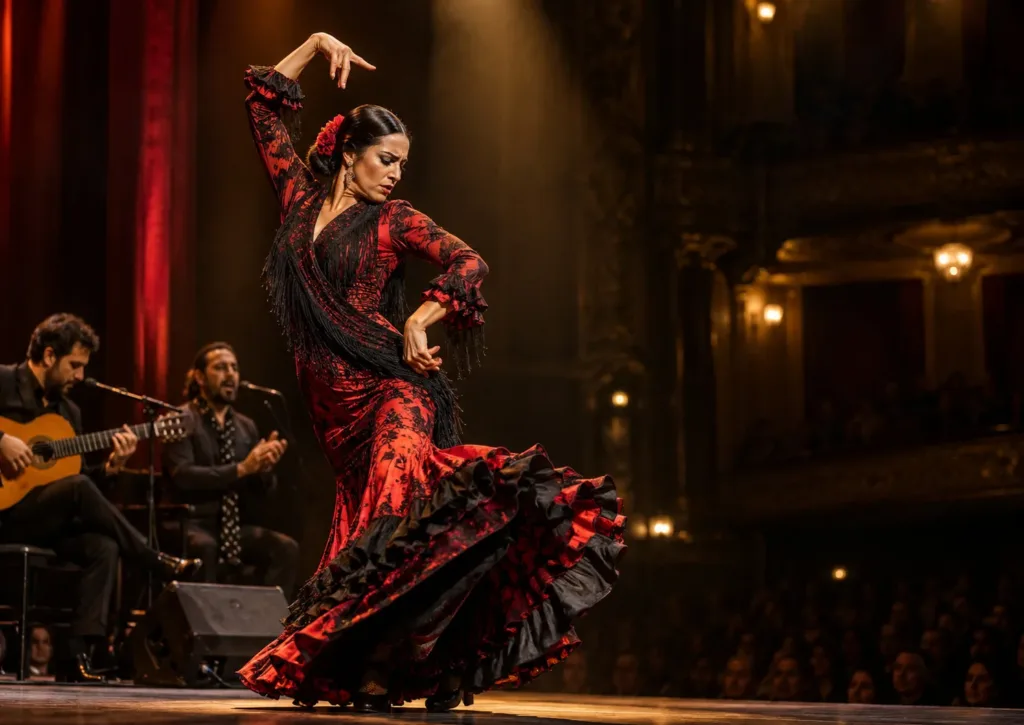
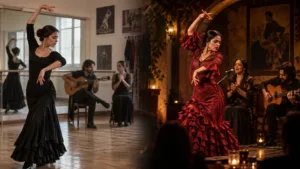
Each of these places changed how flamenco was presented, while also helping to preserve it. Peñas became spaces for listening, meeting and transmission; tablaos established steady professional work for numerous performers; and festivals broadened audiences and encouraged larger productions.

Today these different ways of experiencing flamenco coexist. One artist might grow up in a family setting, train formally, perform in a peña, work regularly in a tablao and then develop a production for a large theatre.

To understand these venues, read Tablao, peña, zambra, cave or theatre: differences and how to choose.

Tradition does not mean standing still

A common mistake when talking about tradition is to imagine it as fixed. In flamenco, tradition has survived precisely because it has changed.

Roma artists have actively shaped that evolution. They have preserved older forms but have also experimented with harmonies, stage formats, instruments, repertoires and collaborations. Flamenco’s continuity does not depend on repeating exactly what earlier generations did, but on maintaining a recognisable dialogue with them.

This tension between heritage and exploration explains much of the genre’s vitality. Compás, characteristic phrasing and family memory can coexist with a symphony orchestra, contemporary staging or new choreographic languages.

Roma creativity in contemporary flamenco

The 24th Seville Flamenco Biennial in 2026 offered several examples of the relationship between memory and creativity. The show A canela y clavo, featuring Esperanza Fernández, Duquende, José Valencia, Pepe Torres and Nazaret Reyes, was conceived as a tribute to the profound Roma imprint on flamenco: a living expression rather than a static inheritance.

Another production, Serás Farruquito , turned biography and family transmission into theatrical material. Farruquito’s work explored heritage, learning, recognition, resilience and legacy, connecting his personal story to the following generation.

On 1 October 2026, Marina Heredia also performed with the Royal Seville Symphony Orchestra in ¡En libertad! El camino de los gitanos, a new work that traces the Roma people’s historical journey and turns it into contemporary musical expression. The project coincided with the commemoration of six centuries since the first documented Roma presence on the Iberian Peninsula, recorded in 1425.

These examples show that identity is not only a memory: it can also become the starting point for new artistic works.

Six centuries of documented presence on the Iberian Peninsula

The Archive of the Crown of Aragon preserves a safe-conduct issued on 12 January 1425 by Alfonso V to Juan de Egipto Menor (John of Little Egypt) and his companions. It is regarded as the first documented Roma presence in Iberian territory.

That document does not mark the beginning of a culture or explain six centuries of history on its own, but it provides a chronological reference. Long periods of integration, marginalisation, persecution and resistance followed. Roma memory in Spain cannot be separated from those experiences.

By the time flamenco emerged as a recognisable genre centuries later, Roma communities were already part of Andalusia’s social fabric. Their contribution to flamenco therefore unfolded within a much broader history of coexistence as well as discrimination.

From family learning to the conservatory

The ways flamenco is passed on today are far more varied. Families and artistic dynasties remain important, but they are no longer the only path. Academies, conservatories, universities, companies, festivals, peñas and tablaos form a network for learning and professional development.

This has not eliminated oral transmission. Instead, it has placed that practice alongside other approaches. A young artist might learn compás at home, technique at a conservatory, stagecraft in a company and the profession itself by performing each evening before a live audience.

UNESCO highlights the importance of families, social groups and peñas in transmitting flamenco. Spain’s Ministry of Culture also recognises contemporary spaces for education and dissemination.

What does the Roma imprint on flamenco mean today?

It does not mean that all flamenco artists are Roma, nor that flamenco can be explained solely through Roma culture. And it certainly does not mean that the Roma contribution belongs only to the past.

It means recognising an essential historical influence on the formation and evolution of the genre. It means understanding the role of families and dynasties in passing on repertoires and expressive codes. It means acknowledging Roma performers who transformed singing, dance and guitar playing. And it means recognising how that memory continues to inspire creative work today.

Flamenco is at once a shared heritage and a memory rooted in particular communities. Its strength lies in turning centuries of coexistence, hardship, celebration, exchange and creativity into an artistic language that continues to change.

A memory that remains in motion

Perhaps the best way to understand the Roma imprint on flamenco is to avoid treating it as a museum exhibit. It lives in archives and recordings, but also on stages, in rehearsals, at family gatherings and in new compositions. It lives in artists who inherit a tradition and decide how to continue it.

Contemporary flamenco does not necessarily break with its memory when it experiments. It often returns to that memory to ask new questions. This ability to look back without ceasing to move forward helps explain why the genre is still alive.

It also captures one of the keys to understanding the Roma contribution to flamenco: a profound inheritance that not only preserves the past but continues to shape the creation of the future.

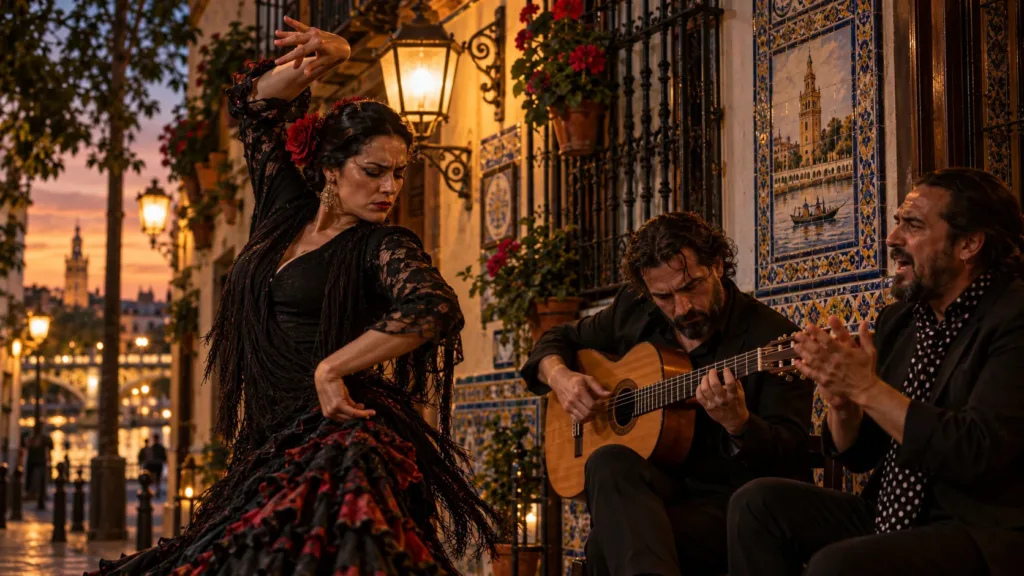
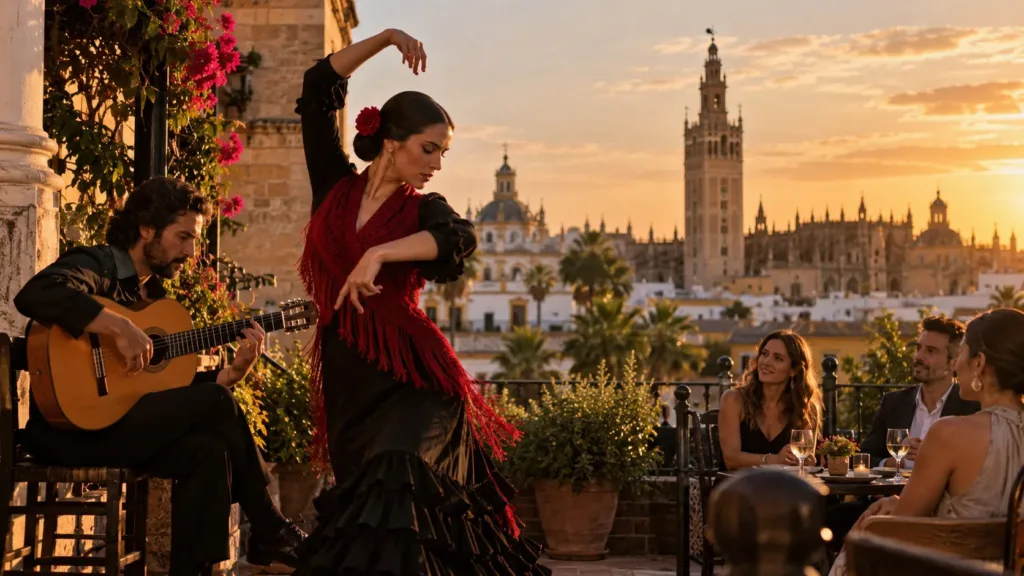
Bailaora flamenca acompañada por guitarra y palmas en Triana, Sevilla

From heritage to the stage: experience live flamenco

Flamenco’s memory is also written afresh on stage every night. To discover its singing, dance and guitar playing, you can compare professional shows in different cities and choose the experience that best suits you.

Check times, the features of each experience and availability before booking online. Every performance is different, and no single venue represents the full diversity of flamenco.

Frequently asked questions about the Roma imprint on flamenco

No. Flamenco is a plural, hybrid cultural creation. The Roma contribution is essential to understanding its development and transmission, but it is not its only root.

It has played a fundamental role in family and community transmission, the preservation of repertoires and performance codes, and the artistic creation of numerous generations of singers, dancers and guitarists.

For much of its history it was learned mainly orally and through practice: by listening, watching and participating in families, gatherings and communities. Today that path coexists with academies, conservatories and other training spaces.

Among others, Triana and other neighbourhoods of Seville, Jerez de la Frontera, Cádiz, Utrera, Lebrija, Granada and certain areas of Extremadura are part of geographies historically linked to flamenco transmission and creation.

No. Flamenco tradition has evolved constantly. Many Roma artists have combined memory and inherited codes with new musical, theatrical and choreographic forms.

The Archive of the Crown of Aragon preserves a safe-conduct issued on 12 January 1425 by Alfonso V for John of Little Egypt and his companions, considered the first documented Roma presence in Iberian territory.

Sources and references

This guide draws on institutional and cultural sources to put the history, transmission and Roma contribution to flamenco into context. It avoids attributing the genre’s origins to any single community and distinguishes between documented facts and complex historical processes.

Book online: the key to securing your seat

In many cities, flamenco tablaos sell out easily, especially on weekends and during peak season. That’s why, if your dates are set, the most important thing is to book online.

Direct recommendation: book online through our website to guarantee your seat and arrive with everything confirmed. If you already have your destination, go straight to your city to see available options and clear recommendations.

Flamenco Sevilla | Tablaos Flamencos

Seville

Flamenco Madrid | Tablaos Flamencos

Madrid

Flamenco Barcelona | Tablaos Flamencos

Barcelona

Flamenco Granada | Tablaos Flamencos

Granada

Flamenco Córdoba | Tablaos Flamencos

Cordoba

Flamenco Málaga | Tablaos Flamencos

Malaga

Flamenco Valencia | Tablaos Flamencos

Valencia

Flamenco Jerez | Tablaos Flamencos

Jerez

Find out more about this with your favorite AI:

Did you like this article? Share it!:

Tags: Flamenco Biennial, Flamenco Biennial 2026, Flamenco dance, Flamenco guitar, Flamenco singing, History of flamenco

Article published by:

Related articles

Flamenco and painting: when dance also becomes visual art
From conservatoire to tablao: how young flamenco artists train today