History of flamenco

From conservatoire to tablao: how young flamenco artists train today

The romantic image of a flamenco artist learning solely at home, listening to their elders and stepping onto the stage almost by intuition, remains part of the genre’s history. But it no longer explains on its own how many young performers train.

Today, a dancer, singer or guitarist may attend a conservatoire, study with private teachers, take classes at academies, participate in competitions and flamenco clubs, join a company and, at the same time, develop their craft night after night in a tablao.

Contemporary flamenco training increasingly combines oral transmission, formal education, technical training and stage experience. There is no single route, and artists do not all go through the same stages.

Quick answer: young flamenco artists train today by combining different routes. Conservatoires and academies provide technique and structure; teachers, families and flamenco clubs pass on repertoire, conventions and experience; companies develop collective discipline; and tablaos turn all of this into practical stagecraft. There is no single compulsory path.

Can you study flamenco at a conservatoire?

Yes, although it depends on the discipline and the region. In Andalusia, for example, professional dance education includes a specialism in Flamenco Dance and is structured across six academic years. Higher artistic dance programmes are equivalent to a university degree, with pathways relating to performance, choreography and teaching.

Formal education offers a systematic approach to body technique, musical knowledge, repertoire, history, interpretation, physical preparation, composition, teaching and choreographic analysis.

But attending a conservatoire does not automatically make someone a professional artist. Flamenco also requires direct engagement with the stage, with other performers and with a tradition that cannot always be learnt solely in a classroom.

Traditional transmission remains essential

The arrival of formal programmes has not replaced historical ways of learning. Family transmission, teachers, academies, neighbourhoods with a flamenco tradition, flamenco clubs and ongoing contact with artists still play a decisive role.

Many young people combine both routes. They may study technique at an official institution in the morning and attend classes with a particular teacher in the afternoon to explore a style, a palo or a particular understanding of dance in greater depth.

Training does not end when you obtain a qualification. Even established performers continue taking classes, researching repertoire, working with other artists and seeking new tools for expression.

Dance, singing and guitar: three different paths

Speaking of “flamenco training” as though all disciplines worked in the same way would be an oversimplification. Dance, singing and guitar playing have different requirements and pathways.

How flamenco dancers train today

Dance is where structured teaching is most visible. The body needs physical preparation, technique, coordination, knowledge of compás and gradual development. This is why conservatoires, schools and academies play an important role.

A young dancer may work on footwork, arm movements, turns, alignment, musicality, repertoire and different palos. As they progress, they need to learn something no technical exercise can replace: how to listen to the singer and guitarist in a live performance, when to wait, when to respond and how to build a performance that does not feel mechanical.

That learning accelerates when they begin performing in front of an audience.

How flamenco singers train

In singing, oral transmission remains particularly important. Listening to historical recordings, learning styles and variants, studying lyrics, learning from other singers and becoming immersed in the repertoire are fundamental parts of the process.

Vocal training has also become more important. It is increasingly common to work on breathing, vocal care, technique and injury prevention while preserving a personal sound and the expressive characteristics of flamenco singing.

Singing for dance also requires an understanding of llamadas, cierres, escobillas and changes in dynamics. This ability is acquired above all through working with other artists.

How flamenco guitarists train

Flamenco guitar requires a demanding technical foundation: compás, accompaniment for singing and dance, harmony, falsetas, rasgueos, picado, arpeggios and rhythmic techniques.

One of the major steps comes when a guitarist stops playing alone. Accompanying others requires listening, anticipation and adaptability.

A guitarist may master a concert piece yet still need years to develop the flexibility required by a flamenco ensemble.

Flamenco clubs: learning in front of an audience that knows flamenco

The flamenco clubs, or peñas, remain among the genre’s great informal schools. As well as preserving repertoires and organising recitals, they give young artists opportunities to perform for audiences very familiar with flamenco.

Circuits and competitions for new talent also serve an educational purpose. In 2026, for example, the Circuito Andaluz de Jóvenes Flamencos included categories for dance, singing, guitar and other instruments, and held part of its selection process in Andalusian flamenco clubs.

The value of these experiences is not only in winning a prize. Preparing a performance, delivering it live, sharing a bill with other performers and receiving an audience’s immediate response are all part of becoming a professional.

You can explore this context further in our guide to the Circuito Andaluz de Peñas.

Companies: discipline, repertoire and collective creation

Joining a company brings another level of learning. Artists stop thinking solely about their individual contribution and become part of a collective creation involving rehearsals, artistic direction, schedules, repertoire, production and touring.

Companies develop precision, the ability to share a stage and the capacity to repeat a work without losing intensity. They also bring young performers into contact with choreographers, directors and artists from different generations.

Ongoing training is increasingly present even within professional organisations. In 2026, the Ballet Flamenco de Andalucía expanded its training programme with workshops and encounters led by artists from different generations.

This demonstrates something important: continuing to learn is part of the job.

The tablao: where technique becomes stagecraft

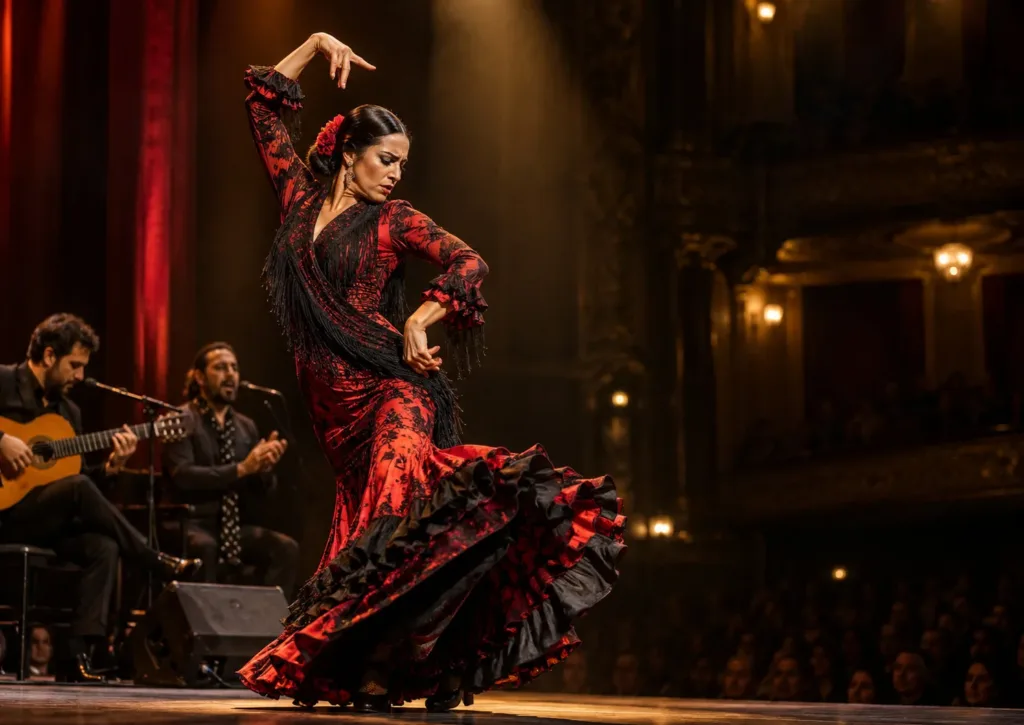
The flamenco tablao plays a role that is difficult to replace. It is a performance venue, but also a practical school.

Learning to respond in real time

Performing regularly forces young artists to make decisions in real time. Every singer breathes differently, every guitarist brings different nuances and audiences react differently each night.

Performers learn to listen, adjust, improvise and sustain a performance’s intensity. In this sense, a tablao offers something different from a conservatoire: formal education can provide technique, structure and knowledge; the tablao adds practical stagecraft.

Learning to work as a professional

The tablao also teaches professionalism: arriving prepared, respecting timings, working with different artists, adapting to last-minute changes and maintaining a high standard even when performing several days a week.

The history of these venues helps explain why they remain so important. Today’s tablaos are the result of a long evolution connected to the old cafés cantantes. We explain this in more detail in our article on the origins of the flamenco tablao.

Can you study and work at the same time?

Not only is it possible: it is common. A flamenco artist’s career rarely follows a straight line.

A young person may be completing professional studies while performing at weekends, join a company for a season and then return to classes. They may also start working very early, discover technical gaps through performing and return to more structured training years later.

In other cases, the opposite happens: comprehensive academic training comes first, followed by the need to gain experience in small venues without the stage distance of a large theatre.

It is therefore more accurate to speak of a training ecosystem than a ladder with compulsory steps.

Do you need a family background in flamenco to become an artist?

No. Growing up in a flamenco environment can provide early exposure to compás, repertoire and particular ways of passing on knowledge, but it is not a requirement for developing a professional career.

Conservatoires, academies, schools and specialist programmes have opened up more routes into the art. At the same time, people from flamenco families also frequently pursue formal studies and technical training today.

Tradition and academia are not opposing worlds. They increasingly overlap.

What young artists are looking for today

New generations do not simply reproduce earlier models. Many seek to master the tradition and then find a voice of their own.

This process may include contemporary dance, composition, theatre, music production, new technologies, historical research or collaborations with other genres. But innovation is stronger when it is grounded in knowledge of flamenco conventions: compás, repertoire, structures and forms of accompaniment.

Contemporary creation does not remove the need to learn the tradition. In many cases, it makes that knowledge even more necessary.

From classroom to stage: when does a career really begin?

There is no precise moment. For some artists, a first contract comes after years of study. Others begin performing while they are still training.

Competitions, flamenco clubs, festivals, companies, scholarships and tablaos offer different points of entry. Some careers develop quickly, while others take longer.

Moving into professional work requires skills that are not always assessed in class: stage presence, adaptability, stamina, communication and the ability to work as part of a team.

Training that never ends

Flamenco has changed, and so has the way it is learnt. Today, conservatoires coexist with family homes, official qualifications with private lessons, digital archives with oral transmission, and large companies with small stages.

But one thing remains: flamenco is learnt by listening and doing. Technique can be studied, knowledge organised and history researched. Yet practical mastery develops when all of this comes into contact with other artists and an audience.

For many young people, the real journey does not simply lead from conservatoire to tablao. It moves continually between the two: studying, performing, making adjustments, studying again and returning to the stage with new tools.

Frequently asked questions about training young flamenco artists

At professional dance conservatoires, authorised centres, schools, academies and with private teachers. In Andalusia, Flamenco Dance is one of the specialisms within professional dance education.

No. There are many pathways. Many professionals combine formal education with academies, teachers, family transmission and stage experience, while others develop their careers without completing official programmes.

Because they provide real experience in front of an audience and opportunities to work with different singers, dancers and guitarists. A tablao helps develop listening, improvisation, adaptability and practical stagecraft.

Flamenco clubs preserve repertoire and tradition, organise recitals and offer performance opportunities to emerging artists. They also host circuits and competitions that provide a platform for new generations.

Yes, very frequently. Classes, workshops, research and work with other teachers are part of ongoing training even for performers with established careers.

Yes. Many young people combine training and performances. Stage experience can reveal areas to strengthen in class, while study provides new tools that can then be tested on stage.

Book online: the key to securing your seat

In many cities, flamenco tablaos sell out easily, especially on weekends and during peak season. That’s why, if your dates are set, the most important thing is to book online.

Direct recommendation: book online through our website to guarantee your seat and arrive with everything confirmed. If you already have your destination, go straight to your city to see available options and clear recommendations.

Flamenco Sevilla | Tablaos Flamencos

Seville

Flamenco Madrid | Tablaos Flamencos

Madrid

Flamenco Barcelona | Tablaos Flamencos

Barcelona

Flamenco Granada | Tablaos Flamencos

Granada

Flamenco Córdoba | Tablaos Flamencos

Cordoba

Flamenco Málaga | Tablaos Flamencos

Malaga

Flamenco Valencia | Tablaos Flamencos

Valencia

Flamenco Jerez | Tablaos Flamencos

Jerez

Find out more about this with your favorite AI:

Did you like this article? Share it!:

Tags: flamenco artists, Flamenco dance, Flamenco guitar, Flamenco singing, Flamenco tablao, History of flamenco

Article published by:

Related articles

The Roma imprint on flamenco: from memory to contemporary creation