History of flamenco

Flamenco and painting: when dance also becomes visual art

When rhythm also leaves a visual trace

Flamenco is usually defined through singing, dance and guitar, but its history is also full of images. Painters, illustrators, photographers, set designers and multidisciplinary artists have tried to capture something that, in principle, seems impossible to stop: a moving body, a gesture that lasts an instant, a llamada, a desplante or the tension of a seguiriya.

The relationship between flamenco and painting is not simply about depicting dancers, guitars or Andalusian scenes on canvas. At its most interesting, something deeper happens: painting learns from rhythm and movement, while dance begins to be understood as line, form, volume, space and colour.

From a painting inspired by flamenco to a body that paints

For a long time, painting looked at flamenco from the outside. The artist observed the singer, dancer or guitarist and transferred the scene to a fixed surface. In the 20th century, creators such as Vicente Escudero began to erase that boundary by directly linking his drawings to his way of dancing.

Today, some projects go one step further: visual creation happens within the performance itself. Dance does not merely inspire a later visual artwork; it can produce strokes, marks and compositions in real time. The stage becomes studio, canvas and choreographic space all at once.

Quick answer: the dialogue between flamenco and painting goes far beyond paintings with flamenco themes. Julio Romero de Torres made cante hondo and its artists an essential part of his pictorial universe; Vicente Escudero explicitly connected the avant-garde, drawing and dance; and contemporary creators such as José Maldonado use painting, dance and music within a single stage work. The result is a territory where the body can function as line, gesture, matter and even as a brush.

Painting flamenco: depicting what is about to disappear

A painting remains; a dance happens and disappears. That difference explains much of the fascination that visual arts have felt for flamenco. The painter tries to fix a posture, an atmosphere or an emotion that exists on stage for only a few seconds.

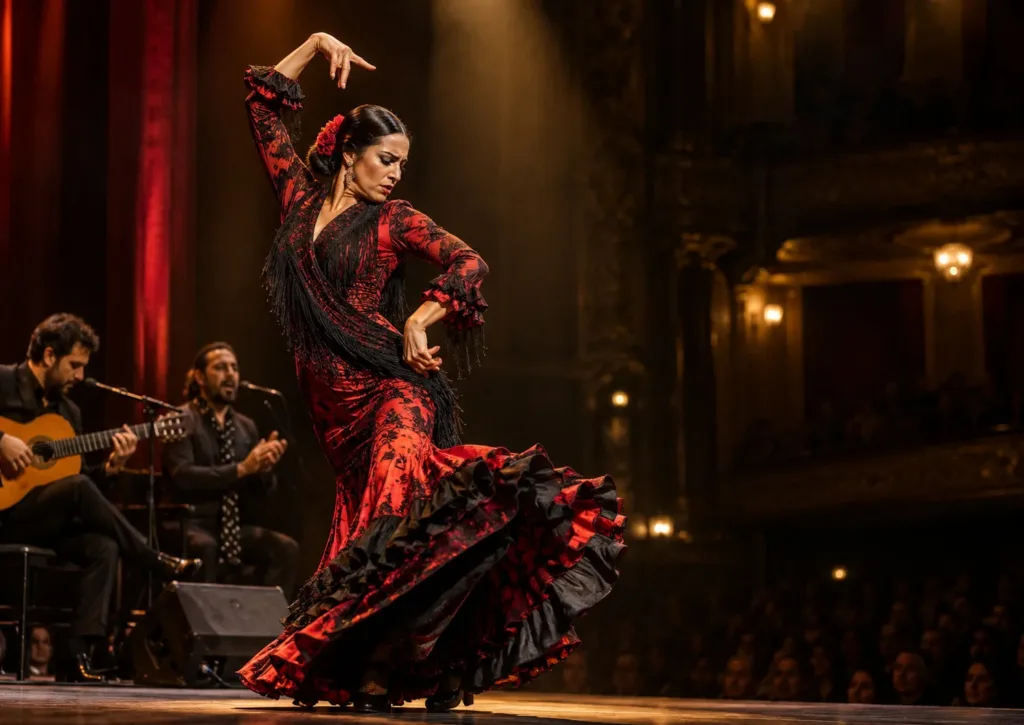
That is why the best flamenco-themed works do not function like literal photographs. A dancer’s raised arm, the inclination of a body, the darkness of a background or the presence of a guitar can condense movement, tension and character without needing to show an entire choreography.

Painting can stop time. Flamenco, by contrast, demands to be experienced. When the two languages meet, that opposition becomes an extraordinary source of creation.

Beyond costumbrismo

During the 19th and 20th centuries, images of dances, cafés cantantes, performers, courtyards and Andalusian scenes abounded. Many helped spread a visual image of flamenco, although some remained trapped in a picturesque view of Andalusia.

The subject becomes more interesting when a work stops using flamenco as mere decoration. The artist then begins to ask about its structure: how can compás be drawn? How can a silence be represented? What shape does a desplante have? Can a line convey the energy of zapateado?

That is where the true dialogue between disciplines appears. The question is no longer simply painting someone dancing, but trying to understand visually what makes that movement flamenco.

Julio Romero de Torres: a painter deeply connected to cante jondo

In the work of Julio Romero de Torres , flamenco is not an occasional detail. The Julio Romero de Torres Museum dedicates one of its rooms to the Cordoban painter’s relationship with flamenco and copla, and his works include titles such as Cante Hondo, La nieta de la Trini or Alegrías.

Romero de Torres portrayed performers, incorporated guitars and used references to cante as part of his own symbolic language. His figures do not need to be performing a step to convey an atmosphere connected to cante jondo. The gaze, posture, background and objects create an almost theatrical tension.

His case is important because it shows that flamenco could become pictorial material of great artistic ambition, not merely a folkloric motif.

Flamenco as a symbol, not a postcard

In his paintings, flamenco elements often coexist with references to Córdoba, copla, religion, desire or female identity. The result does not try to explain a palo or document a performance. It constructs an imaginary world.

That distinction is essential for understanding the relationship between painting and cante jondo. A painting can speak about flamenco without describing it literally. It can do so through a guitar in the background, the bodily attitude of a figure or a sense of waiting.

Before contemporary dance began experimenting directly with paint on stage, artists such as Romero de Torres had already demonstrated that flamenco could be a way of thinking visually.

Vicente Escudero: when painting began to dance

The decisive step came with figures who were both performers and visual artists. Among them stands out Vicente Escudero, dancer, choreographer, theorist, painter and illustrator, and one of the most singular personalities in 20th-century Spanish dance.

Escudero experienced the European avant-garde at close range and made that experience part of the way he thought about dance. The Reina Sofía Museum recalls his relationship with Cubism and Surrealism and how, during his years in Paris, he frequented circles connected to Picasso, Léger, Juan Gris, Miró, Duchamp and Man Ray.

This was not about placing a modern set behind a traditional dance. Modernity entered the body itself: in line, verticality, fragmentation, economy of gesture and the spatial conception of choreography.

Pintura que baila: an idea ahead of its time

Escudero wrote about the relationships between the arts and even titled one of his texts Pintura que baila. His drawings and paintings have been studied alongside his choreographies because both fields formed part of the same creative investigation.

His lines do not try to reproduce a body anatomically. They tend to synthesise it. A curve can be an arm; an angle, a position; a blot, an energy. That simplification closely resembles what happens in memory after watching someone dance: we do not remember every movement, but certain lines and moments of maximum intensity.

With Escudero, flamenco stops being only the subject of a painting and begins to share compositional mechanisms with it.

Flamenco and the avant-garde: geometry, rhythm and rupture

The encounter between flamenco and modern art was not an anomaly. The 20th century turned dance into a laboratory where set design, lighting, music, costume, painting and movement began to relate to one another in new ways.

Flamenco possessed qualities especially fertile for that dialogue. Its work with rhythm allows compás to be translated into visual repetition. Body positions create geometries. The contrasts between stillness and explosion recall the relationship between empty space and form. Even costume produces lines and volumes that change as the body turns.

This visual reading helps explain why flamenco has interested artists who did not necessarily belong to its musical tradition.

The stage as composition

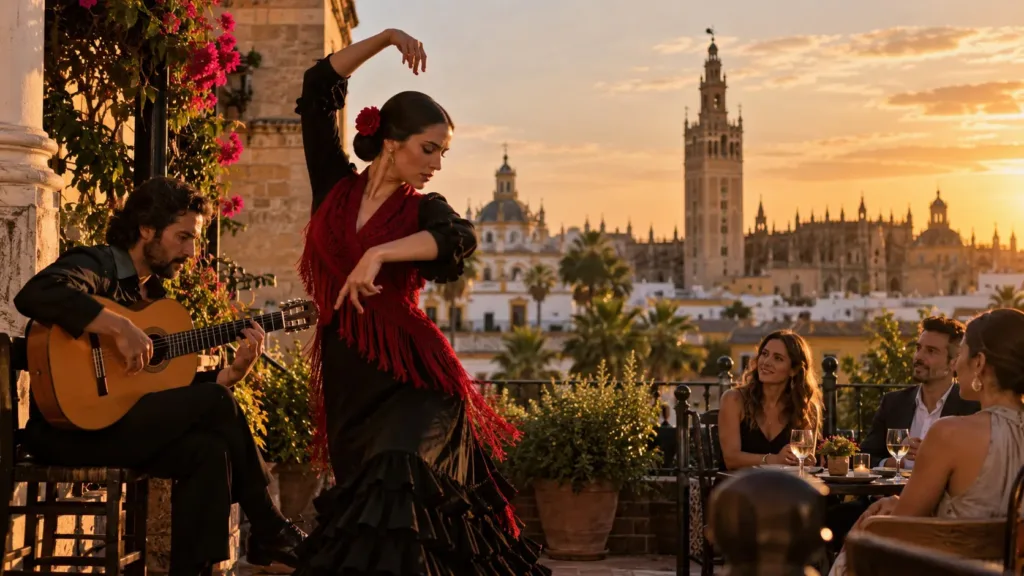
Watching a performance only as a sequence of steps leaves out an important part of what is happening. Every scene constructs an image: who occupies the centre, where the singing and guitar are placed, which areas remain empty, how the light enters and which colours dominate.

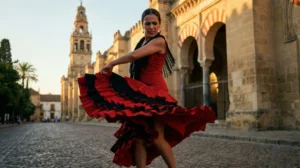
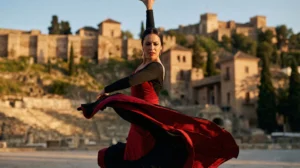
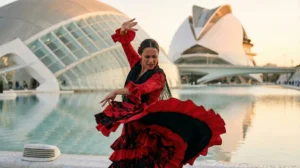
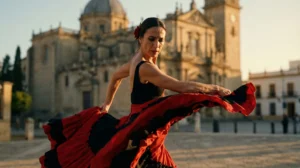
A good dance can create powerful images without complex scenery. The silhouette of a still body before beginning, an extended bata de cola or a group forming a semicircle around the dancer can have a visual force comparable to a pictorial composition.

That is why photography, painting and stage design find such rich visual material in flamenco.

José Maldonado: the artist who dances, choreographs and paints

In contemporary flamenco, José Maldonado represents one of the clearest examples of boundaries disappearing. A dancer, choreographer and visual artist, he has developed projects in which painting is not an accessory placed around dance but part of the creative mechanism itself.

His show Galería combines dance, music, painting and audiovisual resources, and incorporates live painting. He has also developed the exhibition Monstruos del Flamenco, built around hybrid figures that blend references to major personalities in flamenco art.

From Galería to a stage transformed into a studio

In Galería, Maldonado connects movement and painting with cultural references such as Manuel de Falla, Federico García Lorca, Salvador Dalí and Carmen Amaya. The audience does not watch two independent works —a dance on one side and a painting on the other— but a process in which the disciplines influence one another.

That approach also changes the relationship with time. A traditional painting is usually presented as finished. Here, the visual work can be born in front of the audience and share with flamenco its nature as an event.

What matters is not only the result left on the surface, but having witnessed how it was created.

Guacamayo: the body turned into a brush

The project Guacamayo, scheduled in 2026, takes this investigation even further. The work integrates dance, singing, guitar, percussion and painting, and treats the body as a brush capable of projecting movement and colour onto a white surface.

The idea is especially suggestive because it reverses the historical relationship between flamenco and painting. It is no longer the painter who observes a dancer in order to represent them later. The dance itself produces the image.

Every gesture can leave a trace. The choreography does not end at the body: it extends physically into the visual space. The canvas thus becomes a material memory of something that would otherwise have disappeared when the performance ended.

Which elements of dance can become a visual language

Line. Arms, back, legs and hands draw directions through space.

Geometry. A pose can create triangles, diagonals, circles or strongly marked verticals.

Rhythm. The repetition of steps and accents can be translated visually into series, intervals and patterns.

Empty space. Pause and stillness have a function comparable to the unpainted space in a composition.

Material. Costume, hair, shawl, bata de cola or dust from the floor react to movement and extend the body.

Colour. Lighting, costume and set design can completely change the meaning of the same choreography.
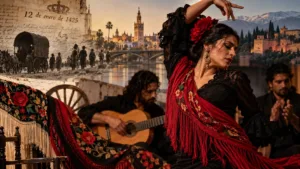
Sound can also suggest an image

Although painting and photography belong to the visual realm, in flamenco it is difficult to completely separate what is seen from what is heard. A heel strike changes the perception of a movement. A guitar strum can make a gesture feel sharper. A silence focuses the gaze.

That is why works that bring flamenco and visual arts together often actively include singing, guitar and percussion. They are not there as a soundtrack to a pictorial action. They form part of the architecture of the image.

If you want to better understand how rhythm and character change between styles, our guide to flamenco styles helps you recognise those differences.

Museums and galleries: when flamenco enters the exhibition space

The dialogue does not happen only in theatres. The Museo del Baile Flamenco in Seville, for example, dedicates its second floor to temporary exhibitions of painting, drawing, sculpture and photography related to flamenco. Its programme has brought together artists from different countries and has also shown work connected to Vicente Escudero.

These spaces are important because they allow flamenco to be observed outside the fleeting moment of performance. Visitors can pause before a work, compare styles and see how artists from very different cultures interpret the same universe.

Flamenco thus appears not only as a musical and choreographic genre, but also as a source of international visual creation.

Photography: freezing what dance never stops moving

Photography occupies a fascinating middle ground. Unlike painting, it can record a real instant; unlike video, it freezes it. Choosing exactly when to press the shutter transforms a complete movement into a single image.

In flamenco, a fraction of a second changes everything. A gesture can appear expansive or closed; fabric can remain suspended; an expression can concentrate the meaning of a scene. Photography does not replace dance, but it can reveal forms that the eye barely had time to perceive during the performance.

That is why the visual history of flamenco cannot be understood without photographers, posters, portraits, archives and stage documentation.

Three moments for understanding the relationship between flamenco and painting

Stage Figure or example What changes
Painting represents flamenco Julio Romero de Torres Cante, performers and their symbols enter a pictorial language of its own.
Painting and dance share an investigation Vicente Escudero Drawing, the avant-garde and choreography begin to be conceived as parts of the same creation.
Dance produces painting José Maldonado The visual work can be born live as a physical consequence of movement.

After looking this way, a performance appears different

Knowing this relationship changes the way we watch live flamenco. Suddenly the lines of the body matter more, as does the way an artist occupies space, the distance between performers, contrasts in lighting or the way a garment extends a turn.

This does not mean turning dance into an intellectual exercise. Quite the opposite: it allows us to appreciate more fully everything happening at once. Flamenco is music and movement, but it is also visual composition in real time.

Our guide to what “authentic flamenco” really means explores this idea of a living art that does not depend on stereotypical scenery to be recognisable.

An art that has always known how to enter into dialogue

Painting does not make flamenco more modern, just as flamenco does not automatically make a painting more profound. The interest appears when the two disciplines transform one another.

Julio Romero de Torres found a symbolic universe in cante jondo. Vicente Escudero connected his dance with the avant-garde and turned drawing into another way of investigating movement. José Maldonado has brought that relationship to the contemporary stage, allowing painting to emerge during the dance itself.

This journey shows that flamenco is not a closed tradition. Its strength also lies in its ability to converse with other languages without ceasing to be recognisable.

From canvas to stage, and from stage back to canvas

For generations, visual artists tried to capture flamenco. Today, some dancers return the gesture: they use flamenco to produce images. Between those two extremes lies more than a century of encounters, explorations and experiments.

Perhaps that is the best way to understand the relationship between flamenco and painting. Neither discipline needs to explain the other. They meet because both work with rhythm, tension, matter, gesture, memory and emotion.

And when that encounter works, the viewer is no longer quite sure where the dance ends and the image begins.

Frequently asked questions about flamenco and painting

It ranges from the depiction of flamenco artists and scenes in paintings to contemporary works in which painting and dance are created simultaneously. Both disciplines share elements such as rhythm, gesture, composition, line, tension and the use of space.

Many artists have worked with flamenco themes. Julio Romero de Torres is one of the most important examples because of the depth with which he incorporated cante hondo, performers, guitars and flamenco symbols into his pictorial universe.

Yes. In addition to being a dancer, choreographer and dance theorist, Vicente Escudero was a painter and illustrator. His visual work is studied in relation to his choreographies and to the influence that artistic avant-gardes had on the way he conceived dance.

Guacamayo is a work by José Maldonado scheduled in 2026 that integrates dance, singing, guitar, percussion and painting. The piece treats the body as a brush that projects movement and colour, making dance and visual imagery part of the same process.

Yes. Some contemporary creators use bodily movement to generate strokes or intervene on surfaces during the performance itself. In these cases, painting stops being scenery and becomes a direct consequence of the choreography.

The Museo del Baile Flamenco in Seville has a space dedicated to temporary exhibitions of painting, drawing, sculpture and photography related to flamenco. Museums, cultural centres and festivals also regularly programme exhibitions about artists, photography and flamenco visual creation.

Yes. Photography has been fundamental in building the visual memory of flamenco. Portraits, stage images, posters and archives preserve gestures, artists and forms of representation that would otherwise have existed only during the performance.

It can help you look in a different way. Concepts such as line, composition, volume, contrast, empty space and colour allow us to appreciate visual aspects of dance that can go unnoticed when all attention is focused on rhythm or technique.

Book online: the key to securing your seat

In many cities, flamenco tablaos sell out easily, especially on weekends and during peak season. That’s why, if your dates are set, the most important thing is to book online.

Direct recommendation: book online through our website to guarantee your seat and arrive with everything confirmed. If you already have your destination, go straight to your city to see available options and clear recommendations.

Flamenco Sevilla | Tablaos Flamencos

Seville

Flamenco Madrid | Tablaos Flamencos

Madrid

Flamenco Barcelona | Tablaos Flamencos

Barcelona

Flamenco Granada | Tablaos Flamencos

Granada

Flamenco Córdoba | Tablaos Flamencos

Cordoba

Flamenco Málaga | Tablaos Flamencos

Malaga

Flamenco Valencia | Tablaos Flamencos

Valencia

Flamenco Jerez | Tablaos Flamencos

Jerez

Find out more about this with your favorite AI:

Did you like this article? Share it!:

Tags: arte jondo, flamenco artists, Flamenco dance, Flamenco fusion, History of flamenco

Article published by:

Related articles

What is flamenco duende: meaning, Lorca and how to recognize it