Flamenco by city

Flamenco in Triana: history, compás and where to experience it today

Flamenco in Triana: a history that still resonates across the river

Triana is one of flamenco’s great historic territories. Across the Guadalquivir, this old suburb of Seville was home for generations to Roma and non-Roma families, potters, blacksmiths, sailors and workers who made singing, dance and compás part of everyday expression. Its name appears very early in written sources on flamenco and remains associated with styles, artists and ways of performing that form part of the memory of arte jondo.

But reducing it to the phrase “Triana, the birthplace of flamenco” would oversimplify a much richer history. Flamenco was not born in a single neighbourhood or community: it took shape through exchanges between different parts of Andalusia. What makes Triana distinctive is the intensity of its contribution and the continuity of a flamenco identity of its own, still recognisable in the soleá, tangos, certain forms of dance and, above all, in a particular way of living the compás.

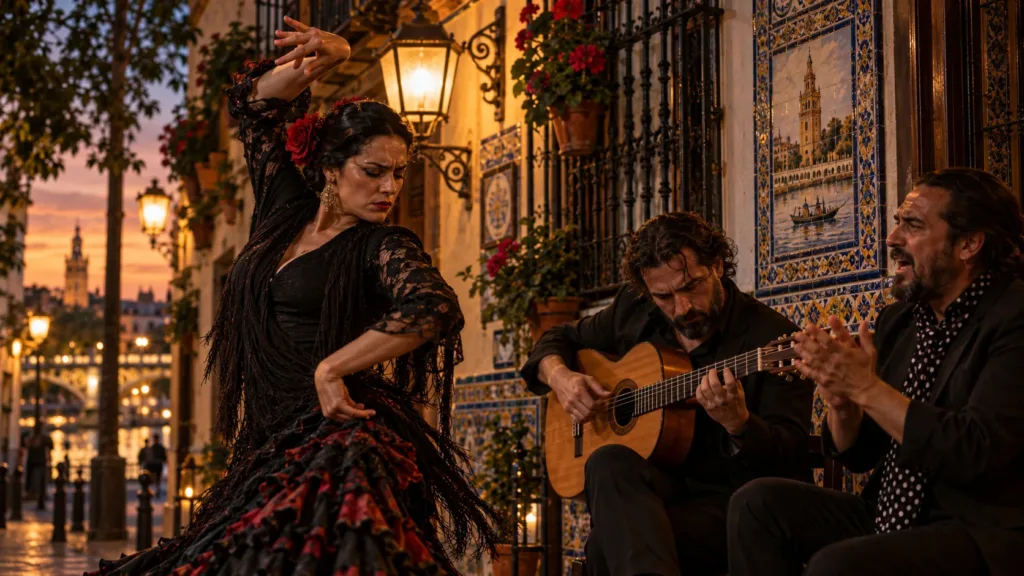
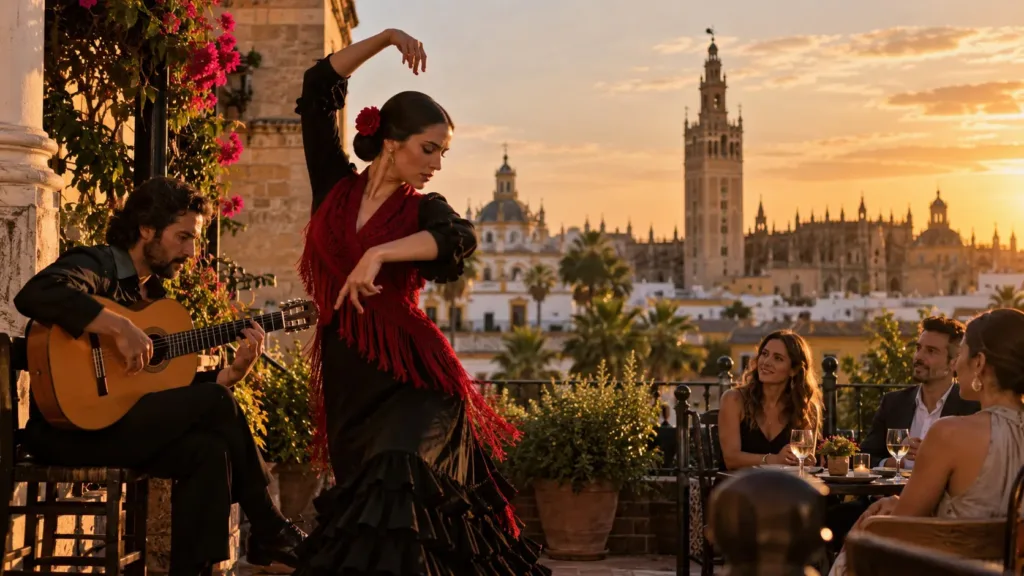
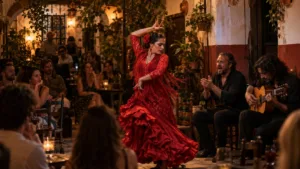
Bailaora flamenca acompañada por guitarra y palmas en Triana, Sevilla

Quick answer

Why is Triana so important to flamenco? Because it was one of the centres where flamenco took shape and was passed down during the 18th, 19th and 20th centuries. Historical sources place festivities, dances and performers in Triana from very early dates; the Andalusian Flamenco Institute links the neighbourhood to fundamental forms such as the soleá of Triana and the tangos of Triana. The Cava, communal courtyards, forges and patios are part of that memory.

Flamenco today no longer functions as it did in historic Triana, but the neighbourhood still offers professional singing, dance and guitar performances. If you want to guarantee a performance during your visit, our current recommendation in Triana is Baraka Sala Flamenca, on Calle Pureza: a small-capacity venue designed to let you experience the singing, guitar and dance up close. Booking in advance is advisable, especially at weekends, on public holidays and during busy periods.

Why Triana has a place of its own in flamenco history

Triana has developed a strong cultural identity shaped by its historic position as a neighbourhood separated from central Seville by the river. Its status as an old suburb encouraged an intense community life and a mixture of trades, families and traditions. Ceramics, pottery, blacksmithing, port work and communal courtyards are not merely picturesque scenery: they help explain the social context in which certain musical repertoires and dance forms were passed from generation to generation.

Flamenco history particularly remembers the coexistence of Roma and non-Roma communities. The Andalusian Flamenco Institute itself points to contact between Roma people and Andalusians as one of the important elements in the genre’s formation. In Triana that coexistence was especially visible and left traces both in repertoires associated with Roma families and in cantes linked to pottery-making and non-Roma popular settings.

For that reason, it is more accurate to describe Triana as one of flamenco’s great historical centres than to claim it as the genre’s exclusive birthplace. Cádiz, Jerez, Los Puertos, Utrera, Alcalá, Granada, Málaga and other areas were equally decisive. What is exceptional about Triana is that its name became linked to a recognisable school, its own repertoires and a collective memory that continues to serve as a reference inside and outside Seville.

The earliest documentary traces: from Triana festivities to “A Dance in Triana”

Triana appears in some of the earliest written references now used to study flamenco’s antecedents. Andalucía.org records an item from around 1740 mentioning the granddaughter of Baltasar Montes, described as the oldest Roma man in Triana, dancing in noble houses in Seville accompanied by string and percussion instruments.

A century later, Serafín Estébanez Calderón devoted one of the most frequently cited episodes of Andalusian Scenes to “A Dance in Triana”. El Planeta and El Fillo appear in the account, two essential names in the early genealogy of flamenco singing. It is neither a recording nor a modern report and should be read with the caution appropriate to costumbrista literature, but it shows how strongly Triana was already associated with dances, singers and gatherings that attracted the attention of writers and travellers.

Nineteenth-century sources also show how dance gradually moved out of family and private settings and became professionalised. The Andalusian Flamenco Institute includes Triana, alongside Cádiz and Granada’s Sacromonte, among the geographical centres of an early stage of flamenco dance before the cafés cantantes.

These references matter because they challenge a common idea: flamenco in Triana is not a recent tourist invention. The neighbourhood’s relationship with the genre is documented long before the emergence of the modern tablao.

The Cava, communal courtyards and an everyday way of living flamenco

For generations, much of Triana’s flamenco memory was linked to the Cava, the historic name associated with today’s Calle Pagés del Corro and the surrounding area. Historiography and oral tradition distinguish between the Cava de los Gitanos and the Cava de los Civiles, with families, trades and repertoires that were not always the same.

The communal courtyards encouraged a shared way of life. Patios, doorways, workshops and taverns were places where music could emerge outside any professional stage. Singing might serve a celebration, accompany work, enliven a family gathering or simply communicate something. In that context, compás was not merely something to be studied: it was learned by listening and taking part.

The romantic image of a Triana in permanent celebration, however, is no fairer to the neighbourhood. Those communities experienced poverty, persecution and deep inequality. Flamenco culture coexisted with difficult living conditions and physically demanding work. Understanding that social dimension changes the way we hear cantes about hardship, pride, love, loss or resistance.

Triana was also open to outside influence. Artists and aficionados from elsewhere came to the Cava, and its ways of singing travelled to other places. Flamenco was built through precisely this continuous movement: one voice learned a variation, another performer transformed it, and the repertoire eventually acquired a geographical or family name.

Triana’s compás: soleá, tangos and early cantes

Saying that Triana “has compás” is more than a phrase. The neighbourhood is historically linked to several fundamental flamenco styles.

The soleá of Triana

The Andalusian Flamenco Institute identifies La Andonda, a singer from Triana, as the earliest known reference for the style and links this to the Triana origin of the soleá. From Triana, the cante spread and generated schools and variants in Alcalá de Guadaíra, Jerez, Cádiz, Utrera, Lebrija and other areas.

Within Triana itself there are different solearera traditions and memories. The so-called pottery-makers’ soleares, or those of the Zurraque, also remind us that the neighbourhood’s flamenco history cannot be reduced to a single family or community.

The tangos of Triana

The tangos are another fundamental style with highly recognisable local forms. The Andalusian Flamenco Institute explicitly includes the tangos of Triana among its main variants and recalls performers such as El Titi de Triana. Their four-beat compás, danceable character and rhythmic freedom make them one of the liveliest languages in the repertoire.

Tonás, martinetes and debla

Triana’s memory is also linked to the family of tonás and to cantes performed without guitar accompaniment. The Andalusian Flamenco Institute’s own entry on the debla states that Tomás Pavón recovered a version he had heard in the Cava de los Gitanos. Around forges and trades, accounts of martinetes and other stark, highly expressive cantes have likewise been preserved.

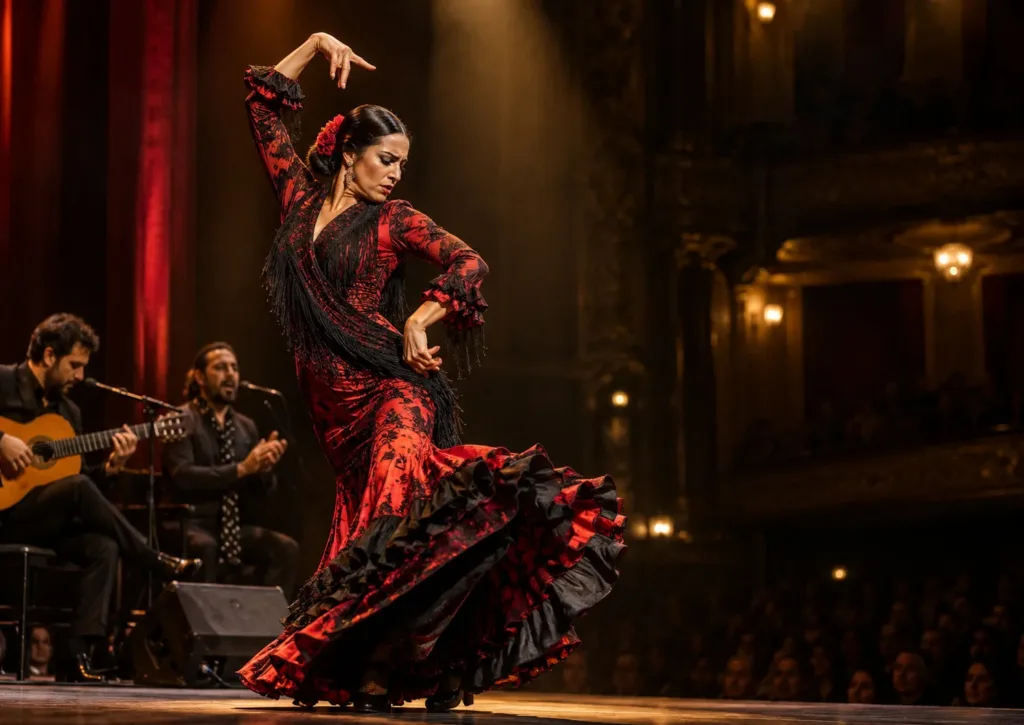
Flamenco Triana | Tablaos Flamencos

Triana and the Seville school of dance

Triana’s contribution is not limited to singing. The neighbourhood is one of the key settings for understanding the evolution of flamenco dance in Seville. Nineteenth-century descriptions place dances there before the professionalisation of the cafés cantantes, and throughout the 20th century the neighbourhood continued to nurture a school with a powerful personality.

An essential figure is Matilde Coral, born in Triana and recognised as one of the great teachers of the Seville school. In various interviews, she explained that the neighbourhood itself taught her to dance: neighbours singing soleares, tangos and sevillanas, children dancing, and a way of living together in which knowledge was passed on naturally.

This helps explain a feature of traditional flamenco: before reaching an academy or a stage, many dance codes were learned through observation. Posture, arm work, the sense of the remate and, above all, the ability to enter and leave the compás were developed by listening to others.

With professionalisation, that knowledge moved into tablaos, companies, academies and theatres. Flamenco today is technically far more complex and scenically diverse, but it still rests on the same principle: dance does not sit on top of the music, it lives within it.

Artists and names linked to Triana’s flamenco memory

A definitive list would be impossible. Triana has produced and welcomed numerous families and performers, while many biographies also cross into other neighbourhoods and towns. Even so, certain names help trace different periods.

La Andonda is linked to the earliest soleares; the Cagancho family occupies a central place in the memory of the Cava; El Titi de Triana became associated with a distinctive form of tangos; Naranjito de Triana carried the neighbourhood’s name into one of the great singing careers of the 20th century; and Matilde Coral turned the Seville school of dance into a language passed on to new generations.

The point is not to turn the neighbourhood into a museum of surnames, but to understand that Triana flamenco was transmitted as a network. Families, neighbours, professional artists and aficionados shared repertoires and ways of doing things. Some names achieved international fame; others remained in the oral memory of those who heard them in patios, celebrations or gatherings.

When Triana changed: rehousing, urban development and dispersal

The Triana that nurtured much of this memory ceased to exist in the same form during the 20th century. Housing deterioration, urban redevelopment and rehousing processes profoundly changed the communal courtyards and the neighbourhood’s social composition. Numerous families, including many Roma families, were moved to other parts of Seville.

This process has also been studied academically as a key episode for understanding how urban planning altered the practice and perception of flamenco in the city. The documentary film Triana pura y pura, directed by Ricardo Pachón, placed that dispersal at the centre of its story and recovered testimonies from people who lived through the period.

It is important, however, to avoid an overly simple interpretation. “Flamenco” did not disappear from one day to the next, nor was everyone affected in the same way. What was broken was a particular community structure: families that had lived close together stopped sharing patios and streets, and part of the informal transmission moved to other neighbourhoods.

Paradoxically, that dispersal also helped carry Triana ways of doing flamenco into new parts of Seville. The city’s flamenco map became broader and more complex.

Where to experience flamenco in Triana today

Today’s visitor will not find the 19th-century Cava, but will find a neighbourhood with a stable professional flamenco offering. The key is to distinguish between flamenco memory, cultural atmosphere and a scheduled performance.

Our recommendation for flamenco in Triana: Baraka Sala Flamenca

The safest option for anyone who wants to hear singing and guitar and see dance on a specific date is to book a scheduled show. For now, this guide recommends Baraka Sala Flamenca, located on Calle Pureza in the heart of Triana.

Baraka Sala Flamenca stands out precisely for its intimate format. The performance takes place in the Lola de los Reyes room, a 48-seat venue where the audience is very close to the artists. Its proposal focuses on the show itself: approximately one hour of flamenco with four performers — singer, guitarist, male dancer and female dancer — plus one drink included. Dinner is not offered, leaving you free to organise the rest of your evening in Triana. Performance times and prices can vary by date, so it is advisable to check availability and book Baraka before going.

If you prefer an intimate format, proximity to the stage is a real advantage: you can notice breathing, cues, palmas and nuances that are lost in larger venues. If this is your first flamenco experience, you do not need to know the palos beforehand. Simply watch how singing, guitar and dance converse with one another.

Peñas, series and celebrations

Triana also retains a flamenco life that goes beyond commercial shows. Peñas, associations, festivals and special programmes may offer recitals or occasional activities. During the Velá de Santa Ana, for example, the neighbourhood strengthens its festive and cultural character.

The Flamenco Biennial has also historically used spaces in Triana and reclaimed the neighbourhood as a symbolic stage in different editions. These are excellent opportunities, but they depend on the calendar and do not replace a stable programme.

What about spontaneous flamenco in bars?

It can happen, but you should not plan a visit on the assumption that it will. The image of walking into any Triana tavern and finding an authentic flamenco juerga every night belongs more to the tourist imagination than to everyday life today. If flamenco is an important part of your trip, book a show and treat any spontaneous encounter as a bonus, not a guarantee.
A flamenco walking route through Triana

A good way to understand the relationship between the neighbourhood and flamenco is to walk through it before the show. There is no need to turn the stroll into an exhaustive monument-by-monument route; a few points are enough to help you read the history.

1. Triana Bridge and Plaza del Altozano

Crossing the Isabel II Bridge from the centre places you immediately in the landscape that has defined the neighbourhood’s identity: the river as both boundary and connection. At the Altozano stands a monument dedicated to flamenco, a good point from which to introduce the relationship between Triana and arte jondo.

2. Triana Market and Castillo de San Jorge

The market shows the continuity of everyday neighbourhood life. Beneath it are the remains of the Castillo de San Jorge, a site that helps reveal other layers of Triana’s history before you continue towards Calle Pureza.

3. Calle Pureza

Pureza brings together some of Triana’s most recognisable symbols and retains a flamenco presence through venues and performance spaces. The street also leads towards Santa Ana, one of the neighbourhood’s historic and religious landmarks.

4. Pagés del Corro and the memory of the Cava

Walking along Pagés del Corro has special meaning if you already know the history of the Cava. The present-day street does not recreate life in the old communal courtyards, but it allows you to locate physically one of the places most frequently cited in flamenco memory.

5. Calle Castilla and the Zurraque area

Towards the northern part of the neighbourhood, other memories emerge that are linked to communal courtyards, pottery and flamenco. The reference to the Zurraque is especially connected with the pottery-makers’ soleares and the memory of a working-class Triana.

6. Calle Betis at sunset

Finishing by the river is an excellent way to end the route before entering a show. Betis offers the most open view of Seville from Triana and concentrates restaurants and some flamenco spaces. After the walk, the tablao stops feeling like an isolated activity and makes sense within the neighbourhood around it.

How to choose a flamenco show in Triana

There is no single “correct” way to see flamenco. A small venue, a flamenco theatre, a tablao or a special programme can offer very different experiences, and all can be valid if the artistic proposal is strong.

Put the show first. If flamenco is your main interest, choose first on the basis of artistic quality and format. Dinner can complete the evening, but it should not be the main criterion.

Book in advance. Intimate venues have limited capacity and the most convenient times can sell out. Booking online avoids travelling there without a guaranteed ticket.

Check what your ticket includes. Some options include a drink, tapas or other services, while others focus exclusively on the performance. Always check the specific description before paying.

Allow plenty of time. Triana invites you to stroll and dine without rushing. Arriving in good time avoids entering after the performance has begun and lets you enjoy the intimacy of the venue more fully.

Do not look for proof of “authenticity” based on clichés. A professional show does not stop being authentic because it has tickets, a timetable or an international audience. Flamenco has also developed on professional stages for more than a century and a half. What matters is artistic respect, the quality of the performers and their ability to create a genuine dialogue between singing, guitar and dance.

If you want more criteria, you can read our guide on how to choose authentic flamenco in Seville and our article on the history of Seville’s cafés cantantes.

Frequently asked questions about flamenco in Triana

Triana is one of flamenco’s great historical centres and its contribution is documented from very early dates, but the genre cannot be attributed to a single neighbourhood. Cádiz, Jerez, Los Puertos, Utrera, Alcalá, Granada and other Andalusian areas were also decisive in its formation.

The soleá of Triana and the tangos of Triana are two of the clearest associations. The neighbourhood’s memory is also linked to tonás, martinetes, debla and different forms of cante passed down in the Cava, communal courtyards and pottery-making settings.

The Cava was a historic name linked to today’s Pagés del Corro and nearby areas. Tradition distinguishes between the Cava de los Gitanos and the Cava de los Civiles. Their communal courtyards and communities form an essential part of the neighbourhood’s social and flamenco memory.

Some venues have a regular programme and others offer performances on certain days or in particular seasons. As times and availability change, the safest option is to check the offering for your specific date and book before going.

In this guide, our current recommendation is Baraka Sala Flamenca on Calle Pureza. You can check its listing on Tablaos Flamencos to see performance times, prices and availability for your chosen date and book online.

It depends on the experience you want. Triana adds historical context and the possibility of combining the show with a walk through one of the neighbourhoods most closely linked to flamenco. Central Seville offers a wider selection of tablaos and times. Quality depends on the venue and artistic cast, not only on the neighbourhood.

It can happen occasionally, but it cannot be guaranteed and should not be the basis of a travel plan. To make sure you see live singing, guitar and dance, book a scheduled performance.

No. Knowing the palos and compás helps you appreciate details, but it is not necessary. A good performance lets you feel the dialogue between the artists and the intensity of the music even if it is your first time seeing flamenco.

Triana is best understood by listening

Triana does not need to remain frozen in a postcard from the past to retain its flamenco importance. Its history lives in the names of its cantes, in the biographies of its artists, in the memory of the Cava, in Seville dance and in the way the neighbourhood continues to claim this heritage.

Walking through Altozano, Pureza, Pagés del Corro, Castilla or Betis provides context. Entering a live flamenco venue afterwards connects that history with the present. Today’s stage is different from a patio or communal courtyard of a century and a half ago, but the principle remains recognisable: someone sings, someone answers on guitar, the dancer listens and the compás organises the conversation.

If you are planning a visit and want to finish your route with live flamenco, you can check availability and book Baraka Sala Flamenca to complete your route through Triana.

Book online: the key to securing your seat

In many cities, flamenco tablaos sell out easily, especially on weekends and during peak season. That’s why, if your dates are set, the most important thing is to book online.

Direct recommendation: book online through our website to guarantee your seat and arrive with everything confirmed. If you already have your destination, go straight to your city to see available options and clear recommendations.

Flamenco Sevilla | Tablaos Flamencos

Seville

Flamenco Madrid | Tablaos Flamencos

Madrid

Flamenco Barcelona | Tablaos Flamencos

Barcelona

Flamenco Granada | Tablaos Flamencos

Granada

Flamenco Córdoba | Tablaos Flamencos

Cordoba

Flamenco Málaga | Tablaos Flamencos

Malaga

Flamenco Valencia | Tablaos Flamencos

Valencia

Flamenco Jerez | Tablaos Flamencos

Jerez

Find out more about this with your favorite AI:

Did you like this article? Share it!:

Tags: flamenco in Seville, Flamenco in Triana, Flamenco tablao in Triana, History of flamenco, Triana neighbourhood

Article published by:

Related articles

Free flamenco in Seville