Flamenco Biennial

The Biennial returns to Hotel Triana: three nights of flamenco in a historic communal courtyard

The Seville Flamenco Biennial 2026 brings back one of the venues most closely linked to its recent history. After four years outside the programme, Hotel Triana will once again open its courtyard to flamenco for three consecutive late-night performances, on 17, 18 and 19 September 2026, always at 11:00 pm.

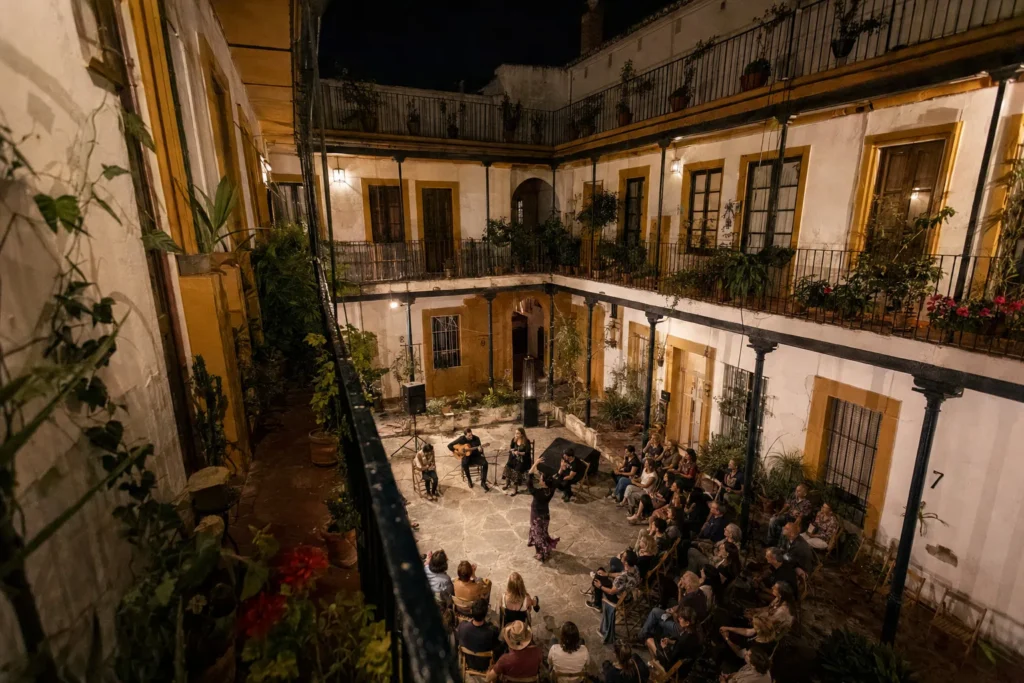
It is neither a conventional theatre nor a working hotel. It is a historic building erected for the 1929 Ibero-American Exposition and later converted into a communal courtyard residence. Its galleries, U-shaped layout and the closeness between artists and audience make every performance an experience that is difficult to recreate at any other Biennial venue.

La Bienal vuelve al Hotel Triana: tres noches de flamenco en un antiguo corral de vecinos

Quick answer: Hotel Triana will host three Unique Nights at the 2026 Biennial: Mujeres gitanas, on 17 September; Uvitas negras, on the 18th; and Andalucía en el tiempo, on the 19th. All three evenings will begin at 11:00 pm and will be devoted, respectively, to Gitano women, the flamenco of Los Palacios and the memory of the cantes of Andalusia’s eight provinces.

Hotel Triana programme at the 2026 Biennial

Date Time Show Featured artists
17 September 11:00 pm Mujeres gitanas Remedios Amaya, Montse Cortés, La Fabi and Josemi Carmona
18 September 11:00 pm Uvitas negras 75th anniversary of the Peña El Pozo de las Penas in Los Palacios
19 September 11:00 pm Andalucía en el tiempo Artists from Andalusia’s eight provinces under the direction of Manuel Curao


All three productions are classified as Unique Nights: encounters created specifically for this edition that will be difficult to see again with the same line-up and in the same setting. You can explore how they fit into the rest of the series in our guide to the Unique Nights of the 2026 Biennial.

Why Hotel Triana’s return is one of the Biennial’s major stories

Hotel Triana is not returning to the programme merely as a picturesque venue. The Biennial has historically used this courtyard to revive a way of experiencing flamenco rooted in neighbourhoods, families, peñas and gatherings that continue late into the night. The last edition to include this venue was in 2022, so its 2026 return comes four years later.

The Biennial’s director, Luis Ybarra, has conceived these evenings as a celebration of authenticity, a meeting point for late-night flamenco and an exercise in remembrance. That idea runs through the entire programme: first, three Gitano women with very different careers; then, three generations of flamenco from Los Palacios; and finally, performers who preserve styles and repertoires associated with different parts of Andalusia.

Hotel Triana’s return also connects with another important revival in 2026: the reopening of the Teatro Lope de Vega. The two venues, however, play opposite yet complementary roles. The Lope offers the grandeur of a historic theatre; Hotel Triana restores the intimate atmosphere of an inhabited courtyard, with the audience gathered around and popular architecture forming part of the stage.

In an edition filled with major productions, premieres and exploratory works, these three nights focus on oral transmission, cante, place and memory. That is what makes them unique.

A former 1929 hotel converted into a communal courtyard residence

The building stands at 28 Calle Clara de Jesús Montero, between that street and Calle Manuel Arellano. It was built between 1927 and 1929 to accommodate visitors during the Ibero-American Exposition, although it never ultimately operated as the hotel for which it had been designed. Over time, it became communal housing and joined Triana’s tradition of corrales de vecinos.

It has three floors, interior galleries and a U-shaped structure around the courtyard. During the 1980s it was renovated with the aim of keeping traditional neighbourhood families there. The property belongs to Seville City Council and remains residential, an important point to remember: Hotel Triana is neither tourist accommodation nor a cultural venue that is permanently open.

That is precisely why performances in its courtyard are exceptional. The architecture is not a set designed to evoke community life; it is the actual architecture of the corral, with its balconies, passageways and domestic proportions. The audience does not merely listen to cante: for a few hours, it enters a place that preserves part of Triana’s social history.

If you would like to discover other distinctive venues in this edition, we have gathered a selection of the most spectacular venues at the 2026 Seville Flamenco Biennial.

17 September: Mujeres gitanas

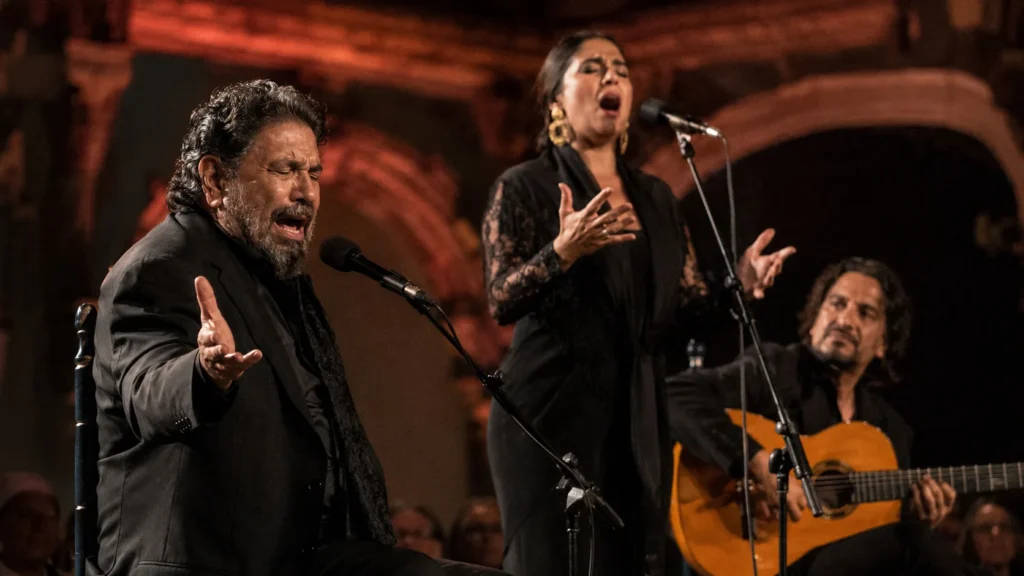
The first night will bring together Remedios Amaya, Montse Cortés and La Fabi, accompanied on guitar by Josemi Carmona. The encounter stems from an idea associated with the flamenco musical La verdad duele and seeks to recover a direct, organic form of expression free of unnecessary elements, with the Gitano woman at the heart of the story.

The three singers represent very different experiences. Remedios Amaya has close ties to Triana and occupies a distinctive place among the great flamenco voices of recent decades. Her cante can move from depth and gravity to a rhythmic energy recognisable from the very first bars.

Montse Cortés brings an interpretive depth developed alongside figures such as Paco de Lucía, Sara Baras and Farruquito. La Fabi, meanwhile, has extensive experience singing for dance and a command of compás that has made her one of the most sought-after voices among leading dancers and companies.

Josemi Carmona will create the musical bridge between tradition and the present. The official listing also includes José Serrano, Israel Gutiérrez “Piraña”, Álvaro Llanos and Los Cherokee. More than a sequence of individual recitals, the night is conceived as an encounter between voices, family memory and different ways of understanding cante.

The concept is especially well suited to Hotel Triana. Speaking about oral transmission and flamenco learned through shared life takes on another meaning in the courtyard of a former communal residence.

18 September: Uvitas negras and the flamenco of Los Palacios

The second evening will celebrate the 75th anniversary of the Peña Flamenca El Pozo de las Penas, a cornerstone of cultural life in Los Palacios y Villafranca. This will be the first time the town joins the Biennial as a guest territory.

The title Uvitas negras refers to the well-known street cry that Manolo Caracol dedicated to grapes from Los Palacios. Taking that reference as its starting point, the show evokes the flamenco gatherings of the peña and brings together several generations of artists connected with the town.

The line-up includes Itoly de Los Palacios, Juan “El Distinguido”, Nene Escalera, Manuel Orta, Miguel Ortega, José Ángel Carmona, Anabel de Vico and Juanelo. The night will also feature one of its most eagerly awaited moments with the return of Juan Manuel “El Mistela” to Seville’s stages as a dancer.

The guitarists will be Niño Fraile, joined by guests Salvador Gutiérrez and Juan Requena. Artistic direction is by Manuel Curao. The aim is not to present a frozen picture of the past, but to show continuity between historic artists, performers at the height of their maturity and younger generations.

Los Palacios has its own flamenco identity and an exceptionally important network of peñas. Uvitas negras will reveal how that identity has been passed down, transformed and kept alive for seven and a half decades.

19 September: Andalucía en el tiempo

The final night will broaden the focus from a single town to Andalusia as a whole. Andalucía en el tiempo will bring together male and female singers associated with the different provinces, many of whom are now removed from the usual circuits or have retired from the stage.

The announced line-up includes El Pecas, from Huelva; Diego “El Boquerón”, from Seville; Carmen de la Jara, from Cádiz; Curro Lucena, from Córdoba; Joselete de Linares, from Jaén; Jaime “El Parrón”, from Granada; Paqui Corpas, from Málaga; and José Sorroche, from Almería. They will also be joined by Romerito de Jerez, a particularly valuable presence because of his age, memory and career.

The guitars of Antonio Carrión and Eduardo Rebollar will accompany a journey through soleás, seguiriyas, tangos, fandangos, malagueñas, abandolaos, mining cantes, cantiñas and bulerías. Manuel Curao once again takes charge of the artistic direction.

The purpose is not to create a rigid catalogue in which each province is reduced to a single palo. The aim is to show the diversity of accents, schools, local variants and ways of expression that make up Andalusia’s flamenco geography. Bringing these artists together in one courtyard makes the night a rare opportunity to hear repertoires and voices that seldom coincide at today’s festivals.

What the late-night experience will be like

All three performances will begin at 11:00 pm. The timing is intentional: Hotel Triana will close the programmes on the 17th, 18th and 19th with an atmosphere unlike that of earlier shows. The late-night concept extends the day’s flamenco conversation and ends it in a setting where closeness matters more than large-scale stage production.

The courtyard and galleries encourage a direct relationship with the sound. Its human scale may recall a gathering or an old flamenco convivencia, although it remains a scheduled and organised performance within the Biennial.

Some nights can also be combined with other performances. On 17 September, Arcángel will appear at 8:00 pm at the Lope de Vega before Mujeres gitanas. On the 18th, Antonio Reyes will present Seis cuerdas, seis at 8:00 pm, also at the Lope, before Uvitas negras. On the 19th, Cañizares and the Royal Seville Symphony Orchestra will begin at 8:00 pm at the Teatro de la Maestranza, three hours before Andalucía en el tiempo.

These combinations require allowing for travel and the time needed to leave each venue. Avoid scheduling activities too tightly or assuming that every performance will end at an exact time.

Practical information: location, tickets and recommendations

  • Venue: Hotel Triana, 28 Calle Clara de Jesús Montero, Seville.
  • Dates: 17, 18 and 19 September 2026.
  • Time: 11:00 pm on all three nights.
  • Programme type: Unique Nights at the 24th Flamenco Biennial.
  • Tickets: sales and availability through the Biennial’s official channels.

With three one-off line-ups and such a distinctive venue, checking availability in advance is advisable. Our guide to tickets, prices and discounts for the 2026 Biennial explains the purchasing channels, announced discounts and recommendations for avoiding resale or unofficial links.

Arrive with time to spare, check the access conditions shown on your ticket and consult the organisers if you need specific information about mobility or accessibility. As this is a residential property opening exceptionally for a cultural event, the instructions of staff and the daily life of its residents must be respected at all times.

The programme and availability may change. Before travelling, always check the official Hotel Triana page on the Biennial website.

Frequently asked questions about Hotel Triana at the 2026 Biennial

Hotel Triana will host performances on 17, 18 and 19 September 2026. All three will begin at 11:00 pm.

On 17 September, the programme will feature Mujeres gitanas; on the 18th, Uvitas negras; and on the 19th, Andalucía en el tiempo. All three are Unique Nights created for the Biennial.

No. Although it was built with the intention of operating as a hotel during the 1929 Ibero-American Exposition, it became a communal courtyard residence instead. Today it is a municipally owned residential building and opens its courtyard only for selected cultural events.

It is at 28 Calle Clara de Jesús Montero in the Triana neighbourhood, between that street and Calle Manuel Arellano.

Tickets must be purchased through the official channels linked from the Flamenco Biennial website. Check there for both availability and any last-minute changes.

The programme presents them as Unique Nights, not world premieres. They are encounters conceived specifically for this edition, with line-ups and content that are not part of a conventional tour.

Yes. On the 17th, 18th and 19th there are earlier performances at other Biennial venues. As Hotel Triana begins at 11:00 pm, some combinations are possible, but you should allow enough time for each show to finish and for travel between venues.

Three nights to hear flamenco’s living memory

Hotel Triana’s return captures an essential part of the 2026 Biennial. Not everything happens in the major theatres, nor does everything have to be presented as a large-scale production. Flamenco is also sustained by families, peñas, local repertoires, artists who have disappeared from the usual circuits and places where living together formed part of the learning process.

Mujeres gitanas, Uvitas negras and Andalucía en el tiempo offer three scales of that memory: family transmission, the identity of a town and the diversity of an entire autonomous community. The old communal courtyard provides the right setting in which to explore them.

Anyone who manages to attend one of these nights will experience more than a concert. They will enter one of the places where the Biennial has forged part of its own identity and where the distance between heritage, neighbourhood and flamenco almost disappears.

If tickets sell out or the dates do not suit your trip, Seville still offers a wide range of flamenco performances every night. Our guide to the 2026 Biennial when tickets are sold out brings together alternatives for continuing to enjoy flamenco during the festival.

Book online: the key to securing your seat

In many cities, flamenco tablaos sell out easily, especially on weekends and during peak season. That’s why, if your dates are set, the most important thing is to book online.

Direct recommendation: book online through our website to guarantee your seat and arrive with everything confirmed. If you already have your destination, go straight to your city to see available options and clear recommendations.

Flamenco Sevilla | Tablaos Flamencos

Seville

Flamenco Madrid | Tablaos Flamencos

Madrid

Flamenco Barcelona | Tablaos Flamencos

Barcelona

Flamenco Granada | Tablaos Flamencos

Granada

Flamenco Córdoba | Tablaos Flamencos

Cordoba

Flamenco Málaga | Tablaos Flamencos

Malaga

Flamenco Valencia | Tablaos Flamencos

Valencia

Flamenco Jerez | Tablaos Flamencos

Jerez

Find out more about this with your favorite AI:

Did you like this article? Share it!:

Tags: agenda flamenca, Bienal 2026, Bienal de Flamenco, festivales flamencos, flamenco en Sevilla, flamenco en Triana, sevilla

Article published by:

Related articles

Flamenco singing at the 2026 Biennial: generations, artists and great voices