History of flamenco

What is flamenco duende: meaning, Lorca and how to recognize it

What is flamenco duende: a word for what technique cannot contain

In flamenco, people speak of duende when a performance stops feeling merely correct, beautiful or virtuosic and takes on an intensity that is difficult to explain. It can happen in singing, dance, a guitar falseta or in the complete dialogue of a flamenco ensemble. The audience senses that something is truly happening in that instant and that it could never be repeated in exactly the same way.

The word has become one of flamenco’s most famous concepts, but also one of the most imprecisely used. Having duende does not mean singing with a rough voice, dancing with a dramatic expression or playing louder. Nor is it a quality that belongs to a single style, place or group. It is a way of naming a moment of presence, risk, emotion and interpretive truth that emerges from a prior foundation of knowledge and craft.

One idea before we continue

Duende cannot be programmed or guaranteed. An artist may master the compás, know a flamenco style in depth and possess extraordinary technique, yet a performance can remain excellent without reaching that exceptional state the flamenco world calls “duende”.

The opposite can also happen: one night, a lyric, a silence, a guitar response or an audience reaction creates a special tension and turns an apparently simple performance into something unforgettable.

Quick answer: flamenco duende is a way of describing those exceptional moments when a performance conveys an intensity, truth and power to move us that go beyond technical execution. Federico García Lorca turned the concept into one of the great metaphors of artistic creation in his lecture Play and Theory of the Duende. It is neither a technique that can be learned nor a manufactured emotion: it arises from a combination of craft, personality, risk, listening and an unrepeatable instant.

What “duende” means in flamenco

In everyday Spanish, “tener duende” means having a special charm or appeal. In flamenco, the expression takes on a more intense meaning: it points to a performance capable of creating an extraordinary emotional experience.

The Royal Spanish Academy specifically records the expression “tener duende” with the meaning of possessing charm or appeal. Flamenco usage starts from that semantic territory but goes further. When an aficionado says that a singer “has duende”, they are not usually saying that the artist is pleasant, elegant or charismatic. They mean a particular ability to make singing, dance or guitar acquire a truth that does not seem reducible to technique.

Duende therefore works as a borderline concept. It gives a name to something that can be clearly perceived but is difficult to measure: the electricity of a perfectly placed silence, the tension of a vocal phrase, an unexpected entrance, a resolution that seems inevitable, a lyric sung as though it had just happened, or an instant when stage and audience seem to breathe together.

The performance does not need to be solemn. Duende can appear in a seguiriya, but also in bulerías. It can be dark, festive, restrained, fierce, intimate or luminous. What matters is not the mood but the quality of presence with which the artist turns a learned language into a living experience.

Federico García Lorca and Play and Theory of the Duende

Federico García Lorca was crucial in taking the word “duende” beyond popular and flamenco vocabulary and turning it into a universal idea about artistic creation. In 1933 he developed the concept in his celebrated lecture Play and Theory of the Duende, developed and delivered during his time in the Americas, with a version prepared in Buenos Aires.

Lorca did not write a technical treatise on flamenco studies. His text is poetic, symbolic and deliberately open. He describes duende as a force that does not arrive from outside but compels the artist to struggle with themselves. In contrast with ease, perfect form or inspiration understood as a gift, duende involves risk, transformation and struggle.

To explain it, Lorca turns to flamenco singers, dancers, musicians, poets and bullfighters. Flamenco occupies a central place because for him it was one of the territories where this tension could become especially visible: body and voice are exposed, time unfolds in front of the audience and the performance can change from one night to the next.

Lorca did not invent the word

It is important to qualify a common cliché: Lorca did not invent flamenco duende. The idea of “having duende” existed before his lecture and circulated in musical and popular settings. What the poet did was take it up, transform it and give it a much broader aesthetic dimension.

Contemporary research on Lorca’s text has examined precisely these precedents and the way the concept eventually became one of the most repeated images used to explain flamenco.

That means it must be used carefully. Duende can be a suggestive tool for talking about performance, but it should not become a magical explanation that replaces history, compás, knowledge of flamenco styles or artistic work. If everything is duende, the word explains nothing.

Duende, technique and inspiration: they are not the same

One of the best ways to understand duende is to distinguish it from other concepts that are often confused with it.

Technique

Technique allows an artist to do what they intend to do. In singing it involves breathing, pitch, knowledge of styles and command of vocal phrases; in dance, the body, compás, coordination and resources; on guitar, rhythmic, sonic and harmonic control. Technique does not guarantee duende, but it expands the possibilities for an artist to take risks without losing the language.

Inspiration

Inspiration is usually described as an idea that appears, a creative solution or an impulse. Duende refers less to the arrival of an idea than to how that idea becomes embodied in the moment of performance. A falseta may have been composed years ago and yet acquire a different force on one particular night.

Emotion

Feeling deeply is not enough to speak of duende. An artist may feel a great deal without managing to communicate it, just as an audience may be moved by a lyric, a personal memory or a melody without that exceptional state necessarily being present. Duende involves emotion transformed into artistic form.

Duende needs a language

Duende is sometimes presented as the opposite of technique: the less academic and more spontaneous an artist is, the more “authentic” they supposedly are. That opposition is misleading.

Great flamenco performers command an enormous amount of knowledge, even when it has been acquired orally rather than academically. They know where the accents fall, what each style demands, how to enter after a falseta, how to sustain a lyric, how to recognize a llamada, how to accompany and how to resolve.

That knowledge can be so deeply internalized that from the outside it looks like instinct. But behind it lie years of listening, practice, memory and living with the language. Precisely because the structure has been absorbed, the artist can alter it, stretch it, suspend it or take risks within it.

Duende does not replace craft. If anything, it appears when craft stops showing itself as visible effort and is placed completely at the service of the performance.

Duende in flamenco singing

In flamenco singing, duende can be felt when the voice stops being merely a vehicle for melody and seems to turn the lyric into a present experience. It does not depend on having a rough, broken or powerful voice. Clean, sweet, metallic, deep and high voices have all been capable of producing that sensation.

It can appear in the way a word is attacked, a phrase is extended or broken, in breathing, restraint or silence. A singer with duende does not necessarily need to add more ornamentation: sometimes it happens precisely when they strip things away and concentrate all attention on a melodic line or a single word.

Duende in flamenco dance

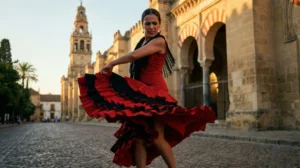
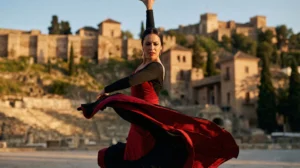
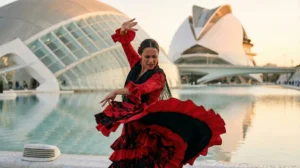
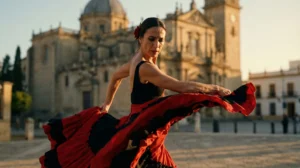
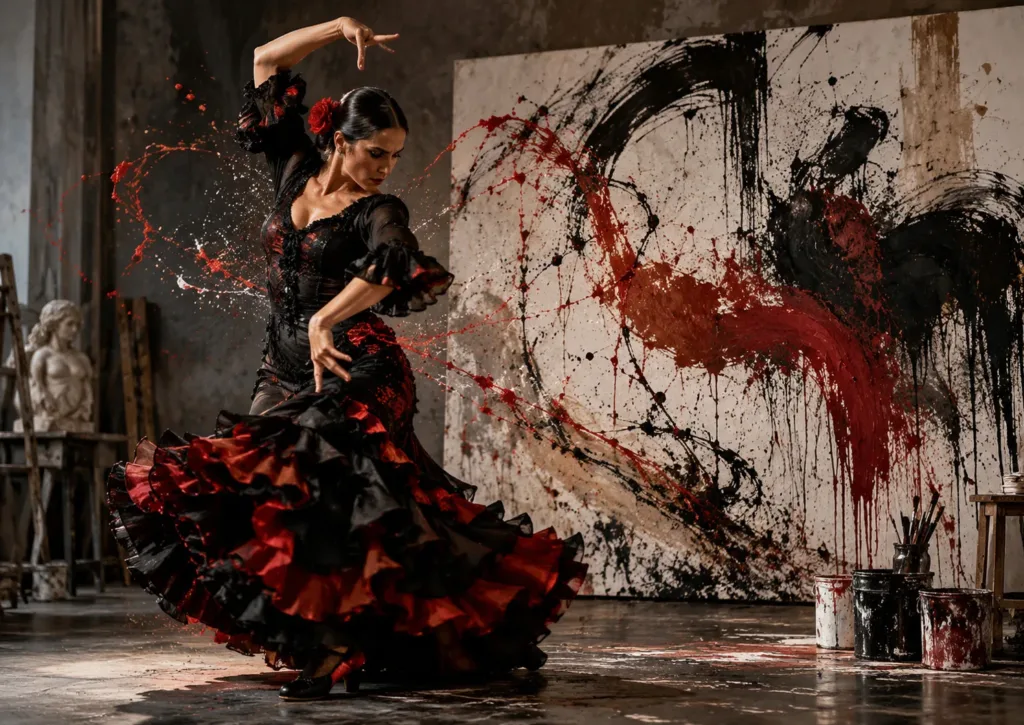
In flamenco dance, duende is not the same as virtuosity either. Extremely fast footwork can be admirable without producing that sensation, while a slow entrance, a pause, a glance or minimal marking can concentrate all the tension on stage.

The key lies in the relationship between body, compás and music. The dancer listens to the singing, responds to the guitar, dialogues with the palmas and manages the space. When all of this comes together with personality and risk, movement stops looking like a learned sequence and becomes stage presence.

Duende in flamenco guitar

The guitar can have duende both in accompaniment and in concert. In accompaniment, it often appears in something almost invisible: knowing how to wait, answering the singer with exactly the right note, holding the compás without invading it or shifting the harmonic weight at precisely the right moment.

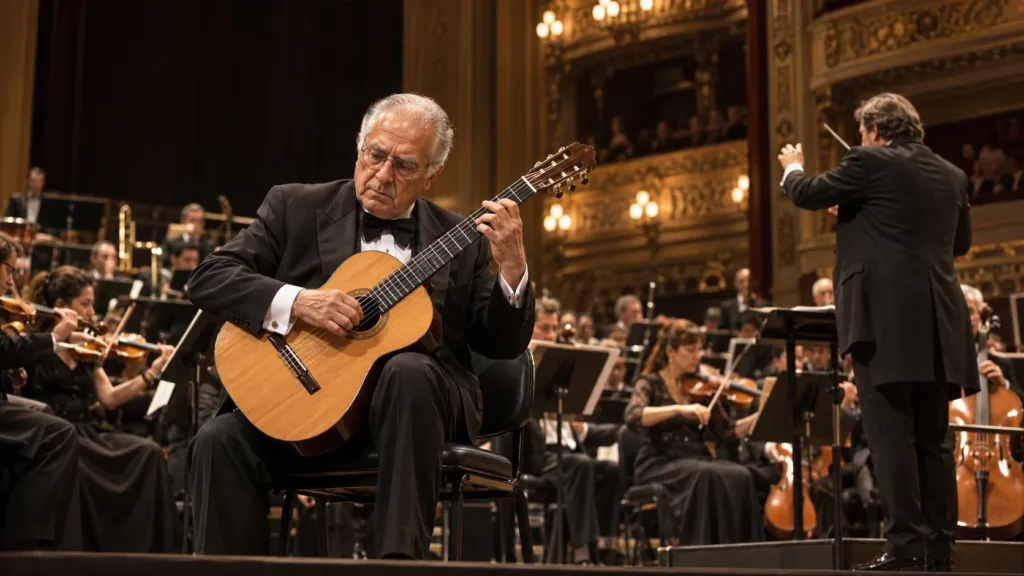
In solo guitar, it can arise when execution stops feeling like display and the falseta seems to breathe. Sound, attack, silence and dynamics matter as much as difficulty. A guitar with personality can say a great deal with very few notes.

Duende can also be collective

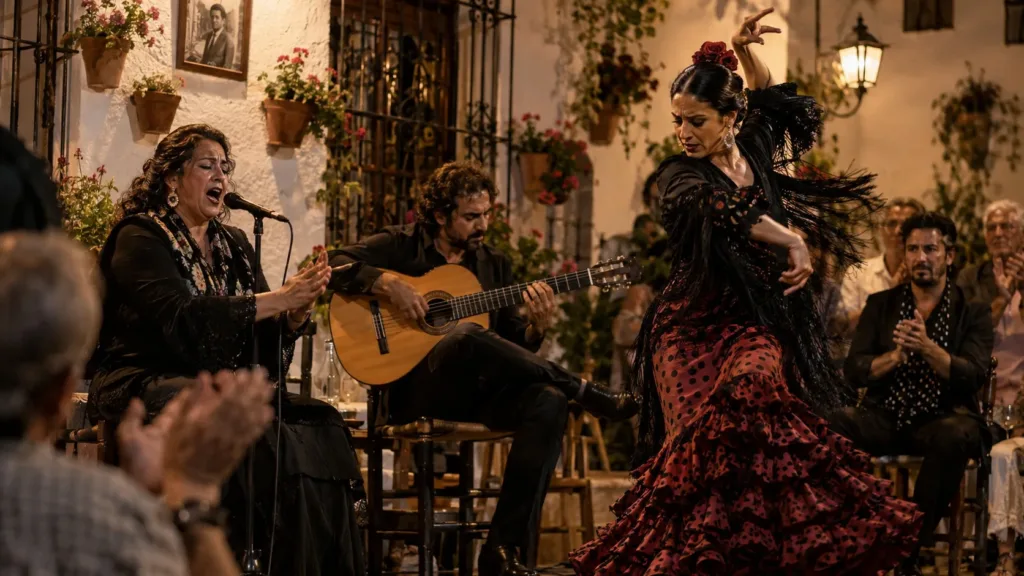
Although we often speak of artists “with duende”, in a flamenco show the exceptional moment can arise from the meeting of several people. A singer proposes an intention, the guitar understands it, the palmas change its energy and the dance responds. No one had planned exactly what has just happened.

This collective quality is essential to understanding why live flamenco can be so different from a recording. The ensemble shares codes that allow improvisation within a structure. When the listening is especially intense, duende seems to belong less to one particular person than to the shared moment.

How can you recognize duende?

There is no objective test, but there are signs that help explain why certain moments are described this way.

  • A sense of the present. The performance feels as though it is truly happening, not merely reproducing something prepared.
  • Risk. The artist allows themselves to stretch time, change an intention, enter less comfortable territory or respond to what is happening.
  • Concentration. A single instant can make the surrounding noise disappear and focus all attention on a voice, a gesture or a sound.
  • Interpretive truth. It does not mean “being natural” in a naive sense, but making the artistic form feel necessary rather than decorative.
  • The collective reaction. Sometimes it is perceived in absolute silence; at other times, in an “olé” that comes just after the exact moment. The audience is also part of the tension.
  • Unrepeatability. The same lyric can be sung again or the same structure danced again, but the specific experience cannot be reproduced identically.

These signs do not form a formula. They are ways of observing a phenomenon that retains part of its power precisely because it cannot be reduced to a checklist.

Can you learn to have duende?

Not in the same way that you learn a scale, a cierre or a choreography. There is no exercise that guarantees duende.

What can be learned is everything that creates the conditions for a profound performance: knowing the repertoire, listening to other artists, understanding the compás, developing personality, mastering the body or instrument, learning to accompany, respecting silence and gaining enough confidence to take risks.

You can also learn not to force emotion. One of the paradoxes of duende is that the harder an artist tries to “look intense”, the easier it is to fall into empty gesture. Depth does not require constant exaggeration.

That is why artistic growth often consists less in seeking duende directly than in building such a solid and personal language that, in certain circumstances, something beyond what was planned can emerge.

Can an artist always have duende?

In everyday speech, someone can be said to “have duende” to indicate a stable quality of charisma or expressive ability. But if we use the concept in its more demanding flamenco sense, duende belongs above all to the moment.

A great artist may consistently give extraordinary performances, but they will not all necessarily have the same intensity. Physical condition, acoustics, repertoire, fellow performers, the audience, the energy in the room and many variables that cannot be fully controlled all play a role.

This does not diminish professional value. On the contrary: technique and experience allow a high level to be sustained even when that exceptional instant does not appear. Duende is the unpredictable extra, not the only measure of quality.

Five clichés about flamenco duende

“It means suffering”

No. Intensity can be tragic, but it can also be festive. A bulería can have as much duende as a soleá.

“It means a broken voice”

No. Vocal timbre does not determine duende. What matters is the interpretation, not a particular vocal texture.

“It means improvising”

Not always. It can appear within a highly worked structure. Improvisation and duende are not synonyms.

“It is something ethnic”

No. Duende is not a biological quality or something exclusive to one people. It is an artistic and cultural concept.

“Older means more duende”

Not that either. The age of a form does not guarantee depth. Duende can appear in a traditional or contemporary proposal.

Duende and “authentic flamenco”

Duende often appears close to another difficult concept: authenticity. It is tempting to think that a performance is authentic if it has duende and false if it does not, but that simplification creates more problems than it solves.

A performance can be rigorously flamenco, respect the style, be well accompanied and possess enormous quality without producing a moment of duende. And a contemporary proposal can start from solid flamenco codes and reach extraordinary intensity even if its aesthetic is not traditional.

Authenticity has to do with the genuine relationship with the flamenco language, not with reproducing a fixed image of the past. Duende, meanwhile, describes the exceptional intensity that can appear within that language.

If you want to explore this distinction further, read our guide to what “authentic flamenco” really means.

Duende in a flamenco tablao

The tablao is one of the places where flamenco’s immediate dimension can be perceived most clearly. The closeness between artists and audience, the intimate size of many venues and the constant communication between singing, guitar, dance and palmas encourage very direct listening.

That does not mean a tablao can “sell duende”. No serious show should promise an artistic state that is, by definition, unpredictable. What it can offer is the setting for flamenco to happen live, up close and with room for interaction.

In a good performance, even someone who does not know the flamenco styles can begin to notice when something special is happening: the musicians look at one another, the dancer’s breathing changes, the audience falls silent or responds at exactly the right point.

How to listen by searching less and perceiving more

If you are going to see flamenco for the first time, you do not need to obsess over “finding duende”. That expectation can make you miss the music.

Listen to the singing, notice how the guitar responds, follow the palmas, watch when the dancer calls or waits, and pay attention to the silences. Little by little you will understand that flamenco is built like a conversation.

Duende, if it appears, does not need to be announced. You recognize it afterwards: because a lyric stays in your memory, because a silence seems longer than it really was, or because for a few seconds the intensity of the entire space changes.

You can discover different places to experience this in our selection of flamenco tablaos in Spain.

Duende beyond flamenco

Lorca’s lecture turned duende into an idea that goes beyond flamenco. The poet connected it with other arts and with a particular way of understanding Spanish creation. Over time, the word has travelled even further and appears in texts about dance, theatre, music, literature, photography and even in languages other than Spanish.

That international success has two sides. On the one hand, it demonstrates the power of the concept: many people recognize the experience of witnessing a work that seems to surpass mere skill. On the other, it can turn duende into an exotic cliché automatically attached to anything “Spanish” or “passionate”.

It is worth bringing it back to concrete ground: duende does not explain an entire culture or replace the analysis of a work. It is a useful metaphor for talking about those moments when technique, presence and risk produce an experience that is difficult to reduce to words.

So what really is flamenco duende?

It is not a mysterious creature, a secret technique or a way of acting. It is the name flamenco has given to the exceptional intensity of certain artistic moments.

Duende appears when a performer knows their language deeply and, at the same time, seems to discover it again in front of the audience. There is structure, but no routine; emotion, but no manufactured sentimentality; technique, but no display; personality, but also listening.

Federico García Lorca helped turn that experience into a great artistic metaphor. His text remains fascinating because it does not try to close the concept with a scientific definition. He presents it as struggle and transformation.

Perhaps that is also the best way to understand it today. Duende is not something you possess like a tool: it is something that happens. And when it happens, a performance stops being only music or dance and becomes, for a few minutes, a shared experience that is difficult to forget.

Frequently asked questions about flamenco duende

It is a way of describing an exceptional moment of intensity, truth and emotional power in a flamenco performance. It is not a specific technique or a flamenco style, but a quality perceived in certain moments of singing, dance, guitar or collective performance.

Federico García Lorca did not invent the word or the expression “tener duende”. The term was already circulating in popular and musical usage. Lorca turned it into a major metaphor for artistic creation in his lecture Play and Theory of the Duende, developed in 1933.

Lorca presented it as a force that demands inner struggle, risk and transformation. He distinguished it from other forms of inspiration and used numerous examples from flamenco, music, dance, poetry and other arts to show how a performance can go beyond mere technical correctness.

There is no technique for learning “duende” directly. What can be developed are the conditions that support a profound performance: command of the language, compás, listening, personality, experience, accompaniment skills, technical control and freedom to take risks.

No. Duende is not the same as sadness or suffering. It can appear in dramatic flamenco styles, but also in festive and luminous ones. What matters is the intensity and truth of the performance, not the specific emotion being expressed.

No. People speak of duende in singing, dance and guitar, and it can also emerge from the dialogue of an entire flamenco ensemble. It can even be perceived as a collective quality created by the interaction between several artists and the audience.

Not necessarily. Technique allows an artist to control the language and take risks, but it does not guarantee an exceptional performance. Likewise, lack of technique does not produce duende by itself. In flamenco, depth and craft usually support one another.

Yes. Duende does not depend on a proposal being old or traditional. It can appear in a classical or contemporary performance whenever there is a solid relationship with the artistic language and genuine intensity in the interpretation.

Book online: the key to securing your seat

In many cities, flamenco tablaos sell out easily, especially on weekends and during peak season. That’s why, if your dates are set, the most important thing is to book online.

Direct recommendation: book online through our website to guarantee your seat and arrive with everything confirmed. If you already have your destination, go straight to your city to see available options and clear recommendations.

Flamenco Sevilla | Tablaos Flamencos

Seville

Flamenco Madrid | Tablaos Flamencos

Madrid

Flamenco Barcelona | Tablaos Flamencos

Barcelona

Flamenco Granada | Tablaos Flamencos

Granada

Flamenco Córdoba | Tablaos Flamencos

Cordoba

Flamenco Málaga | Tablaos Flamencos

Malaga

Flamenco Valencia | Tablaos Flamencos

Valencia

Flamenco Jerez | Tablaos Flamencos

Jerez

Find out more about this with your favorite AI:

Did you like this article? Share it!:

Tags: History of flamenco, What is flamenco

Article published by:

Related articles

Seville’s vanished flamenco tablaos: venues that form part of its history
Flamenco and painting: when dance also becomes visual art