History of flamenco

What “Authentic Flamenco” Really Means

A widely used phrase that is rarely explained

The expression “authentic flamenco” appears on posters and in festivals, academies, tablaos, flamenco clubs and tourist brochures. At first glance, it seems like a simple guarantee: it promises “real” flamenco. Yet the more the word authentic, is used, the more necessary it becomes to ask what it actually means and who gets to decide.

Flamenco is not an antique object that must be preserved unchanged, nor a fixed scene that can be copied every night. It is a living artistic language, built through transmission, knowledge of rhythm, memory, the personality of its performers and the relationship created in each performance. Authenticity therefore does not depend on reproducing a picturesque image, but on maintaining an honest and skilled relationship with that language.

The essential idea

Authentic flamenco does not have to be old, improvised, humble, minority or incomprehensible to a first-time listener. It can be found in a flamenco club, a tablao, a theatre, a square, a festival or a contemporary work.

What matters is the presence of flamenco knowledge, artistic intention and interpretive truth: that singing, guitar playing, dance and rhythm are not mere decoration; that the artists understand the codes they use; and that the work does not pretend to be something it is not.

Tradition provides the language. Each performer decides what to say with it.

Quick answer: “Authentic flamenco” means a performance genuinely connected to the flamenco language: its rhythms, styles, forms of accompaniment, cultural memory and ways in which artists communicate. It does not require copying the past or rejecting professional venues. It may be traditional or innovative, intimate or large-scale. Authenticity lies in knowledge, listening, intention and the coherence of the artistic proposal—not in the clichés surrounding it.

An important distinction

This article answers a cultural question: what we mean when we call flamenco authentic. It is not intended to recommend a particular city, neighbourhood or venue.

If you want to turn these ideas into a practical decision, our guide to where to see authentic flamenco in Seville explains how to compare formats, venues and conditions before booking. Separating these two intentions lets us explore the concept here without turning the article into a list of establishments.

What “authentic flamenco” really means

Authenticity is neither a particular musical style nor an official label. Nor is there a single authority that can certify it. In flamenco, the word usually brings together four related ideas.

Knowledge

Performers know the genre’s codes: rhythm, the structure of the palos, cues, endings, the relationship between lyrics and melody, and the possibilities of accompaniment. That knowledge may come from family transmission, artistic coexistence, formal study or a combination of paths. What matters is not presenting a particular biography, but mastering the language brought to the stage.

Continuity

The artistic proposal maintains a recognisable connection with flamenco tradition. This does not mean imitating an old recording, but understanding where the forms being used come from and how they have been passed down. Continuity makes transformation possible without erasing the starting point.

Interpretive truth

The performance has intention and presence. The artists do more than reproduce gestures associated with flamenco: they make musical and stage decisions that make sense within the work. Emotion may be restrained or explosive, but it need not be exaggerated to prove that it exists.

Coherence

A show is honest when it delivers what it promises. An avant-garde creation can be presented as such; so can a traditional recital. The problem is not mixing languages, using lighting or performing for an international audience. The problem arises when aesthetics entirely replace substance and something that barely retains flamenco’s codes is sold as flamenco.

In short, authenticity is not about looking old. It means that the form, content and way they are performed maintain a true relationship with flamenco.

Flamenco tradition is not a museum piece

Tradition is often confused with an obligation to repeat. In reality, a cultural tradition exists because it is transmitted and because each generation gives it new shape. If it remained completely still, it would cease to respond to the lives of those who practise it.

Flamenco has developed through encounters, movement, inherited repertoires, creative personalities and changing professional contexts. It has neither a single date of birth nor one line of origin. Its history is deeply connected to Andalusia, with a fundamental contribution from the Andalusian Roma people and roots and developments also shared with regions such as Murcia and Extremadura.

UNESCO inscribed flamenco in 2010 on the Representative List of the Intangible Cultural Heritage of Humanity. The concept of intangible heritage is especially useful: it protects not an object, but knowledge, practices and forms of expression that communities recognise, transmit and recreate.

Heritage does not mean blind obedience

Every artist receives earlier materials: rhythms, melodies, lyrics, technical resources, ways of accompanying and reference points. But transmission has never been a perfect photocopy. Even within the same palo, local, personal and generational variations emerge.

The Regional Government of Andalusia captures this dual character by presenting flamenco as past, present and future, tradition and avant-garde. This is not a contradiction. A living culture can preserve memory and produce something new at the same time.

That is why asking whether a work is authentic requires more precision than asking whether it is “like it used to be”. We should look at whether it understands what it transforms and whether that transformation comes from an artistic need, not merely a commercial appearance.

The language that sustains authenticity

Talking about authenticity without talking about language easily leads to clichés. Flamenco has forms, rhythms and internal relationships that allow performers to understand one another.

Compás

Compás is not simply a matter of counting beats. It organises accents, silences, entries, finishes and expectations. It allows a singer, guitarist, dancer and palmeros to know where they are, even when the performance changes in the moment.

Not all palos are structured in the same way, and some singing styles are treated more freely. Even so, a sense of time, breath and structure remains essential. Compás can be felt clearly without becoming constant percussion.

Singing, guitar playing and dance

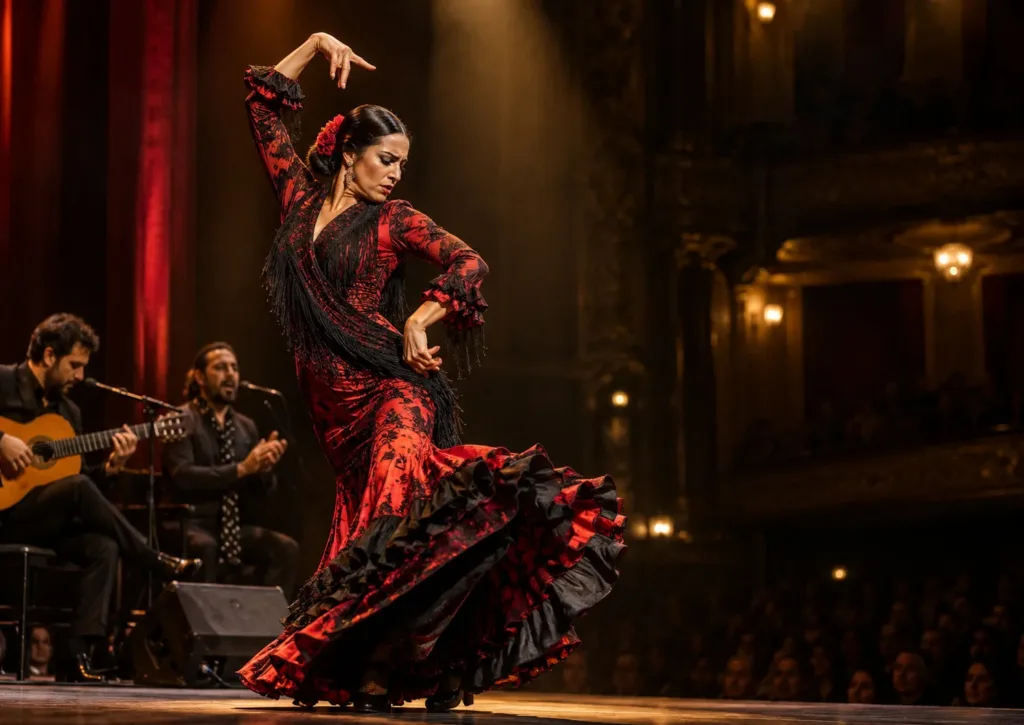
The singing is not a soundtrack for the dance; the guitar playing is not limited to background accompaniment; and the dance is not simply a sequence of showy steps. In a genuine flamenco relationship, each part listens and responds to the others.

The guitar prepares, supports, comments or answers. The singing proposes a melody, lyrics and intensity. The dance may call, wait, mark, challenge or close. Handclaps and jaleos help build the architecture of the moment.

A show does not always need to include the same disciplines or number of artists. Authenticity is not a fixed template. It lies in understanding the role each element plays and the quality of communication between them. Our flamenco glossary will help you become familiar with many of these terms.

Preparation, improvisation and spontaneity

One of the most persistent myths claims that flamenco is authentic only when it arises without rehearsal. The artistic reality is more interesting. A performance can be prepared while retaining ample room for decision.

In a tablao there is usually an order of appearance, an expected duration and certain shared structures. That does not make the show mechanical. The chosen lyrics, a falseta, the length of an escobilla, the response to a cue, the character of a silence or the audience’s energy can change what happens.

Flamenco improvisation does not arise from an absence of rules, but from knowing them so well that performers can act within them in real time. Craft creates freedom.

Spontaneity also needs context

A private gathering can produce an unrepeatable moment, but spontaneity and authenticity are not synonyms. Something spontaneous can be superficial; something carefully prepared can be deeply true.

Another confusion should also be avoided: travellers cannot demand access to the intimacy of a family, community or artists’ gathering in order to obtain a “more authentic” experience. Those situations are not tourist products. Professional venues offer another legitimate relationship: artists at work, an audience listening and a framework created for sharing staged flamenco.

Respecting that difference is a way to approach flamenco without turning the private lives of its communities into an attraction.

Can contemporary flamenco be authentic?

Yes. Being contemporary does not invalidate authenticity, just as using a theatre, stage design or new technologies does not automatically erase flamenco. The right question is not whether the work looks modern, but how it relates to the language it transforms.

A work can engage with contemporary dance, jazz, electronic music, poetry or the visual arts while maintaining a strong flamenco identity. The opposite can also happen: a production full of ruffles, polka dots and guitars may use the outward symbols without building a consistent flamenco discourse.

Rooted innovation does not ask the past for permission, but it knows the past. When creators understand the materials and modify them with intention, their work can expand the tradition instead of abandoning it.

And what about more traditional flamenco?

Choosing traditional forms does not in itself guarantee an authentic performance. Repeating familiar lyrics or dressing in a certain way is no substitute for listening, compás or personality.

A classical singing recital can feel radically alive when the performer makes the repertoire their own. Likewise, a dance built on recognisable structures can feel new through the way it inhabits time, relates to the guitar or resolves an ending.

Tradition and creation are not opposite ends of a spectrum. Tradition provides a field of possibilities; creation decides how to explore it. To learn about the different families and structures, see our guide to flamenco palos.

Tablao, flamenco club, theatre or festival: the venue does not confer authenticity

No space has an exclusive claim to “real” flamenco. Each format creates different conditions.

A flamenco club grows out of organised afición and can support transmission, specialist listening and local programming. A tablao provides professional continuity, closeness to the stage and regular work for artists. A theatre makes it possible to develop larger-scale works. A festival can bring together research, memory, leading figures and new generations.

Any of these places can host a performance that is exceptional, routine, daring or unsuccessful. The name of the venue does not determine the outcome.

A tourist audience does not determine quality either

A show aimed at visitors is not therefore false. Artists do not lose their knowledge because some of the audience come from other countries. In fact, tablaos have for decades been places of work, learning, encounter and artistic development.

What matters is whether flamenco is at the centre of the experience or used as mere decoration. An accessible presentation can help a new audience without simplifying the art until it becomes empty. Explaining is not diminishing; becoming professional is not falsifying; selling tickets is not betraying a tradition.

When the practical aim is to choose a show, consider the format, the prominence of live performance, visibility and the information provided. You can compare options in our selection of flamenco tablaos in Spain.

What does not prove that flamenco is authentic

Common idea Why it is not enough What to look for
“There are no tourists” The audience’s origin does not change the artists’ knowledge. Quality of performance, listening and the central role of the show.
“The venue is very small” Intimacy can help, but it does not guarantee acoustics, visibility or artistry. Actual listening conditions and the relationship with the stage.
“Everything is improvised” Flamenco combines familiar structures with decisions made in the moment. Responsiveness within the compás.
“There is no production” Good lighting or professional organisation do not make a performance less genuine. Whether the production serves the work or tries to hide its weakness.
“It is old” Age does not ensure that a performance is alive. Understanding, personality and a present-day sense of the repertoire.
“It creates duende” Duende is a poetic image, not a measurable certificate. Presence, artistic tension and communication, without demanding a particular emotion.

How can a beginner recognise it?

You do not need to identify every palo to sense a genuine artistic relationship. A viewer without formal training can look for simple signs:

  • The performers listen to and look at one another, rather than appearing to perform in separate worlds.
  • The guitar changes with the singing or dancing instead of functioning as an identical backing track.
  • Silences, pauses and restrained moments matter.
  • The handclaps support the music rather than serving as constant decoration.
  • Virtuosity serves an intention instead of becoming a succession of tricks.
  • The show conveys a coherent identity, even if the viewer does not know its rules.

These signs are not a mathematical test. A performance may be restrained, festive, raw, elegant, experimental or popular. Authenticity allows for more than one aesthetic.

Listen before judging

Flamenco is often approached with expectations learned from film, advertising or social media. Some people expect constant speed; others, solemn pain; others, red dresses and castanets. When the real stage does not match that image, they may think that “something is missing”.

Approaching it attentively means accepting that flamenco contains many characters. There are festive and solemn palos, singing styles with a marked compás and others treated freely, stripped-back works and major productions. They do not all seek the same effect.

A good first listen is not about guessing names, but perceiving relationships: who proposes, who responds, when the tension rises, why a silence arrives and how the ending is built. Understanding those connections transforms the experience.

Authenticity also means respect

The discussion should not be limited to sound. Authentic flamenco is part of a culture and a professional sector. Presenting it respectfully means acknowledging the artists, caring for their working conditions, avoiding turning entire communities into stereotypes and giving the audience clear information.

It also means understanding that performers are not obliged to display suffering, intimacy or a particular biography to prove their truth. Artistic authority comes from their work and knowledge, not from fitting a romantic image of poverty, marginality or mystery.

Defending authenticity cannot be used to deny professionalisation. Being paid to perform, rehearsing, producing a work, using stage techniques or addressing new audiences are legitimate parts of cultural activity.

A useful word when used precisely

“Authentic” can be an empty word when it merely accompanies a commercial promise. But it can also name something important: the difference between using flamenco as decoration and treating it as a language with history, rules, memory and the capacity to change.

To use it rigorously, absolute claims should be replaced with concrete questions. Who is performing? What relationship exists between the disciplines? Does the work understand the codes it uses? Is the traditional element alive or merely imitated? Does innovation arise from study? Does the space protect listening? Is the communication transparent?

The more precise the description, the less need there is to keep repeating that something is “authentic”. Authenticity is ultimately perceived in the details.

Authentic flamenco is living flamenco

Authentic flamenco is not a motionless copy of the past or a secret experience reserved for specialists. It is a living practice that preserves memory, masters its codes and allows each artist to build a voice of their own.

It can happen in a flamenco club or a major theatre, before seasoned aficionados or first-time listeners. It may respect a traditional form or open a conversation with other languages. What it cannot lose is a conscious relationship with what makes it flamenco.

The best way to approach it is to listen without clichés: pay attention to compás, communication and the truth of the performance. Each viewer can then discover which way of experiencing flamenco speaks to them most powerfully.

Frequently asked questions about authentic flamenco

It means that the performance maintains a genuine, conscious relationship with the flamenco language: its rhythms, palos, forms of accompaniment, cultural memory and communication between artists. It does not depend on an old-fashioned aesthetic or a particular venue.

Not necessarily. A traditional proposal can be authentic, but so can a contemporary creation that understands flamenco’s codes and transforms them with artistic intention. Tradition and innovation are not incompatible.

Yes. The audience’s origin does not determine quality. A tablao can offer authentic flamenco when it works with professional artists, puts live performance at the centre and creates good listening conditions.

No. Flamenco clubs fulfil an essential cultural role and tablaos sustain important professional activity, but no format guarantees the artistic outcome by itself. Authenticity depends on what happens in the performance.

No. Flamenco combines preparation, shared structures and decisions made in the moment. Improvisation arises from mastery of its codes, not from the absence of rehearsal or rules.

No. These elements may contribute to the experience, but they do not certify artistic quality. Look instead at compás, performance, how artists listen to one another and the coherence of the proposal.

Compás organises accents, silences, cues and endings, allowing singing, guitar, dance and handclaps to communicate. Not all palos display it in the same way, but a sense of time and structure is fundamental.

Yes. You do not need to be an expert. Listening to different palos, observing how performers relate to one another and learning basic concepts helps distinguish a solid flamenco proposal from an atmosphere based only on clichés.

Andalusia is its main historic territory and the Andalusian Roma people have made a fundamental contribution, although flamenco also has roots and developments linked to Murcia and Extremadura and is now performed internationally. Geography matters as memory, but it is not an absolute artistic boundary.

Because flamenco is a living, plural and changing tradition. There is no single aesthetic and no authority capable of certifying every proposal. The definition must consider knowledge, continuity, interpretive truth and coherence.

Book online: the key to securing your seat

In many cities, flamenco tablaos sell out easily, especially on weekends and during peak season. That’s why, if your dates are set, the most important thing is to book online.

Direct recommendation: book online through our website to guarantee your seat and arrive with everything confirmed. If you already have your destination, go straight to your city to see available options and clear recommendations.

Flamenco Sevilla | Tablaos Flamencos

Seville

Flamenco Madrid | Tablaos Flamencos

Madrid

Flamenco Barcelona | Tablaos Flamencos

Barcelona

Flamenco Granada | Tablaos Flamencos

Granada

Flamenco Córdoba | Tablaos Flamencos

Cordoba

Flamenco Málaga | Tablaos Flamencos

Malaga

Flamenco Valencia | Tablaos Flamencos

Valencia

Flamenco Jerez | Tablaos Flamencos

Jerez

Find out more about this with your favorite AI:

Did you like this article? Share it!:

Tags: authentic flamenco, flamenco culture, flamenco dance, flamenco guitar, flamenco singing, flamenco tradition, Intangible Cultural Heritage

Article published by:

Related articles

Cafés cantantes in Seville: history, venues and their role in the development of flamenco