Flamenco guides

How to tell if a flamenco show is authentic

How to recognize a good flamenco show without being misled by labels

The word “authentic” appears constantly on booking pages, posters and tourist descriptions. But a label proves nothing by itself. A flamenco show can be professional, well produced, attract an international audience and still be deeply rooted in flamenco. The opposite can also happen: a very traditional-looking aesthetic may hide a weak or superficial proposal.

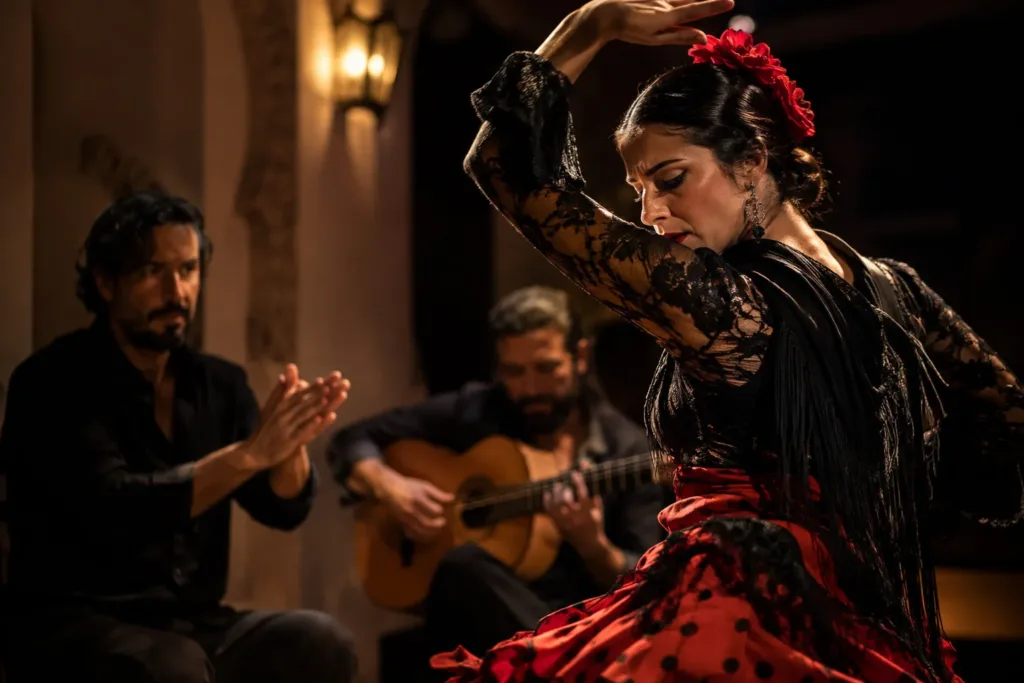
The most useful way to tell whether a flamenco show is authentic is to observe how the singing, guitar, dance, palmas and compás relate to one another, what information the venue provides before you book, and whether the performance truly remains at the center of the experience.

Quick answer: a flamenco show is more trustworthy when the singing, guitar and dance are performed live, the artists listen and respond to one another, there is a clear command of compás, the staging supports rather than replaces the performance, and the venue clearly explains what the experience includes. Authenticity does not depend on the venue being small, hidden away, free of tourists or made to look old.

This guide answers a practical question

This article is not intended to define philosophically what “authentic flamenco” means. For that question, we have a specific guide on what “authentic flamenco” really means.

The aim here is different: to help you evaluate a specific performance before buying a ticket and while watching the show. And if you are looking for local recommendations, our guide to where to see authentic flamenco in Seville applies these criteria to a specific city.

What to check before booking a flamenco show

Authenticity cannot be fully verified from a sales page, but there are advance signs that can help you rule out unclear or questionable offers.

The description mentions artists and disciplines

A serious listing explains whether there will be singing, guitar, dance, palmas or percussion, although it may not always publish the exact cast weeks in advance. Tablaos often work with rotating line-ups, and that is normal. What matters is that it is clear there will be a real performance rather than simply “flamenco atmosphere”.

The duration is stated

A professional show usually gives an approximate duration. There is no single length that guarantees quality, but descriptions that are excessively vague deserve caution. Knowing how long the performance lasts helps distinguish stage time from a possible dinner, cocktail or additional activity.

The ticket explains what is included

Show only, a drink, tapas or dinner are all perfectly legitimate formats. The problem arises when an offer mixes concepts without making clear how much time is actually devoted to the performance.

The offer is not sold only through clichés

Words such as “pure”, “secret”, “no tourists”, “Gypsy”, “traditional” or “authentic” may appear in a description, but they should not replace concrete information. A good operator should explain what the performance is like instead of merely promising a mysterious experience.

There is information about the venue

Visibility, layout, proximity to the stage, accessibility and recommended arrival time all affect the experience. A venue that pays attention to these details usually shows that it understands the performance as something that must be seen and heard properly.

The booking is presented transparently

Purchase conditions, policies for children, access and possible differences between seating areas should be clear. This does not prove artistic quality, but it does show professionalism. And professionalism does not reduce authenticity: it creates the conditions artists need to work well.

First sign: the flamenco is happening live

In the classic tablao format, the singing and guitar should be performed live. This allows the performance to breathe and each artist to respond to what is happening on stage.

A recorded guitar cannot change a falseta because the dancer extends a llamada. A fixed backing track cannot adjust its intensity when a singer delivers a verse differently that night. Live music makes flamenco dialogue possible.

That does not mean a contemporary creation cannot use electronics, recordings or sound design. It can. The difference is whether those elements are a conscious part of the work or whether they are being used to replace the live performance the audience believes it is seeing.

For a first experience in a tablao, the simplest reference point is this: you should be able to identify artists genuinely playing, singing and dancing on stage.

Live performance does not mean chaos or lack of structure

A common mistake is to think that anything authentic must be improvised. A show can have a set running order, a defined duration and prepared moments without becoming a mechanical reproduction.

The artists know shared structures, compases and resources. That foundation allows them to make decisions during the show: change a lyric, extend a falseta, adjust an escobilla, anticipate a cierre or respond to a different energy.

Flamenco spontaneity comes from craft. The greater the shared knowledge, the more freedom there is to alter the development without losing the form.

So do not look for disorder as proof of authenticity. Look for the ability to adapt within a recognizable structure.

One of the best clues for someone who does not yet know the flamenco palos is to observe the attention between the performers.

Watch how the guitar accompanies the singing. Notice whether the dancer waits for a phrase before entering. Look at the glances, llamadas, changes in intensity, silences and cierres. The communication may be very visible or almost imperceptible, but it should be there.

In a strong performance, each discipline has autonomy while also forming part of a shared architecture. The guitar is not a fixed soundtrack. The singing is not simply music to dance over. The dance is not merely a sequence of steps placed on top of a backing.

Listening can also be heard in the silences

People seeing flamenco for the first time may expect constant intensity. Yet some of the most revealing moments are precisely those in which less happens.

A pause before an entrance, a guitar lowering its volume, a breath before a lyric or a break in the dance can hold as much tension as a spectacular remate.

When everyone seems to need to fill every second with speed, palmas, footwork and virtuosity, it is worth asking whether the show is leaving room for the language or merely trying to impress.

Flamenco can be explosive, but it also needs contrast. The ability to listen and wait is a sign of craft.

Third sign: compás supports what is happening

You do not need to know how to count a soleá or a bulería to notice that a rhythmic structure exists. Compás organizes accents, entrances, cierres and relationships between the artists.

Palmas are especially useful to observe. When they are done well, they do not function as background noise or permanent applause. They support the music, create tension and help shape the changes.

There are also more freely treated forms of cante, so not everything should sound rhythmically the same. The key is for each style to have internal coherence and for the artists to share the same sense of time.

If you would like to go deeper, our guide to the flamenco palos helps explain the different families and structures.

Improvising does not mean doing just anything

In flamenco, improvising means making decisions within a known language. A dance llamada makes sense because the accompanists recognize its function. A cierre works because everyone shares a rhythmic and structural reference.

That knowledge allows the show to change without falling apart.

So authenticity does not depend on every minute being new. What matters is that there is room for interpretation and response. The same structure can produce very different performances depending on the artists, the energy, the chosen lyric and the way they communicate.

The useful question is not “is everything improvised?”, but “are the artists genuinely reacting to one another?”.

Fourth sign: the staging serves the flamenco

Good lighting, a carefully designed stage, professional sound or spectacular architecture do not make flamenco less authentic.

The right question is whether those elements help you listen and watch or whether they are trying to replace the artistic content.

A tablao can use understated or sophisticated production. A theater can develop a work with dramaturgy, video and scenography. Both formats can be fully flamenco.

Be more cautious when the experience relies almost entirely on sets, costumes, effects, clichés or promotional photos without explaining what is happening musically.

The size of the venue is not a certificate either

Small venues offer proximity and can create great intensity, but they are not automatically better. A poor layout can make the dance hard to see; weak acoustics can harm the singing; an excessively cramped room can reduce comfort.

A larger venue can also offer good visibility, a well-proportioned stage and excellent listening conditions.

Do not turn intimacy into an absolute rule. Assess distance, viewing angle, acoustics, audience behavior and the prominence of the stage.

In our selection of flamenco tablaos you can compare different formats and cities.

Five things that do NOT prove a show is authentic

Apparent sign Why it is not enough What to look at instead
“There are no tourists” The origin of the audience does not change the artists’ knowledge. Quality of the live performance, listening and stage focus.
“It is in a historic neighborhood” Geography provides context, but it does not guarantee the artistic result. Programming, artists and venue conditions.
“It is very small” Intimacy helps, but visibility or acoustics may still be poor. The real relationship between stage and audience.
“There is no dinner or production” Food and professional production do not make flamenco fake. Whether the service respects the show and the production does not cover up the content.
“Everything looks old” Costumes and decoration can reproduce an aesthetic without musical depth. Compás, interpretation, communication and knowledge.

What to watch during the show if it is your first time

You do not need to become an expert to assess a performance. You can watch for simple signs.

  • The artists look at one another: there is communication and shared attention.
  • The guitar changes: it accompanies what is happening instead of repeating the same pattern.
  • The singing has a central role: it is not reduced to a soundtrack.
  • The palmas have a purpose: they support the compás and the changes.
  • The dance listens: it does not look like choreography isolated from everything else.
  • There are contrasts: speed, silence, tension and pause coexist.
  • Virtuosity has a purpose: technical resources build the interpretation.
  • The performance feels alive: there is a sense that the artists are sharing something in that moment.

Do not look for a mandatory emotional response

Another common mistake is to think that authentic flamenco must always cause an immediate emotional shock. Not every show, palo or artist seeks the same effect.

You may encounter a festive piece, a restrained interpretation, a rough-edged cante, an elegant proposal or a highly powerful dance. Emotion also depends on the sensitivity and experience of the listener.

Do not use as your only criterion whether you cried, whether the audience shouted a lot or whether you felt something “mystical”. Those reactions may exist, but they are not technical proof.

First observe the quality of the artistic relationship. Then let the experience affect you in whatever way it does.

Can a tourist-oriented show be authentic?

Yes. “Tourist-oriented” often describes the audience or sales channel, not the artistic content. A tablao can welcome people from many countries every night while working with professional flamenco artists.

The key is whether the show adapts to visitors through explanations and accessible organization, or whether it is simplified until flamenco becomes a caricature.

Explaining how long the show lasts, making booking easy or offering information in several languages does not diminish the art. In fact, it helps new audiences approach it with greater attention.

The problem is not that there are tourists. The problem would be if flamenco stopped being the center of the proposal.

And is a peña always more authentic?

No. Flamenco peñas play an extremely important cultural role and can offer extraordinary recitals. Their atmosphere, the presence of knowledgeable aficionados and the closeness can be very special.

But the format alone does not guarantee the result. A tablao can offer an unforgettable night and a peña a routine performance, or the other way around.

Each space has a different function. What matters is evaluating the specific content and conditions, not turning the name of the venue into an automatic hierarchy.

For a traveler with only a few days, a tablao usually offers greater regularity and easier booking. For an aficionado who can adapt their schedule, a peña or festival can broaden the experience considerably.

Checklist to decide whether it is worth booking

  1. Does the listing clearly explain what kind of show you will see?
  2. Will there be live singing, guitar and/or dance?
  3. Is the duration of the performance stated?
  4. Do you know exactly what the ticket includes?
  5. Does the venue provide information about visibility or seating areas?
  6. Does the description talk about the show itself, not only decoration, food or clichés?
  7. Are the booking conditions transparent?
  8. Do the schedule and location allow you to arrive in good time?
  9. Does the proposal match what you are looking for: show only, a food experience, an intimate format or a large production?
  10. Can you tell that flamenco is at the center of the experience?

If most of these answers are yes, you are already evaluating the performance using criteria far more useful than any promise of “pure flamenco”.

Frequently asked questions about recognizing an authentic flamenco show

Look for a genuinely live performance, artists who listen and respond to one another, a clear command of compás, and staging that gives prominence to singing, guitar and dance. The label “authentic” by itself proves nothing.

Yes. The origin of the audience does not determine artistic quality. A tablao can work with professional artists and welcome international visitors every night. What matters is that flamenco remains at the center of the experience.

No. A small venue can offer great proximity, but it can also have poor visibility or acoustics. A larger room may be better designed. Assess the real conditions for seeing and hearing the performance.
Not necessarily. Food can be part of the experience as long as the service is organized to respect the performance. If you prefer maximum concentration, you can choose a show-only option.
No. Artists work with known structures, compases and resources. Flamenco improvisation means making decisions within that language, not performing without preparation.

It is fundamental in many palos because it organizes accents, llamadas, cierres and the relationship between performers. You do not need to know how to count it to sense that a shared structure exists.

Not by definition. Both spaces can offer extraordinary performances. Peñas have a specific cultural and associative role; tablaos provide professional regularity and easier access for visitors.

Check the duration, disciplines and format, what the price includes, booking conditions, visibility, schedule and whether the description provides real information about the performance. A transparent listing is a good sign of professionalism.
Book online: the key to securing your seat

In many cities, flamenco tablaos sell out easily, especially on weekends and during peak season. That’s why, if your dates are set, the most important thing is to book online.

Direct recommendation: book online through our website to guarantee your seat and arrive with everything confirmed. If you already have your destination, go straight to your city to see available options and clear recommendations.

Flamenco Sevilla | Tablaos Flamencos

Seville

Flamenco Madrid | Tablaos Flamencos

Madrid

Flamenco Barcelona | Tablaos Flamencos

Barcelona

Flamenco Granada | Tablaos Flamencos

Granada

Flamenco Córdoba | Tablaos Flamencos

Cordoba

Flamenco Málaga | Tablaos Flamencos

Malaga

Flamenco Valencia | Tablaos Flamencos

Valencia

Flamenco Jerez | Tablaos Flamencos

Jerez

Find out more about this with your favorite AI:

Did you like this article? Share it!:

Tags: authentic flamenco, flamenco show, Flamenco tablaos, Live flamenco show

Article published by:

Related articles

Flamenco gratis en Sevilla
Free flamenco in Seville

Guide to free flamenco in Seville: La Carbonería, temporary events, peñas and why booking a tablao is the safest option.

What Is the Fin de Fiesta in a Flamenco Show?