Flamenco guides

Can you take photos and videos during a flamenco show?

Can you take photos and videos during a flamenco show?

One of the most common questions before entering a tablao is whether you can take out your phone to snap a photo or record a few seconds of the performance. The correct answer is simple: it depends on each venue’s policy. There is no single rule for all flamenco tablaos.

Some venues do not allow photos or videos during the show; others allow photography without flash; and some tablaos allow photos and short videos as long as they are taken discreetly. So the best rule is not to assume that recording is allowed or forbidden, but to check the venue’s instructions and follow them from the start of the show.

Quick answer: yes, some tablaos allow photos or videos, but not all of them. If they are allowed, take them without flash, keep your screen dim, do not raise your phone or block anyone’s view, and avoid long recordings. If the venue prohibits photography or filming, keep your phone away during the performance. If in doubt, ask the staff before the show begins.

The real rule: it depends on the tablao

There is no general rule requiring every tablao to apply the same policy. Each venue decides how best to protect the audience experience, the artists’ work and the atmosphere in the room.

That is why two flamenco shows can have different rules even in the same city. At one venue you may be allowed to take photos throughout the performance without flash; at another you may be asked to wait until the end; and elsewhere photography may be allowed but video recording may not.

So statements such as “you can record in tablaos” or “tablaos never allow photos” are too absolute. The useful answer is: check the specific rules for the show you are going to attend.

The priority is that your phone does not change the experience

A discreet photo can go almost unnoticed. Ten phones held up for several minutes completely change the relationship between stage and audience.

In a tablao, the distance between performers and spectators is usually very small. A bright screen, a flash, an autofocus assist light, a shutter sound or someone raising an arm can therefore be far more noticeable than at a large concert.

A simple rule of thumb is: if getting your photo requires you to draw attention to yourself, you are probably interfering too much. The souvenir should remain secondary; the performance is still the main event.

Three common policies on photos and videos

Policy What it usually means What you should do
No photos or videos allowed Your phone should remain put away during the performance. Take photos before or after the show if the venue allows it, and enjoy the performance without recording.
Photos yes, video no Discreet photography is allowed, usually always without flash. Take only a few photos, from your seat and without blocking anyone’s view.
Photos and short videos The venue allows you to capture brief memories, but not record the full performance. Record short clips and then put your phone away again.

These are common approaches, but each venue may add its own nuances. There may be specific moments when photography is allowed, a more phone-friendly finale, or a photo opportunity after the show. Instructions from venue staff always take precedence over any general advice.

Why some tablaos limit recordings

The first reason is respect for the audience. In a dark room, any screen becomes more visible. If you are sitting behind someone who keeps a phone raised, part of the stage may be blocked precisely during the most intense moments of the dance.

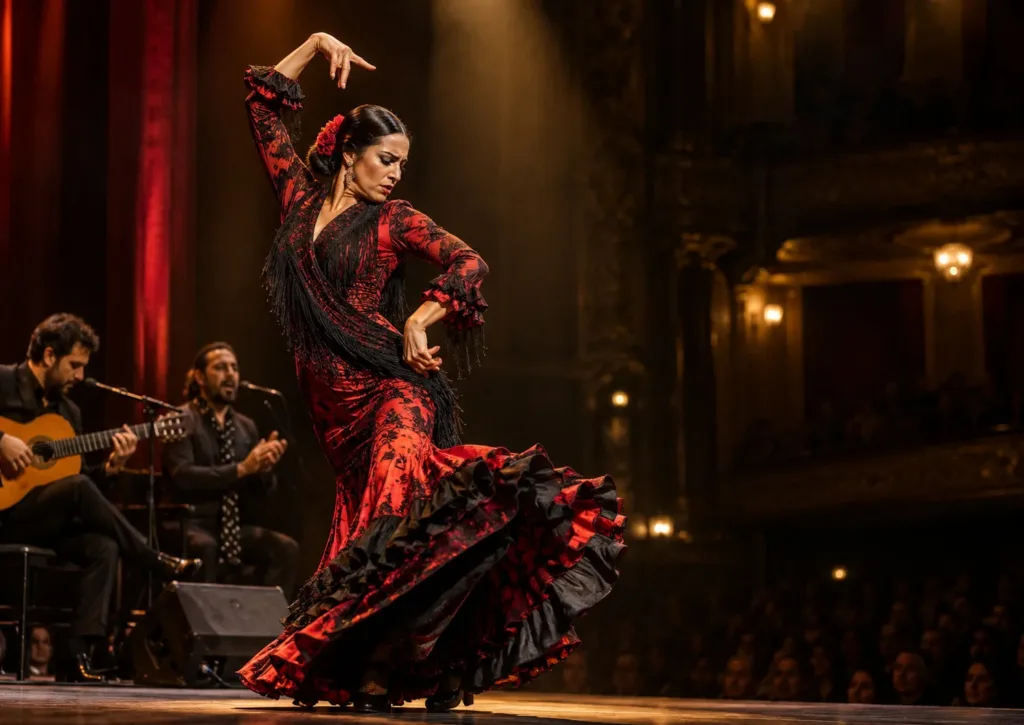
The performers’ concentration matters too. Live flamenco requires constant listening between singing, guitar, dance and palmas. The audience is very close and forms part of the atmosphere. An unexpected flash or a light pointed at the stage can break that concentration.

Finally, prolonged recording changes how you experience the performance. Flamenco is not meant to be experienced entirely through a phone screen. When allowed, you can take home a memory without turning the show into a recording session.

Flash deserves a separate rule

Even if a tablao allows photography, you should assume that flash should not be used unless there is a very unusual and explicit instruction saying otherwise. It is one of the clearest ways to disturb both the artists and the rest of the audience.

The same caution applies to a phone’s continuous light and to the autofocus assist light on some cameras. Check your settings before the performance starts so they do not switch on automatically.

If your phone or camera cannot produce a clean image in the available light, it is better to accept a little motion blur than to light the stage artificially. In fact, part of flamenco’s visual power lies precisely in theatrical lighting, gesture and movement.

How to know whether you can take photos before the show starts

The easiest way is to check the tablao’s own information. The policy may appear on the booking page, in the FAQs, in the confirmation email, on your ticket or on a notice inside the venue.

If you cannot find anything, ask the staff before the lights go down. A ten-second question avoids spending part of the show wondering whether or not to take out your phone.

In our section of flamenco tablaos you can review each option before booking. And if you have other common questions about schedules, arrival, children, dinner or conditions, see our frequently asked questions.

Do not automatically copy what someone else is doing

Just because someone in the front row takes out their phone does not necessarily mean it is allowed. They may not know the rules, they may have permission, or staff may be waiting for an appropriate moment to intervene.

It is also not a good idea to interpret “nobody has told me anything” as permission. If there is a visible instruction, follow it from the beginning.

Conversely, if the venue explicitly says that flash-free photography is allowed, there is no reason to feel uncomfortable about taking an occasional picture. The key is to do it with discretion and common sense.

Golden rules if photography is allowed

  • Never use flash.
  • Lower your screen brightness before the show begins.
  • Keep your phone at body level, not above your head.
  • Do not step into the aisle or stand up to get another angle.
  • Turn off sounds, alerts and any auxiliary lights.
  • Avoid long bursts of photos.
  • Do not spend several minutes reviewing the images you have just taken.
  • Take one or two photos and return your attention to the stage.

These rules have an extra advantage: besides disturbing people less, they usually produce better memories. When you try to photograph every moment, you end up watching the show on a small screen. If you wait for a particular moment and take only a few pictures, you will pay more attention to the performance and remember the night better.

The best moment is not always the most spectacular one

Fast zapateado may look like the ideal moment for a photo, but it is also one of the hardest because of the movement. Sometimes a pause, a llamada, a singer’s gesture, a guitar falseta or a moment of attentive interaction between the artists creates a much more expressive image.

If you use a phone, avoid excessive digital zoom: it reduces quality and encourages you to keep the phone raised for longer. Compose with what you can see from your seat and accept the real distance.

And remember something important: you do not need to leave the venue with a perfect photograph. You paid for a live experience, not a photo shoot.

How much video is reasonable to record?

When the tablao allows video, the most sensible approach is to think in terms of short clips, not full numbers. A few seconds may be enough to remember the energy of the night or share a moment; several continuous minutes mean keeping the screen on and the phone raised for too long.

Some venues explicitly state that videos must be short. If no duration is specified, apply the principle of minimum interference: capture the memory and put your phone away again.

Recording the entire show should not be assumed to be allowed simply because nobody stopped the first recording. If you need to record a performance extensively for professional reasons, you should request permission in advance.

A bright screen can still disturb people even without flash

It is easy to think that turning off the flash solves everything. However, in a dark venue a bright screen can be visible to several rows.

Before the show, lower the brightness and activate a mode that prevents notifications. If you receive a call, do not answer it inside the room. If you need to deal with something urgent, follow staff instructions and step out at a moment that causes the least disruption.

Your phone should behave like a discreet guest: appear for only a few seconds when allowed and disappear again straight away.

What if you bring a professional camera?

Allowing mobile-phone photography does not automatically mean you can use a large camera, telephoto lens, tripod or video equipment. The size of the equipment, shutter noise and possible professional purpose change the situation.

If you are attending as a spectator and want to bring a mirrorless or DSLR camera, check with the tablao in advance. Do not occupy aisles, set up supports or change position during the performance unless you have permission.

For press photography, commercial content creation, reports, multi-camera recording or work for third parties, prior permission should be considered essential. Buying a ticket does not turn the show into an audiovisual production space.

Photos, videos and social media

Some tablaos explicitly encourage audiences to share photos or clips on social media. Others prefer to limit any recording. Again, the venue’s policy is the reference.

If sharing is allowed, try to make your content reflect the show without detracting from the experience of those watching it. You do not need to record an entire piece to post a story or a memory from the night.

It is also worth distinguishing between personal use and professional or commercial use. Being allowed to post a photo on your personal profile does not mean you may use images of the show in a campaign, advertisement, image library, promotional piece or commercial project without checking the necessary permissions.

What to do if photos and videos are not allowed

It does not mean you have to leave without any souvenir. You may often be able to photograph the façade, the stage before the show starts, the empty room or certain areas of the venue. Some tablaos also provide a photo spot or allow pictures after the performance.

If you would like a photo with the artists, ask whether there is a designated moment for it. Do not assume you can enter private areas or approach the stage once the performance has finished.

Above all, take advantage of having your phone away: you will have an hour—or the actual duration of the show—to notice details that are normally missed when recording.

Enjoying the show without recording is also part of the experience

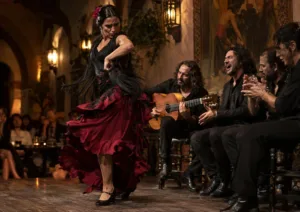
Flamenco in a tablao happens at close range. You can notice the dancer’s breathing, the strike of a foot, the change in the guitar’s dynamics, the entrance of the singing and the glances exchanged between the artists.

That closeness is precisely one of the reasons why so many venues carefully manage phone use. The show works better when the audience looks at the stage rather than at dozens of screens.

If you are choosing where to experience it, our guide on how to tell whether a flamenco show is authentic explains what signs you can look for before booking and during the performance.

30-second checklist before taking out your phone

  1. Has the venue said that photos or videos are allowed?
  2. Have you turned off the flash and auxiliary light?
  3. Is your screen brightness low?
  4. Can you take the photo without raising your phone above other people?
  5. Will you capture only a few seconds instead of recording the whole number?
  6. Is your phone completely silent?
  7. Can you put it away again immediately afterwards?

If any of these answers is no, wait. The best memory of a flamenco show is still having watched it properly.

Frequently asked questions about photos and videos at a flamenco show

It depends on the tablao. Some venues allow flash-free photography during the performance, while others prohibit it or reserve specific moments for photos. Always check the venue’s policy before you start.

It depends on the venue. When video is allowed, the usual and most respectful approach is to record short clips, without lights and without blocking anyone’s view. Do not assume that recording full numbers or the entire show is allowed.

You should not use flash during the performance. It can disturb the artists, break the atmosphere and distract the audience. Also turn off any auxiliary light on your phone or camera.

Do not assume so. A professional camera, large lens, tripod or recording intended for commercial use may require specific permission. Ask the tablao before bringing or using that equipment.

If the venue allows photos or videos for personal use, you can normally share a memory on your social networks while respecting the stated conditions. For professional, promotional or commercial use, check the necessary permissions in advance.

Check the booking page, FAQs, confirmation email, ticket and notices in the venue. If it is not clear, ask the staff before the show begins.

Ask whether you can photograph the venue or stage before or after the performance, or whether there is a photo spot. During the show, keep your phone away and enjoy the performance without screens.

Book online: the key to securing your seat

In many cities, flamenco tablaos sell out easily, especially on weekends and during peak season. That’s why, if your dates are set, the most important thing is to book online.

Direct recommendation: book online through our website to guarantee your seat and arrive with everything confirmed. If you already have your destination, go straight to your city to see available options and clear recommendations.

Flamenco Sevilla | Tablaos Flamencos

Seville

Flamenco Madrid | Tablaos Flamencos

Madrid

Flamenco Barcelona | Tablaos Flamencos

Barcelona

Flamenco Granada | Tablaos Flamencos

Granada

Flamenco Córdoba | Tablaos Flamencos

Cordoba

Flamenco Málaga | Tablaos Flamencos

Malaga

Flamenco Valencia | Tablaos Flamencos

Valencia

Flamenco Jerez | Tablaos Flamencos

Jerez

Find out more about this with your favorite AI:

Did you like this article? Share it!:

Tags: flamenco show, Flamenco tips, Live flamenco show

Article published by:

Related articles

How to tell if a flamenco show is authentic