Flamenco guides

Why every live flamenco show is different

Some visitors leave a tablao with a very specific question: if I return tomorrow, will I see exactly the same show? The short answer is: not necessarily. Even when a venue keeps the same format, approximate running time and recognisable artistic structure, live flamenco retains real scope for the artists to make decisions, listen and respond to one another.

That does not mean everything is improvised or every performance starts from scratch. Singing, guitar, dance and handclapping draw on shared codes: palos, compás, calls, endings, verses, falsetas and structures the performers know deeply. The difference lies in how they combine them, how long a moment lasts, which verse is chosen, how the guitar responds, when the dance enters or the energy of an ending.


Quick answer: each live flamenco show can be different because the artists do more than reproduce a fixed sequence. They work within familiar structures, but listen, respond and make decisions in real time. Compás provides order; experience allows freedom.

A flamenco show is not an exact copy of the previous night

In many performing arts, a score, script or choreography sets out very precisely what should happen at every moment. Flamenco can also be choreographed and rehearsed, especially in theatre productions, but the usual workings of a flamenco ensemble leave room for a more flexible relationship between its members.

A tablao may have already decided which artist will dance alegrías, who will sing soleá or when a guitar solo will take place. Within that framework, however, decisions arise that are not always resolved in exactly the same way. A verse may breathe more, a remate may arrive with a different intensity, a falseta may change and an escobilla may develop differently.

The result is a recognisable experience, but not a mechanical one. Booking a ticket buys admission to an organised performance; what happens within it retains a living element.

What is usually planned

Variation does not mean presenting flamenco as a succession of unplanned surprises. A professional show needs organisation: schedules, running time, entrances and exits, technical coordination and a general idea of the repertoire.

There are also musical structures the performers master. Each palo has its own rhythmic, melodic and expressive characteristics. Calls, endings and changes are not arbitrary signals: they belong to a shared language.

Two performances can therefore keep the same artistic identity without being identical. Structure ensures the artists can come together; listening allows that encounter to take on new nuances.

Structure and freedom: two sides of live flamenco

One key to understanding flamenco is to abandon a false choice: either it is rehearsed or it is improvised. Both can coexist. The better the artists know the structure, the greater their ability to react without losing the compás.

Andalusia’s official flamenco dance curriculum explicitly includes work on improvisation within dance structures. Likewise, flamenco guitar studies include developing the capacity for improvisation and spontaneity. This is not about playing or dancing without rules, but knowing the language well enough to create within it.

This helps explain why an ending may feel especially powerful one night: not necessarily because someone invented something from scratch, but because several artists read the same moment and resolved it together.

Compás creates a meeting point

Compás is one of the main structures that make this freedom possible. It organises accents, breathing, entrances and endings. When the ensemble shares a solid sense of time, each performer can suggest small shifts, silences or variations without disrupting communication.

From the outside, it may seem that a dancer suddenly changes direction or the guitar anticipates a movement. Behind it lies knowledge: rhythmic codes, signals, listening and a great deal of shared experience.

To explore the different forms this language can take, see our guide to the palos of flamenco.

Why the singing can change from one performance to another

The singing is not a recording placed on top of the rest of the show. A singer may have different verses within the same palo, choose between them according to the moment and handle timing, silence and intensity differently.

The relationship with the dancer also changes. Singing can accompany marcaje, support a more restrained moment or grow towards an ending. The dancer listens to the voice and the voice observes the dance. That relationship allows the same structure to breathe differently.

Even the performer’s physical and emotional condition changes nuances: a voice does not respond in exactly the same way every day, just as no human instrument does. In an art so closely tied to presence, those small differences matter.

A different verse changes the colour of a moment

Different verses can be sung within a palo. The choice does not necessarily change the piece’s rhythmic or musical identity, but it can change its poetic content, length and the way the interpretation unfolds.

Two soleares therefore need not create the same feeling, even when they share recognisable features. Flamenco combines inherited forms with personal decisions. UNESCO recognises it as an artistic expression combining singing, dance and guitar playing, transmitted within communities, families, social groups and peñas. That transmission does not turn interpretations into copies: it provides material to recreate.

The guitar listens and responds

The flamenco guitar does more than provide harmonic accompaniment. It can prepare a singer’s entrance, answer a phrase, emphasise a silence, support the dance, change the dynamics or create a space of its own through a falseta.

The guitarist knows the structure but also follows what is happening. If the dancer extends a section, the guitar must accompany that development. If the singing breathes differently, the playing adjusts the space. When a llamada arrives, everyone needs to understand what is being proposed.

Two guitarists can accompany the same dance with different personalities while fulfilling the same role. The sound, falsetas, rhythmic marking and responses to the rest of the ensemble change.

Falsetas bring individuality

A falseta is a guitar passage with its own identity within the development of a palo. A guitarist’s repertoire, variations and way of linking these ideas directly influence the atmosphere of the performance.

This explains why the same dance number can feel different when the guitarist changes. It is not a matter of someone ‘playing another song’: the language of accompaniment allows personality, choice and response.

The guitar may become the centre of attention for a few seconds, then return to supporting the singing or dance. That movement between roles is one reason to watch the whole ensemble, rather than only the performer in the foreground.

What can vary in flamenco dance

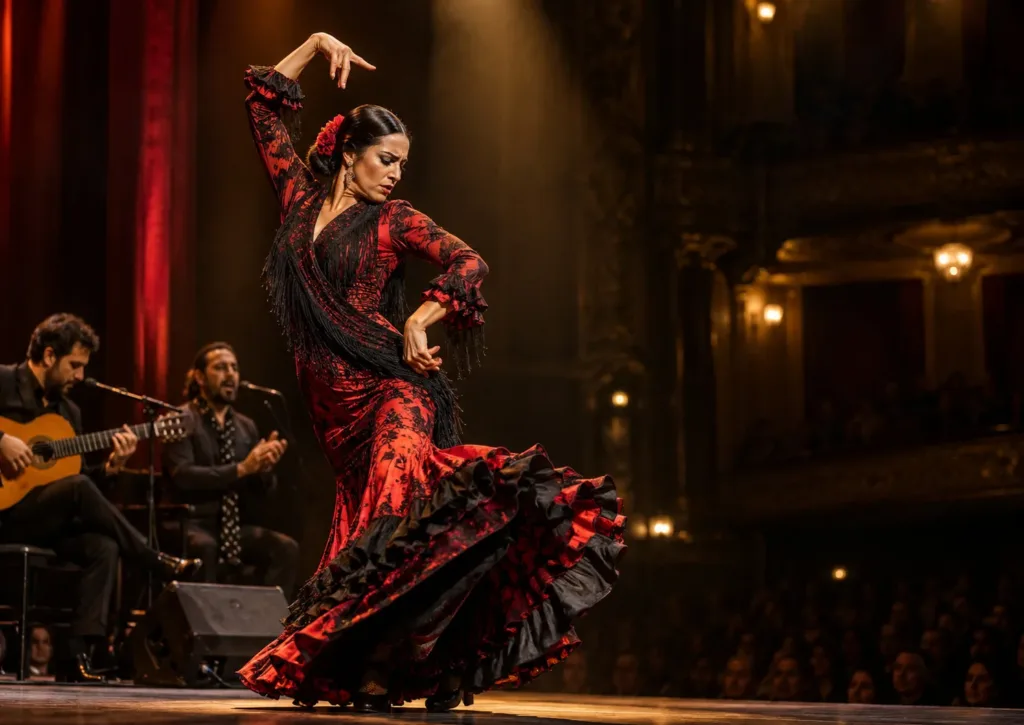
A dance can have a clear structure and still allow variations. It may contain an entrance, marcajes, llamadas, sung verses, an escobilla, changes in dynamics and an ending. Yet the length of some sections, nuances in the footwork, use of space or response to the musicians can change.

A tightly choreographed show offers less room for variation. A tablao ensemble may offer more. Neither model is automatically better: they organise creation in different ways.

What matters is that even with familiar sequences, the dancer does not work in isolation. The sound of the feet affects those clapping; the guitar accompanies the dancer’s intention; the singing creates a phrase the body must listen to.

A llamada is also a conversation

There are signals on stage that help coordinate changes. Some are visible to any spectator: a glance, a breath, a posture or a gesture. Others belong to the technical and rhythmic vocabulary the artists use.

A llamada can announce a transition; a cierre brings the ensemble together at a particular point; a remate reinforces a phrase; an escobilla develops rhythmic footwork. These sections do not appear in the same way in every dance, but they help explain an essential idea: communication is built into the form.

When several performers respond precisely to a signal, the audience senses unity. When they also do so with individuality, there is a feeling that the moment is happening only once.

The flamenco ensemble works like a conversation

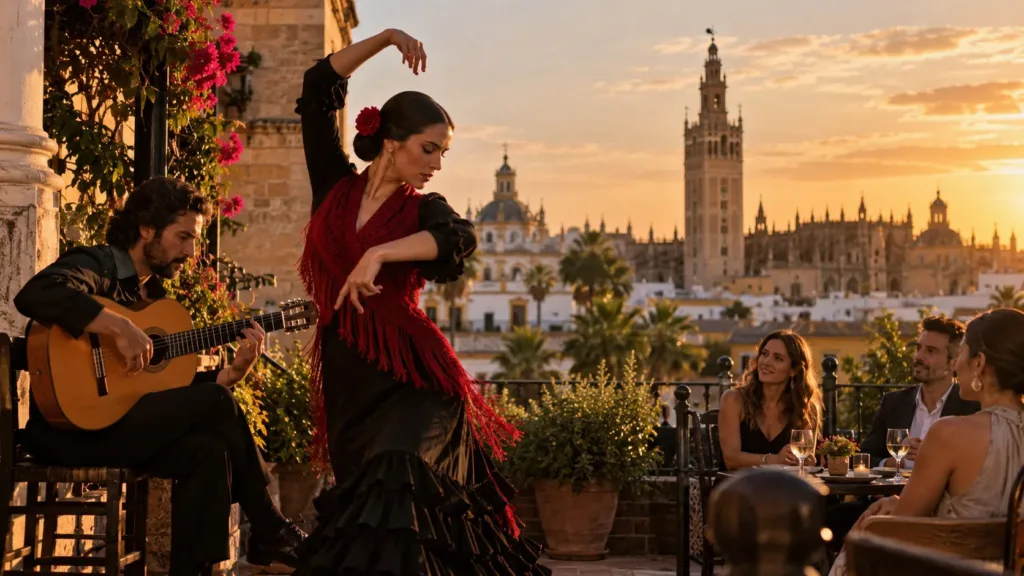
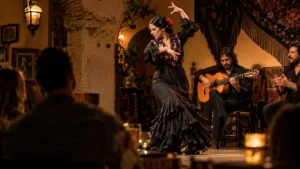
One of the best ways to enjoy a show is to watch the artists who apparently ‘are not performing’ at that instant. The guitarist looks at the dancer. The person clapping follows the breath of the singing. A singer smiles after a remate. Someone prepares an entrance before the audience knows it is coming.

These exchanges explain why live flamenco feels different from a recording. The audience does more than receive a result: it witnesses the coordination taking place.

In our guide to what authentic flamenco really means we explain precisely why authenticity does not require everything to be improvised. Knowledge, listening and coherence matter more than the myth of absolute spontaneity.

Jaleos and handclapping also take part

Handclapping is not decorative applause. It sustains the rhythm and can change in sound and intensity according to the moment. Jaleos are not random shouts either: they arise as responses, encouragement and communication within the performance.

When an ensemble has confidence and experience together, these contributions can create especially concentrated energy. When artists meet for the first time or work in new combinations, their skill allows them to build that coordination through shared codes.

This is why professional flamenco can bring different performers together without losing its language. The shared repertoire provides common ground to which everyone brings their personality.

The cast can transform the whole performance

Many tablaos work with rotating casts or combinations of artists that change from day to day. Sometimes part of the ensemble remains and another dancer joins; at other times a voice, the guitar or several positions change.

Each combination shifts the balance. Some guitarists favour restrained accompaniment and others a more expansive approach; some dancers work particularly with silence and others build on rhythmic power; some voices lead the atmosphere towards different colours.

Returning to the same venue therefore does not necessarily mean repeating the same experience. The tablao provides the framework; the artists create the night.

Even the same artist never gives two identical nights

Even with exactly the same cast, differences would remain. Human performance is never a digital reproduction. Speed, breathing, energy, the sound of the room and relationships between performers all produce nuances.

A good professional does not need to change everything to keep a performance alive. Sometimes the difference is a slightly longer silence, a verse chosen in that moment or a guitar response that prompts another reaction.

That is part of the value of live performance: nothing extraordinary has to happen to make a show unrepeatable. The decisions simply need to belong to the present.

Does the audience change the show?

It can influence the atmosphere, but this idea should not be exaggerated. The audience does not direct the repertoire or decide the endings. The artists lead the performance. However, an especially attentive room, a warm response or concentrated silence can affect the sense of energy in the moment.

Performers notice what is happening in front of them. That awareness may encourage greater tension, a smile, a spontaneous jaleo between colleagues or a different way of savouring an ending. The effect is usually subtle, rather than a complete transformation of the programme.

The spectator’s best contribution is therefore simple: listen, respect the silences and let attention become part of the atmosphere.

Closeness amplifies these nuances

In a small room, details become apparent that other formats may blur: a breath before an entrance, the sharp strike of a foot, a change in guitar dynamics, a coordinating glance or the precise sound of the handclapping.

Closeness alone does not guarantee a better show, but it helps reveal the relational character of flamenco. The spectator sees the piece being built as it happens.

That is another reason to limit distractions. For advice on using your phone during a performance, see our guide to photographs and videos during a flamenco show.

Why a tablao encourages this sense of the present

The tablao became established historically as a professional space for flamenco, inheriting part of the role previously played by cafés cantantes. Its format enables regular performances, brings ensembles together and introduces singing, guitar and dance to very varied audiences.

To explore that development, read the origins of the flamenco tablao: from cafés cantantes to today’s stages.

Regular tablao performances need not become an identical routine. Quite the opposite: working many nights allows performers to master stage codes and react quickly to different colleagues.

Professionalism and spontaneity are compatible

It is sometimes assumed that the more organised a show is, the less spontaneous it can be. That is misleading. Professionalism provides a secure framework: the artist knows the running time, space, repertoire and colleagues’ signals.

Within that framework, freedom can emerge. Knowledge is precisely what separates improvisation from disorder. An experienced ensemble can change a detail without the audience noticing any break because everyone understands how to come together again.

Live performance is therefore not an exception within flamenco: it is one of the clearest places to observe how it works.

Why flamenco is worth seeing more than once

A first visit often impresses through its immediate force: the sound of the feet, the voice, the guitar and the closeness. At a second performance, other things begin to emerge. You recognise an entrance being prepared, notice a glance you previously missed and understand that silence is also part of the music.

If the cast or repertoire changes, you can also discover other sides of flamenco. One night may be marked by the solemnity of a soleá and another by the rhythmic play of bulerías. Even with similar palos, the performers’ personalities transform the experience.

Seeing flamenco several times does not mean repeating a product. It means learning to listen to a living language from different angles.

Frequently asked questions about why live flamenco changes every night

No. Flamenco uses familiar palos, compás and structures, and a professional show usually has prior organisation. Improvisation happens within that framework through decisions about duration, verses, falsetas, calls, responses and nuances.

Yes, depending on the venue and cast. Some tablaos maintain a fairly stable structure, while others change palos, running order or artists. Think of your ticket as access to a live flamenco performance, rather than a guarantee of an identical sequence to another date, unless the venue advertises a fixed programme.

Yes. Even with the same artists and a similar structure, verses, falsetas, the length of some sections, nuances and responses between performers may vary.

It depends on the format. In a tablao ensemble, the cast, some palos, verses, falsetas and dance details can change. In a choreographed production, variations are usually smaller, although human performance is never exactly identical.

Compás is precisely one of the structures that allows improvisation without losing coordination. The artists share a rhythmic organisation and know how to enter, respond and finish within it.

Yes. There are rhythmic, musical and visual signals. Glances, breathing, calls, endings and other devices help communicate changes and allow the ensemble to respond in real time.

It can influence the atmosphere and energy, but does not direct the performance. The artists remain in control of the show, while the audience contributes mainly through attentive listening and a respectful response.

Yes, especially if you want to explore flamenco more deeply. The cast may change, and even when it does not, choices and nuances in the interpretation mean a return visit can offer a different experience.

No. Rehearsal, professionalism and improvisation can coexist. Authenticity does not depend on everything being spontaneous, but on knowledge of flamenco’s language, the quality of the interpretation and communication between the artists.

The value of being there when it happens

The difference between two nights of flamenco is not always a major visible change. It often lies in details: a voice stretching a phrase, a guitar responding differently, a dancer extending the silence before an ending or handclapping that transforms the tension of the moment.

Flamenco has strong structures, which is precisely why it can allow freedom. The artists know where they are so they can decide how to reach the next point.

That combination of knowledge and presence explains why a good live flamenco show does more than reproduce itself: it happens. When it ends, that particular version will never exist in exactly the same way again.

Book online: the key to securing your seat

In many cities, flamenco tablaos sell out easily, especially on weekends and during peak season. That’s why, if your dates are set, the most important thing is to book online.

Direct recommendation: book online through our website to guarantee your seat and arrive with everything confirmed. If you already have your destination, go straight to your city to see available options and clear recommendations.

Flamenco Sevilla | Tablaos Flamencos

Seville

Flamenco Madrid | Tablaos Flamencos

Madrid

Flamenco Barcelona | Tablaos Flamencos

Barcelona

Flamenco Granada | Tablaos Flamencos

Granada

Flamenco Córdoba | Tablaos Flamencos

Cordoba

Flamenco Málaga | Tablaos Flamencos

Malaga

Flamenco Valencia | Tablaos Flamencos

Valencia

Flamenco Jerez | Tablaos Flamencos

Jerez

Find out more about this with your favorite AI:

Did you like this article? Share it!:

Tags: flamenco show, Flamenco tablao, Live flamenco, Live flamenco show

Article published by:

Related articles

Can you take photos and videos during a flamenco show?
Flamenco for beginners: a guide to enjoying your first show