Flamenco Biennial

The most spectacular venues of the Seville Flamenco Biennial 2026

When the city also becomes part of the show

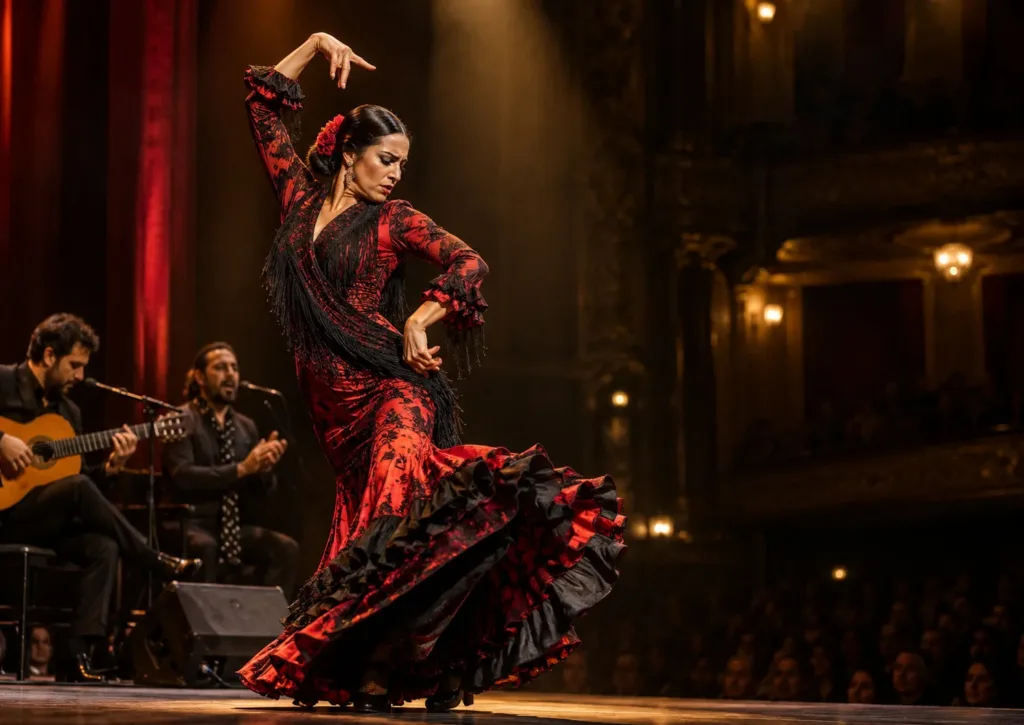
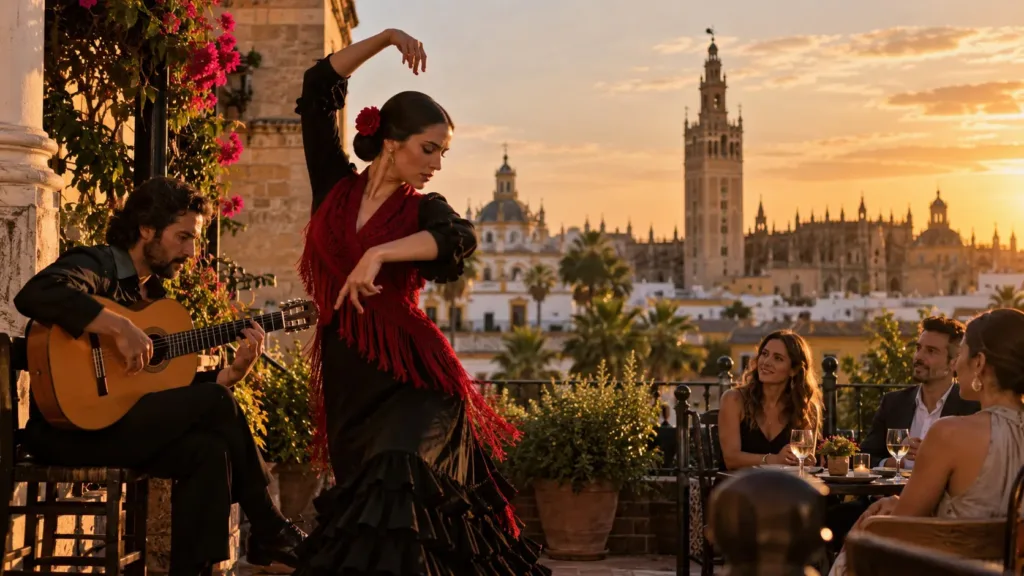
The Seville Flamenco Biennial 2026 cannot be understood only through the artists who take the stage. An essential part of its personality lies in the venues chosen for each production. During the 24th edition, held from 9 September to 3 October 2026, flamenco will fill historic theatres, monumental courtyards, a former artillery factory, a traditional communal courtyard, a Baroque church and even the bullring of one of Seville’s most recognisable buildings.

The official programme is spread across 11 venues, but some turn the architecture itself into an inseparable part of the performance. Watching a recital in the Patio de la Montería at the Real Alcázar, listening to flamenco singing at midday inside San Luis de los Franceses or ending the night beneath the open sky at Hotel Triana is a very different experience from attending a large-scale production at the Teatro de la Maestranza.

This guide selects the most spectacular venues of the Seville Flamenco Biennial 2026, explains what makes them different and highlights which shows are scheduled at each one.

11

official venues

7 especially distinctive settings

Heritage, architecture and flamenco

From 9 September to 3 October 2026

Quick answer: if you are looking for the most special settings of the 2026 Biennial, the standouts include the Patio de la Montería at the Real Alcázar for its monumental setting, San Luis de los Franceses for its intimate Baroque atmosphere, the Royal Artillery Factory for its industrial architecture, Hotel Triana for its traditional communal-courtyard atmosphere, the Real Maestranza Bullring for the major gala on 10 September, the restored Teatro Lope de Vega for its historic return and the Teatro de la Maestranza for the largest-scale productions.

Last updated: 1 September 2026. Programming, access arrangements and ticket availability may change. Always check the official information for each performance.

The most spectacular venues of the 2026 Biennial at a glance

Venue What makes it special Featured programme
Real Alcázar · Patio de la Montería Historic palace and large open-air monumental courtyard Israel Fernández, Rancapino Chico and Xerezanías
Royal Artillery Factory 18th-century industrial architecture and contemporary language Ana Morales and Pablo Martín Caminero’s trilogy
San Luis de los Franceses Baroque setting, intimate acoustics and midday performances Six Unique Matinées
Hotel Triana Historic communal courtyard, open patio and flamenco memory Three late-night performances from 17 to 19 September
Real Maestranza Bullring Large historic open-air venue Gala El mundo por montera, 10 September
Teatro Lope de Vega Neo-Baroque theatre from 1929, reopened after restoration Dorantes, Arcángel, Riqueni, Aurora Vargas, Mayte Martín…
Teatro de la Maestranza Large stage designed for major productions Sara Baras, Israel Galván, José Mercé, Farruquito and the Biennial finale

1. Patio de la Montería at the Real Alcázar: flamenco before centuries of history

The Real Alcázar of Seville is one of those places where visitors need a few seconds to decide where to look first. The palace complex traces its origins back to the 10th century and was transformed over centuries, accumulating Islamic, Mudéjar, Gothic, Renaissance and Baroque layers.

The Biennial uses the Patio de la Montería, a large open space facing the extraordinary façade of Peter I’s Mudéjar Palace. At night, with the monument illuminated and the Giralda visible from certain angles, the setting gains a presence that is difficult to reproduce in a conventional theatre.

Here, heritage is not a neutral backdrop. The scale of the courtyard, the stone, the open sky and even the approach into the complex make the performance an experience directly tied to Seville.

What to see at the Real Alcázar during the 2026 Biennial

The programme concentrates three consecutive nights:

  • 14 September: Israel Fernández presents De oro y marfil.
  • 15 September: Rancapino Chico premieres Pizarra.
  • 16 September: Xerezanías brings together Luis El Zambo, Dolores Agujetas, Antonio de la Malena, Manuel Valencia and Las Tatas de Jerez.

The selection makes sense in a space like this: recitals and encounters where the strength lies in the presence of the performers, the singing and the guitar, without any need to fill the courtyard with scenery.

Ideal for: anyone who wants to experience a Biennial night in an unmistakably Sevillian monumental setting.

2. Royal Artillery Factory: industrial heritage for the most contemporary flamenco

The Royal Artillery Factory offers a completely different experience. Its origins go back to the Morel family’s bronze foundry in the 16th century, although the large building seen today mainly took shape during the 18th century and received a major boost under Charles III.

Its halls, vaults, courtyards, former foundry areas and industrial scale make the Artillery Factory one of the city’s most powerful heritage spaces. After decades connected to military production, it is now being recovered as a major cultural venue.

The building’s raw character works particularly well with projects exploring new languages. Where San Luis encourages contemplation, the Artillery Factory offers depth, texture, shadow and an almost cinematic atmosphere.

What the 2026 Biennial programmes at the Artillery Factory

The 2026 edition uses the venue for two major creative strands:

  • 13 and 14 September: Ana Morales presents the world premiere of Rapsodia. Fantasía subterránea.
  • 22 September: Trilogía. Al toque, by Pablo Martín Caminero.
  • 23 September: Trilogía. Al baile, featuring María Moreno.
  • 24 September: Trilogía. Al cante, with David Carpio.

The dialogue between a historic industrial complex and experimental stage works makes this venue one of the clearest examples of how the Biennial refuses to separate tradition from the avant-garde.

Ideal for: anyone looking for a visually powerful experience and contemporary creative flamenco.

3. San Luis de los Franceses: six matinées inside a Baroque jewel

The Church of San Luis de los Franceses is probably the most intimate and ornate venue on this list. The complex, built between 1699 and 1731 to a design by Leonardo de Figueroa, is considered one of Seville’s finest examples of mature Baroque architecture.

Its architecture was designed to envelop the visitor. Altarpieces, painting, sculpture, light and proportions work together, making any musical performance feel very different from a conventional concert-hall recital.

The Biennial also takes advantage of a special circumstance: performances begin at 12:00 noon. Daylight and the small-scale format completely change the usual rhythm of a festival largely associated with the night.

The Unique Matinées at San Luis

San Luis hosts six performances in dialogue with the world of early music:

  • 12 and 13 September: Pedro El Granaíno, Pan de oro, with Daniel Oyarzábal.
  • 19 and 20 September: Alejandro Hurtado, Devenir de la guitarra, with Enrike Solinís.
  • 26 and 27 September: Encarna Anillo, Camino de flores, with Miguel Rincón.

We have prepared a dedicated guide with the programme and key details of the Unique Matinées at the 2026 Biennial.

Ideal for: those who prefer proximity, natural acoustics, heritage and unhurried listening.

4. Hotel Triana: a traditional communal courtyard beneath the open sky

The name can be misleading. Today, Hotel Triana does not operate as a tourist hotel. It was built for the 1929 Ibero-American Exposition to accommodate visitors, but it never fulfilled that purpose and eventually became a traditional communal residence.

Its U-shaped structure around a large courtyard preserves the communal logic of so many traditional residences in Triana. The building, listed as a Site of Cultural Interest, has maintained a particularly strong relationship with the Biennial and with the district’s flamenco memory.

Here the formal distance of a theatre disappears. The courtyard, galleries, interior façades and open sky create an atmosphere that recalls how much of flamenco’s social history unfolded in shared spaces, courtyards, gatherings and celebrations.

The return of Hotel Triana in 2026

After four years away from the programme, the venue returns with three consecutive nights conceived as late-night performances of the Biennial:

  • 17 September: Mujeres gitanas, with Remedios Amaya, Montse Cortés, La Fabi and other artists.
  • 18 September: Uvitas negras, linked to the 75th anniversary of Peña Pozo de las Penas.
  • 19 September: Andalucía en el Tiempo, with artists from different Andalusian provinces.

All three are conceived as Unique Nights, encounters designed to happen in an unrepeatable way.

Ideal for: anyone who wants to experience one of the most flamenco-filled and least conventional atmospheres of the entire Biennial.

5. Real Maestranza Bullring: a gala that fills the entire arena

The Real Maestranza de Caballería Bullring is one of Seville’s great architectural icons. Construction in masonry began in the 18th century and the complex was finally completed in 1881, after a process lasting more than a century.

Its golden sand arena, white-and-ochre arcades and circular scale create an image radically different from any theatre. For a flamenco production, it also means confronting a huge open-air space with the audience surrounding the stage.

In 2026 the Biennial uses the bullring for a single major event, reinforcing its sense of occasion.

El mundo por montera: the major gala on 10 September

On 10 September at 21:30, the Bullring hosts the 24th Biennial Gala El mundo por montera, with José Mercé, José de la Tomasa, Martirio, Arcángel, La Tremendita, Ángeles Toledano, El Perrete, Manuel de la Tomasa and the Ballet Flamenco de Andalucía directed by Patricia Guerrero.

The event takes place one day after the opening proclamation on 9 September and serves as one of the edition’s major public openings. You can find more information in our guide to how the 2026 Biennial will open.

Ideal for: anyone looking for scale, a major-event atmosphere and a large open-air night in a symbol of Seville.

6. Teatro Lope de Vega: the great return of the 2026 Biennial

The Teatro Lope de Vega adds an extra emotional dimension to this edition. Built for the Ibero-American Exposition of 1929, the Neo-Baroque building formed part of the former Seville Pavilion alongside the Casino de la Exposición.

After being closed for building work, the theatre reopens to the public in time for the Biennial. The comprehensive restoration has cost more than €9.5 million and makes its return one of Seville’s cultural events of the year.

This is not just any festival venue. The Lope has been linked to the history of the Biennial for decades, and its reopening restores one of the theatres that best represents flamenco’s theatrical dimension in the city.

A programme worthy of the reopening

The first artist to step onto the restored stage will be Dorantes, on 12 September, with the world premiere of Fractal Arcano. He will be followed by Arcángel, Antonio Reyes, Rafael Riqueni with Tim Ries, Aurora Vargas and Juana Amaya, David Coria, Mayte Martín, Alfonso Losa and others.

The mix of world premieres, unique nights and artists from different generations makes the Lope one of the venues with the most complete programme of the entire edition.

Its historic-theatre aesthetic also offers an experience very different from the modern Teatro Central or the large scale of the Maestranza.

Ideal for: anyone who values classical theatre, the history of the Biennial and the symbolism of attending its reopening.

7. Teatro de la Maestranza: the stage for large-scale productions

The Teatro de la Maestranza represents the most contemporary and technically ambitious side of this selection. Opened in 1991 and designed by architects Aurelio del Pozo and Luis Marín, it was conceived as a large multipurpose auditorium and later adapted its stage house to meet the demands of opera and other major productions.

At the Biennial it is the natural venue for shows requiring space, stage machinery, large capacity and advanced technical possibilities. In contrast to the heritage character of the Alcázar or San Luis, here the focus is on what can be built on stage.

That does not mean it lacks identity: its relationship with music and the performing arts in Seville since Expo ’92 has made it one of Spain’s major theatres.

Sara Baras, Israel Galván, Farruquito and the finale

The Maestranza programme is one of the strongest of 2026. Sara Baras opens its cycle on 11, 12 and 13 September with the world premiere of Infinita, her return to the Biennial fourteen years later. You can find all the details in our guide to Sara Baras in Seville 2026.

The theatre will then welcome Cañizares with the ROSS, José Mercé, Manuel Liñán, Israel Galván, Farruquito and Marina Heredia, among others. On 3 October it will also host Perlas a Millares, the production that closes the 24th edition.

Ideal for: anyone who wants to see the largest-scale productions and some of the biggest names on the bill.

Which venue should you choose? The experience changes completely

There is no universal “best” venue. The choice depends more on the kind of experience you want than on any architectural ranking.

If you are looking for… Choose…
The most impressive monumental setting Real Alcázar
Intimacy, acoustics and Baroque heritage San Luis de los Franceses
A flamenco atmosphere of courtyard and neighbourhood Hotel Triana
Industrial architecture and contemporary creation Royal Artillery Factory
A major open-air night Real Maestranza Bullring
A newly restored historic theatre Teatro Lope de Vega
Major productions and maximum stage capacity Teatro de la Maestranza

The other official venues of the 2026 Biennial

The selection above does not mean the remaining venues are secondary. The Biennial also uses spaces with clearly defined artistic roles:

  • Teatro Central: the main territory for stage creation and avant-garde flamenco.
  • Espacio Turina: especially well suited to guitar, music and smaller-scale recitals.
  • Teatro Alameda: hosts premieres, young creators and proposals centred on singing, dance and guitar.
  • CaixaForum Sevilla: adds family programming with Tirititrán.

Taken together, the organisation presents the city as a large open stage in which each venue plays a different role in the story of the edition.

Real Maestranza and Teatro de la Maestranza: they are not the same place

It is a fairly common confusion, and in 2026 it is worth avoiding because both venues have major programming.

The Real Maestranza de Caballería Bullring is the historic venue in the Arenal district where the gala El mundo por montera takes place on 10 September.

The Teatro de la Maestranza, also located by the river but in a different building, is the major theatre opened in 1991 where Sara Baras, José Mercé, Israel Galván, Farruquito and other artists perform.

Before attending a performance, always check the full venue name printed on your ticket.

Practical tips if you want to discover the Biennial through its venues

  • Do not choose only by artist. In this edition, some projects are specifically conceived to enter into dialogue with their venue.
  • Check whether the performance is indoors or outdoors. The Real Alcázar, Hotel Triana and the Bullring offer a very different experience from enclosed theatres.
  • Allow for travel time. Although many venues are in the centre or relatively close together, the Biennial is spread across Arenal, Triana, San Bernardo, Cartuja, Macarena and other parts of the city.
  • Check the exact entrance point. At monumental buildings, the entrance for a performance may not be the same as the entrance used for ordinary tourist visits.
  • Arrive with time to spare. Especially on premiere nights, at major galas and in heritage venues.
  • Combine formats. One of the best ways to understand the edition is to attend a matinée, a recital in a monument and a major theatrical production.

If you are spending several days in Seville, our guide to what to see on the first weekend of the 2026 Biennial can help you build a complete itinerary.

The Biennial is also remembered for where it happened

A major festival could simply book artists and distribute them among theatres. The Seville Biennial does something more interesting: it uses the city itself as part of the festival’s language.

In 2026 that idea is especially clear. The return of the Lope de Vega after its restoration, the recovery of Hotel Triana, the creative use of the Royal Artillery Factory, the Baroque matinées at San Luis, the nights at the Alcázar and the major gala in the Bullring create a flamenco geography that could only happen in Seville.

So when two shows interest you equally, look at the venue too. At the Biennial, sometimes the venue is the artist that does not appear on the poster.

Sources and update

To prepare this guide, we cross-checked the official list of venues for the 24th Biennial, the official programme by venue and heritage information published by Seville City Council, ICAS, the Real Alcázar, the Real Maestranza and the Teatro de la Maestranza.

Information reviewed on 1 September 2026. Dates, times, access arrangements and availability may be changed by the organisers.

Frequently asked questions about the venues of the Seville Flamenco Biennial 2026

The programme for the 24th Biennial is spread across 11 venues in Seville, including theatres, monuments, historic courtyards and cultural centres.

The Patio de la Montería at the Real Alcázar is probably the most exceptional monumental setting thanks to its historic surroundings and the open-air performances facing the Mudéjar Palace.

The six Unique Matinées are held at the Church of San Luis de los Franceses on 12, 13, 19, 20, 26 and 27 September, always at 12:00.

It is a building constructed for the 1929 Ibero-American Exposition that never operated as a hotel and was converted into a traditional communal residence. Its courtyard is one of the Biennial’s most characterful venues and one of those most closely connected to flamenco memory.

The Lope de Vega reopens to the public for the 2026 Biennial after a comprehensive restoration. The first Biennial performance on its stage will be Fractal Arcano, by Dorantes, on 12 September.

No. They are two different buildings. The Real Maestranza Bullring hosts the major gala on 10 September; the Teatro de la Maestranza hosts Sara Baras, Israel Galván, José Mercé, Farruquito and other large-scale productions.

The Royal Artillery Factory and the Teatro Central are two of the venues most closely associated with experimentation and contemporary languages in the 2026 programme.

The official Biennial website has a section dedicated to programming by venue. You can also use our complete guide to the Seville Flamenco Biennial 2026 to plan your visit.

Book online: the key to securing your seat

In many cities, flamenco tablaos sell out easily, especially on weekends and during peak season. That’s why, if your dates are set, the most important thing is to book online.

Direct recommendation: book online through our website to guarantee your seat and arrive with everything confirmed. If you already have your destination, go straight to your city to see available options and clear recommendations.

Flamenco Sevilla | Tablaos Flamencos

Seville

Flamenco Madrid | Tablaos Flamencos

Madrid

Flamenco Barcelona | Tablaos Flamencos

Barcelona

Flamenco Granada | Tablaos Flamencos

Granada

Flamenco Córdoba | Tablaos Flamencos

Cordoba

Flamenco Málaga | Tablaos Flamencos

Malaga

Flamenco Valencia | Tablaos Flamencos

Valencia

Flamenco Jerez | Tablaos Flamencos

Jerez

Find out more about this with your favorite AI:

Did you like this article? Share it!:

Tags: agenda flamenca, Bienal 2026, Bienal de Flamenco, festivales flamencos, flamenco en Sevilla, sevilla, things to do in Seville, what to see in Seville

Article published by:

Related articles

Flamenco at the Real Alcázar during the 2026 Biennial