Flamenco in your inbox
Get news, guides and recommendations to enjoy live flamenco.
Subscribe in 10 seconds. No spam. 1 email/month. Unsubscribe in 1 click.
The 2026 Andalusian Flamenco Club Circuit in Seville turns the province into a major route of free recitals. The programme brings together 56 performances at as many flamenco clubs in 41 towns: 53 singing recitals, two dance performances and one guitar recital. The circuit began in June and reaches its busiest stretch between September and October.
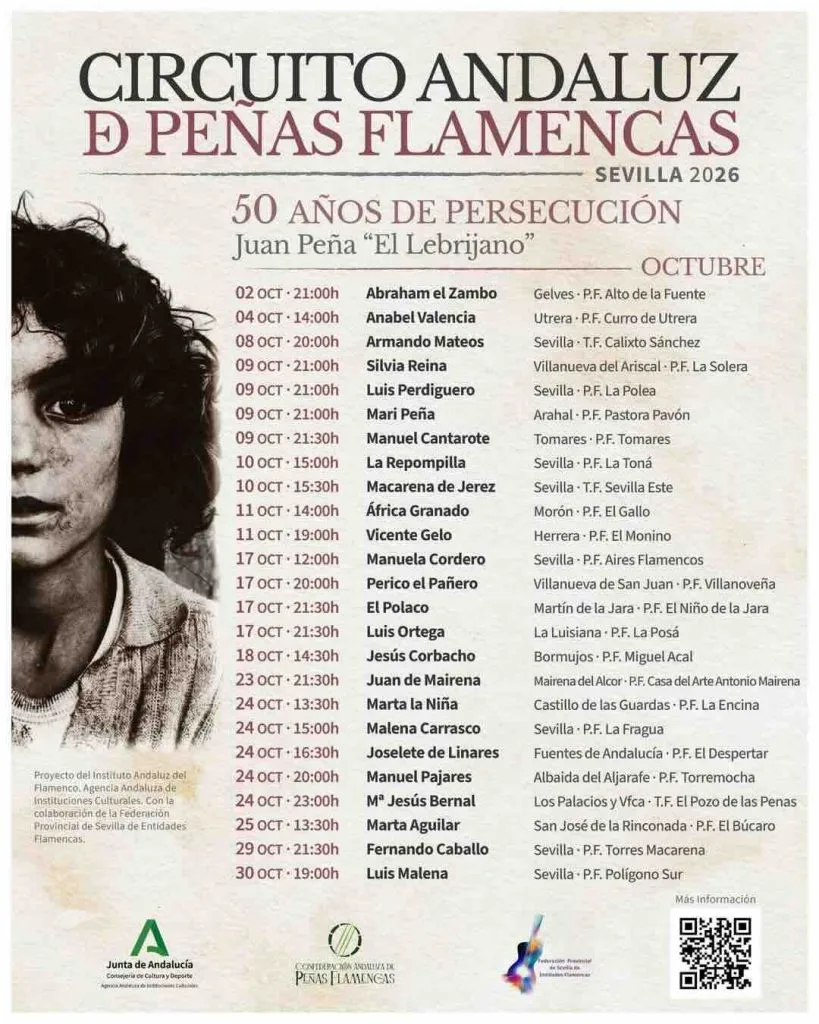
The Seville edition commemorates the 50th anniversary of Persecución, the album by Juan Peña “El Lebrijano” released in 1976 with lyrics by Félix Grande. The dedication connects today’s programme with a landmark work for understanding the memory, identity and narrative power of contemporary flamenco.
This guide brings together the detailed September and October calendar, the artists, host clubs, towns and practical information for attending. Admission is free until capacity is reached, but it is advisable to confirm each event before travelling.


The circuit schedules 56 free performances in 41 towns: 53 singing recitals, two dance performances and one guitar recital. After twelve events held in June, the official calendar lists 44 performances from 2 September to 31 October. Admission is free until capacity is reached, and the time should be confirmed with the host club before setting out.
| Item | Official information |
|---|---|
| Performances | 56 |
| Singing | 53 |
| Dance | 2 |
| Guitar | 1 |
| Towns | 41 |
| Admission | Free until capacity is reached |
The map is not limited to the capital. It reaches Écija, Alcalá de Guadaíra, Dos Hermanas, Mairena del Alcor, Morón, Arahal, Tomares, Gelves, Bormujos, Olivares, Espartinas, Sanlúcar la Mayor, Villanueva del Ariscal, La Algaba, Burguillos, Paradas, Las Cabezas de San Juan, Martín de la Jara, Pruna, Herrera, La Luisiana, Fuentes de Andalucía, Isla Mayor, Aznalcóllar, Albaida del Aljarafe, El Castillo de las Guardas and Los Palacios y Villafranca, among other towns.
Seville has 80 federated flamenco clubs, the largest provincial network in Andalusia. The circuit activates an important part of this network and brings professional performances to audiences that do not always have a regular programme.
The programme lets you choose between Seville city, the Aljarafe, Campiña, Sierra Sur and the metropolitan area. Times range from midday to late evening; not all flamenco clubs open their doors the same amount of time in advance.
The general information states that the Seville circuit runs until 30 October. However, the detailed calendar in the Andalusian Cultural Agenda includes a final event on 31 October: Silvia Reina at Peña Flamenca La Solera in Villanueva del Ariscal.
As a precaution, this guide includes the performance on the 31st. The agenda itself warns that the programme is subject to change.
The city hosts events at Cantes al Aire, El Carbonerillo, La Jumoza 3, Sentir Flamenco at Pablo de Olavide University, Tertulia Calixto Sánchez Marín, La Polea, Sevilla Este, Aires Flamencos, La Fragua, Torres Macarena and Polígono Sur.
The announced artists include Fernanda Peña, Angelita Montoya, Pura de Pura, Anabel Valencia, Armando Mateos, Luis Perdiguero, Macarena de Jerez, Manuela Cordero, Malena Carrasco, Fernando Caballo and Luis Malena.
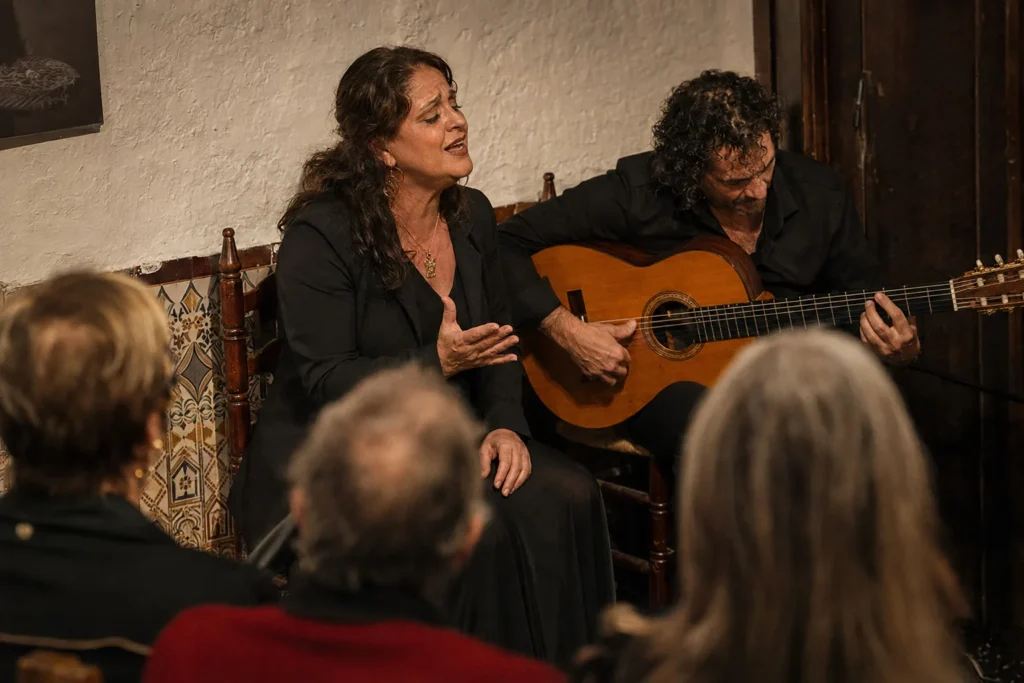
Flamenco singing clearly dominates the programme. This reflects the historic format of a flamenco-club recital: a lead voice, accompanying guitar and an intimate audience attentive to the styles and personality of the performer.
Established artists —such as Alfredo Tejada, Luis Moneo, Jeromo Segura, El Potito, Macarena de Jerez, Anabel Valencia and La Repompilla— appear alongside voices that are still building their professional careers.
Dance is represented by Manuel Bellido, in Écija, and María Távora, in Paradas. The only recital specifically announced as a guitar performance features Tino Van der Sman, in Alcalá de Guadaíra.
To compare different formats, also see our guide to where to see authentic flamenco in Seville.
The Seville programme is dedicated to the 50th anniversary of Persecución, released by Juan Peña “El Lebrijano” in 1976. Created with texts by Félix Grande, the album brought to record a narrative about the historic persecution of the Roma people and opened an expressive territory that was unusual in recorded flamenco at the time.
The tribute also has a strong geographical dimension: El Lebrijano was born in Lebrija and belonged to an artistic lineage that is essential to Seville flamenco. Remembering his work through a network of flamenco clubs connects recorded memory with the spaces where singing is heard, discussed and passed on.
The dedication does not turn the circuit into a repetition of El Lebrijano’s repertoire. It works as the common thread of a diverse programme made up of contemporary artists and spread throughout the province.
For a broader view of the programme, see our general guide to the 2026 Andalusian Flamenco Club Circuit. It includes figures for all eight provinces. This page focuses exclusively on Seville and its detailed calendar.
Yes. The Andalusian Cultural Agenda states that admission is free until capacity is reached. There is no ticket to purchase, but free admission does not guarantee entry if the venue fills up.
Each flamenco club may organise access differently. Some admit people in order of arrival; others may use invitations or confirmations, or give organisational priority to members. If the listing does not explain the procedure, the safest option is to contact the organisation.
In the Aljarafe you will find Gelves, Tomares, Bormujos, Olivares, Espartinas, Sanlúcar la Mayor, Villanueva del Ariscal and Albaida. The Campiña has events in Écija, Arahal, Paradas, Fuentes de Andalucía and La Luisiana. In the metropolitan area, Alcalá de Guadaíra, Dos Hermanas, La Algaba, Mairena del Aljarafe and San José de la Rinconada stand out.
Before planning two performances on the same day, check distances and times. Access, parking and duration are not the same at every venue.
The circuit offers one-off performances at cultural associations and provides a way to experience flamenco through local community life. A tablao has a regular programme, can be booked in advance and is easier to fit into a trip with fixed dates.
If the recital does not coincide with your stay or the venue is full, see the flamenco shows in Seville. A flamenco club offers a unique local event, while a tablao lets you secure a performance within your itinerary.
The main reference is the Andalusian Cultural Agenda. It lists the announced recitals and warns that changes may occur. It is also advisable to check the channels of the host club or the Provincial Federation of Flamenco Associations of Seville.
The programme is organised through collaboration between the Andalusian Agency of Cultural Institutions and the Andalusian Institute of Flamenco and the Provincial Federation of Flamenco Associations of Seville.
Across Andalusia, the 2026 edition totals 225 performances and at least 470 artists. The programme stems from an open call and works with the provincial federations to create line-ups adapted to their networks of flamenco clubs and towns.
The programme announces 56 performances in 41 towns: 53 singing recitals, two dance performances and one guitar recital.
The circuit began on 6 June. The available detailed calendar lists performances from 2 September to 31 October 2026.
Yes. All recitals are announced with free admission until capacity is reached. Depending on the flamenco club, there may be an invitation or confirmation system.
Official information presents the performances as free until capacity is reached. Check with the specific flamenco club to find out how admission is organised.
Manuel Bellido performs on 11 September in Écija and María Távora on 26 September in Paradas.
Tino Van der Sman performs on 18 September at Peña Flamenca La Soleá in Alcalá de Guadaíra.
Yes. Check the artist, time, address and admission conditions before travelling.
In the Andalusian Cultural Agenda and through the host flamenco club or provincial federation channels.
In many cities, flamenco tablaos sell out easily, especially on weekends and during peak season. That’s why, if your dates are set, the most important thing is to book online.
Direct recommendation: book online through our website to guarantee your seat and arrive with everything confirmed. If you already have your destination, go straight to your city to see available options and clear recommendations.
Find out more about this with your favorite AI:
Did you like this article? Share it!:
Article published by:
Macarena Flamenca 2026 in Seville: programme, artists, tribute to José de la Tomasa, start time, location and free admission.
The Flamenco Biennial moves the Noches Únicas on 17, 18 and 19 September to Muelle de la Sal due to high demand. Tickets, artists and refunds.