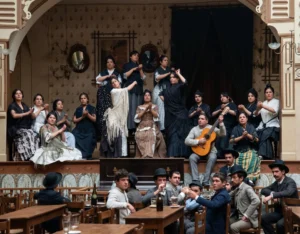
History of flamenco

What is flamenco? Origins, characteristics and essential elements

What is flamenco? Much more than a musical genre

Flamenco is one of Andalusia’s most recognisable cultural expressions and, at the same time, one of the most complex oral musical traditions to capture in a brief definition. It is cante, baile and guitar; but it is also compás, popular poetry, gesture, memory, improvisation, shared experience and a particular way of understanding artistic performance.

A useful way to approach it is to regard it, in essence, as an artistic reinterpretation of the Andalusian musical tradition, enriched and transformed over time by the complex cultural history of southern Spain. We could even speak of a kind of Andalusian musical Romanticism: a tradition that turns experiences, emotions, popular music and inherited forms of expression into an artistic language of its own.

It is the result of the blending of all the cultures that have passed through Andalusia.

Qué es el flamenco: origen, características y elementos fundamentales

However, explaining the origins of flamenco requires caution. For centuries Andalusia was a land of cultural exchange, migration, conquest, trade and coexistence among very different populations, but it is not possible to draw a direct and demonstrable musical line from Tartessians, Phoenicians, Romans, Arabs or Sephardic Jews to a present-day soleá or seguiriya. What we do know is that flamenco developed within this extraordinary Andalusian cultural ecosystem, that the Roma community also took part in its evolution, and that the first recognisable forms and performers begin to be documented during the 18th century, before its major public consolidation in the 19th.

Quick answer: flamenco is an artistic expression born and developed in Andalusia from the musical and cultural traditions of southern Spain. Its three classical pillars are cante, baile and toque. They are joined by compás, palmas, jaleo, the poetry of the lyrics and an extensive family of styles known as palos. Its antecedents are documented from the 18th century, and its professionalisation accelerated during the 19th, especially with the cafés cantantes. Since 2010 it has been included on UNESCO’s Representative List of the Intangible Cultural Heritage of Humanity.

What exactly do we mean by flamenco?

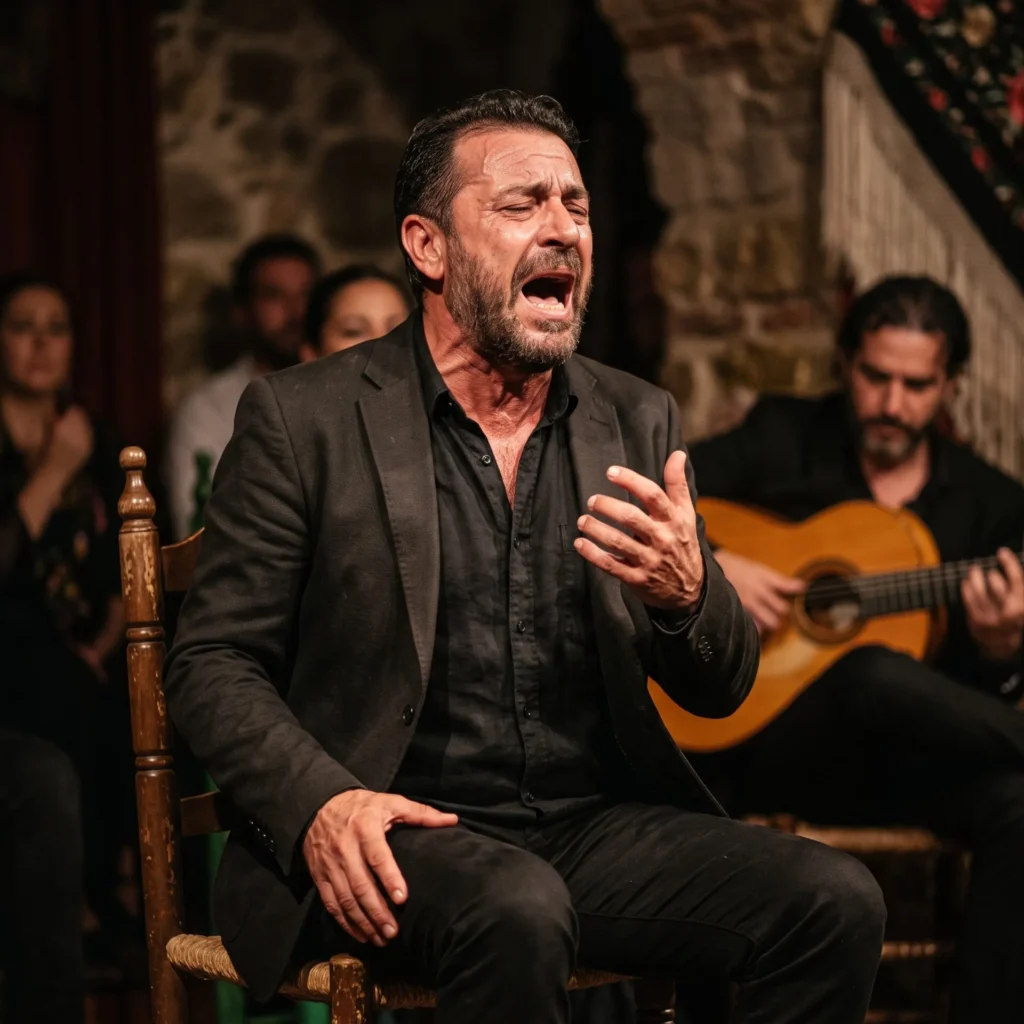
UNESCO defines flamenco as an artistic expression that brings together cante, baile and toque. It is a simple but very useful definition because it avoids reducing flamenco solely to dance —a very common misconception outside Spain— or identifying it only with the guitar.

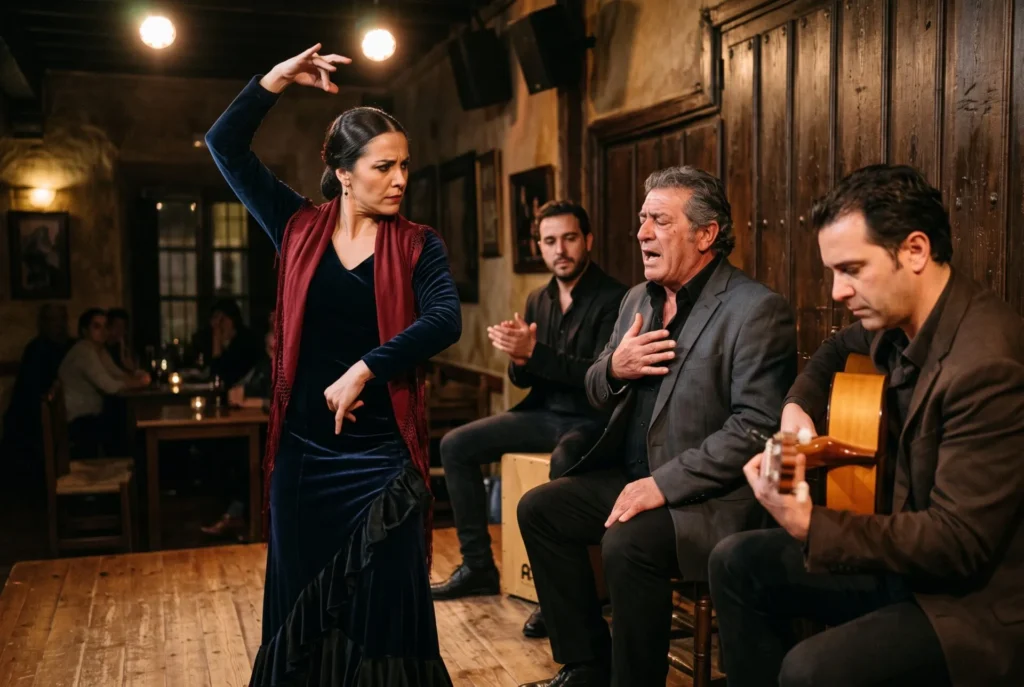
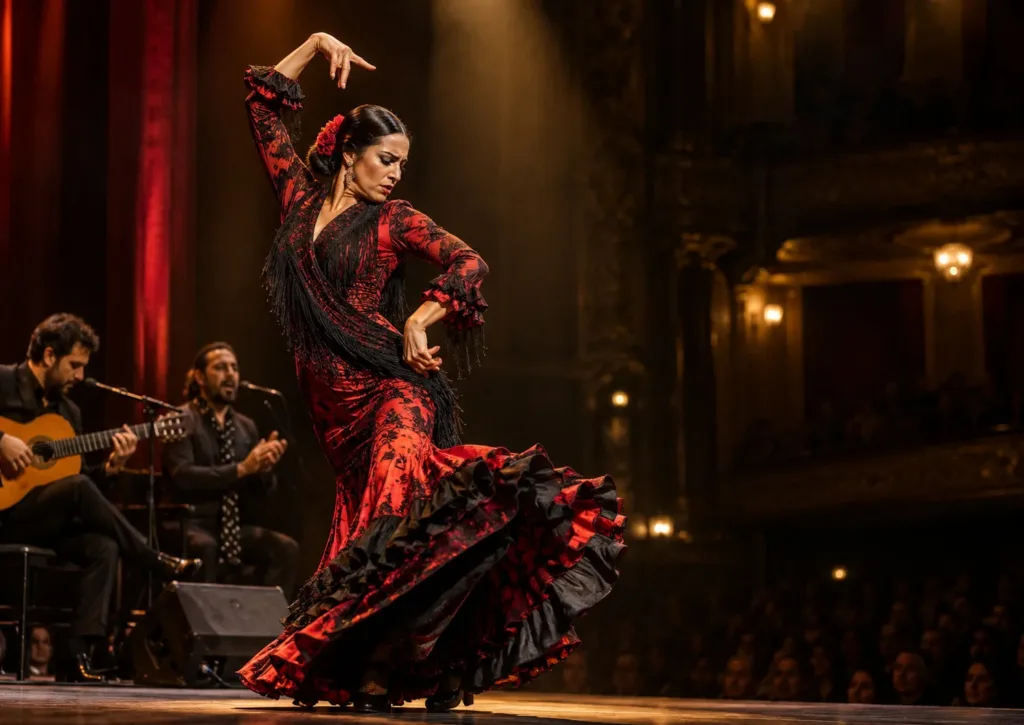
In reality, flamenco functions as a shared artistic system. The singer does not perform in isolation: they enter into dialogue with the guitar, the palmas and, when there is dance, with the dancer’s body. The guitarist accompanies, responds, anticipates, marks structures and also has spaces of their own. The dance listens to the cante and toque, proposes llamadas, cierres and remates, and visually reorganises the energy of the compás.

That is why a high-quality flamenco performance is not simply several disciplines layered on top of one another. What is truly flamenco emerges through interaction: knowing when to enter, when to remain silent, how to sustain the shared pulse and how to improvise without breaking the language of the palo being performed.

Flamenco is also a living tradition. It preserves old structures, but it has never stood still. For generations it has absorbed, transformed and created new repertoires, and it continues to do so today.

Qué es el flamenco: origen, características y elementos fundamentales

Where and how did flamenco originate?

The short answer is clear: Andalusia is the birthplace of flamenco. UNESCO recognises this too, although its heritage declaration also points to related roots and communities in Murcia and Extremadura.

The historical answer, however, needs more nuance. There is no birth certificate for flamenco, no single person who invented it, and no date on which an earlier music suddenly became flamenco. What we call flamenco gradually crystallised from music, dances, romances, poetic forms, ways of singing and social practices that already existed in Andalusia.

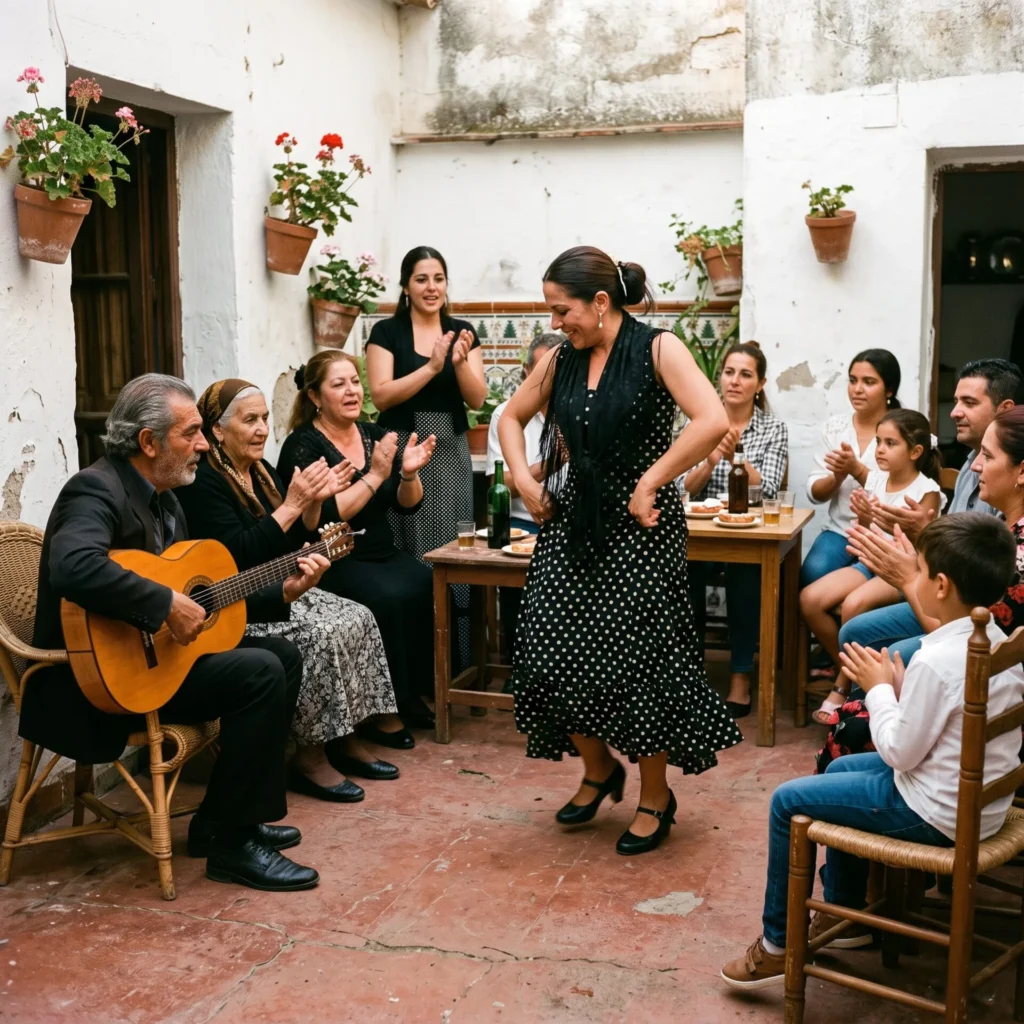
The first documentary references to defined flamenco forms and specialised performers date from the 18th century. During this early period, cante and baile appear in connection with family gatherings, festivities, workplaces, taverns and celebrations. In the 19th century these practices moved more forcefully into public spaces, became professionalised and began to acquire names, repertoires, performers and structures that we can clearly relate to modern flamenco.

This explains why flamenco can be said to have roots that predate the 19th century while, at the same time, the genre we recognise today was consolidated mainly in the middle and second half of that century. The two statements are not contradictory: one refers to the process of formation and the other to its artistic and professional configuration.

Andalusia: a territory of cultural encounters

To understand why flamenco could emerge in Andalusia, we need to look far beyond the musical genre itself and consider the history of the region.

Over the centuries, Andalusia has received populations, religions, languages and traditions from very different origins. The memory of ancient Tartessian and Iberian cultures was joined by Mediterranean colonisation, Phoenician and Carthaginian presence, Romanisation, the long centuries of al-Andalus, Sephardic Jewish communities, the transformations following the Christian conquest and, from the 15th century onwards, the settlement of Roma groups on the peninsula.

To this we must add a decisive element that is sometimes left out of simplified accounts: Andalusia also looked towards the Atlantic. For centuries, Cádiz and Seville were major gateways to the Americas. People, rhythms, dances, lyrics and music travelled in both directions. This relationship left particularly visible traces in the so-called cantes de ida y vuelta, such as the guajira, milonga and rumba, and probably influenced other processes of musical transformation as well.

Seville and Cádiz also exerted a powerful attraction on European travellers, merchants, sailors, artists and writers. During the Romantic period, the image of Andalusia became an object of international fascination. Travellers of the 18th and 19th centuries left some of the earliest written descriptions of festivities, dances and settings that now help us reconstruct flamenco’s documentary prehistory.

All this context makes it meaningful to speak of cultural blending, but we should avoid an overly simple conclusion: that each civilisation contributed a specific piece that was later assembled to create flamenco. Cultural history does not work like a recipe. Rather than a mechanical sum of influences, flamenco should be understood as an Andalusian creation born from historical processes of coexistence, appropriation, reinterpretation and transformation.

Qué es el flamenco: origen, características y elementos fundamentales

Contributions of the Roma community to flamenco

Flamenco cannot be attributed to a single people or community. It is an Andalusian artistic creation that took shape through the participation of diverse artists, families and traditions. Within that process, some Roma communities and families settled in Andalusia made important contributions to certain styles, but it is not rigorous to present Roma people as the exclusive creators of flamenco or as fundamentally responsible for its entire development.

The first documented Roma groups arrived on the Iberian Peninsula in the 15th century. Their historical mobility and later settlement in different territories encouraged, as happened elsewhere in Europe, the adoption and reinterpretation of local music. In Andalusia, this contact took place with existing repertoires, dances and popular forms, which certain families incorporated into their own festive, family and, later, professional contexts.

In some cases, Roma artists and families directly participated in the creation, consolidation or development of styles and variants that are now part of the flamenco repertoire. Their contribution is especially visible in centres such as Jerez, Utrera, Lebrija, Cádiz, Triana and Granada, where performers and families of major historical importance emerged. The bulerías are a good example: in Jerez and other areas they became a festive language of enormous rhythmic richness, closely tied to play with compás, remates and collective improvisation.

The association of some Roma families with festive, compás-driven styles should be understood as the result of practice, family transmission and particular social contexts, not as an exclusive or innate quality of a people. Throughout flamenco history we find great Roma and non-Roma artists who have helped create, preserve, transmit and transform its different palos. The Roma contribution is part of that history, but within a much broader Andalusian artistic process.

From the 18th to the 19th century: when documented flamenco appears

Rather than looking for a single date, it is more useful to observe a number of milestones that allow us to follow the transition from popular and family practices to a professional art with a name of its own.

18th century

First references

Defined forms and specialised performers linked to the genesis of flamenco begin to be documented.

1831

A dance in Triana

Serafín Estébanez Calderón describes in Escenas Andaluzas settings and practices that are fundamental for understanding that pre-flamenco world.

1847

The term in the press

The word “flamenco” is documented in the press in connection with cante, indicating that the new designation was beginning to take hold.

2nd half of the 19th century

Professionalisation

The cafés cantantes expanded audiences, the number of professional artists and the specialisation of repertoires.

In 1881, Antonio Machado y Álvarez, Demófilo, published his Colección de cantes flamencos, a fundamental work for the early study of the genre. By the end of the 19th century, flamenco already had professional artists, specialised venues, recognisable repertoires, schools of performance and a sufficiently consolidated public presence to speak of an artistic phenomenon with an identity of its own.

Where does the word “flamenco” come from?

The etymology and, above all, the semantic path that led the word flamenco to be used for this art have given rise to numerous theories. Links have been proposed with Flanders, Roma people, supposed Arabic expressions, the bird of the same name and even old types of knife.

Modern lexicographical research allows us to separate two questions. The Spanish word flamenco as a demonym related to Flanders is very old. What is truly interesting is how that word came to be associated in the 19th century with particular people, settings and Andalusian artistic forms.

The Diccionario flamenco. Léxico del cante, toque y baile andaluces, published by the Regional Government of Andalusia, notes that in the 19th century the term was closely associated semantically with what was considered Roma-influenced and documents its use in relation to cante in the press in 1847. From the middle of the century onwards, the new meaning spread and ultimately came to designate the artistic genre.

Therefore, when expressions such as felah-mengus or other popular explanations are mentioned, they should be presented as historical hypotheses, not as a definitively proven etymology for the name of the genre.

The cafés cantantes: when flamenco became a profession

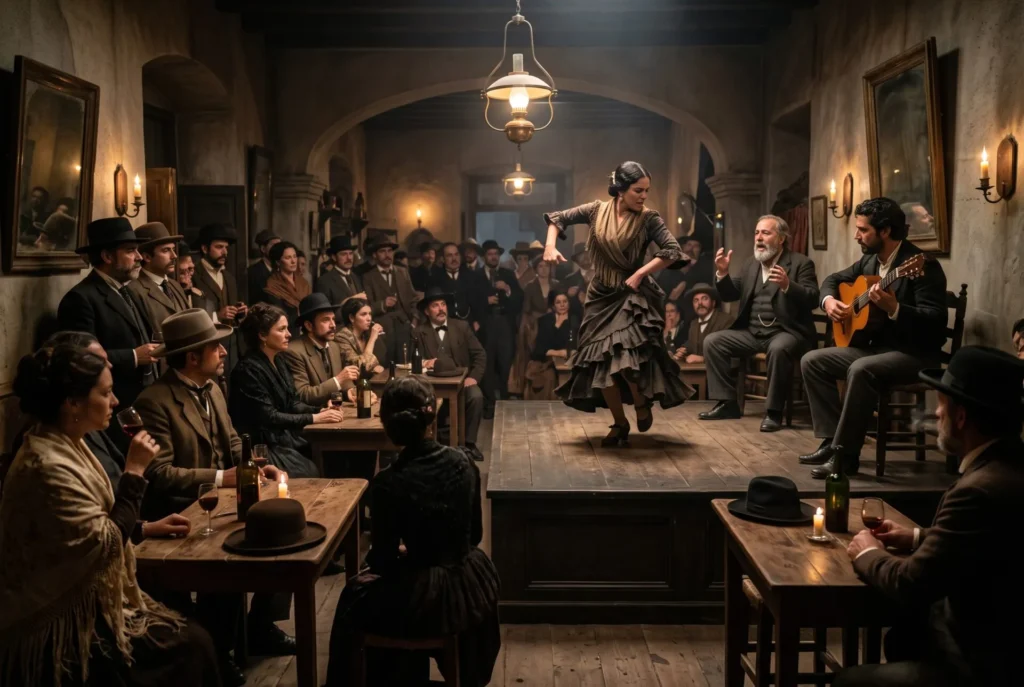
The second half of the 19th century was decisive because flamenco ceased to depend solely on private festivities, family gatherings, taverns or occasional celebrations and found a stable professional circuit in the so-called cafés cantantes.

These were establishments where drinks were served and performances of cante, baile and guitar were offered. Researcher José Blas Vega placed their great period between 1847 and 1920. Seville had famous venues such as Café de Silverio and Café del Burrero; Cádiz, Jerez, Málaga, Granada, Córdoba and other Andalusian cities also developed intense activity.

Their importance was enormous. Artists began to be paid regularly, competition increased, repertoires expanded and specialists in particular cantes emerged. The guitar became firmly established as a fundamental accompaniment, while dance used the wooden stages to develop technical and theatrical resources with greater projection.

Qué es el flamenco: origen, características y elementos fundamentales

The cafés cantantes also created an audience. Flamenco ceased to belong only to those who participated in certain family or social circles and became a show accessible to much wider audiences.

From the cafés cantantes to contemporary flamenco

Flamenco did not stop transforming after its professionalisation. Each stage changed the relationship between artists, audiences, repertoire and performance spaces.

Ópera Flamenca

For much of the 20th century, large companies took flamenco to theatres, bullrings and tours. Fandangos, fandanguillos and more melodic forms became enormously popular, while figures such as Pepe Marchena defined an era.

Festivals, peñas and tablaos

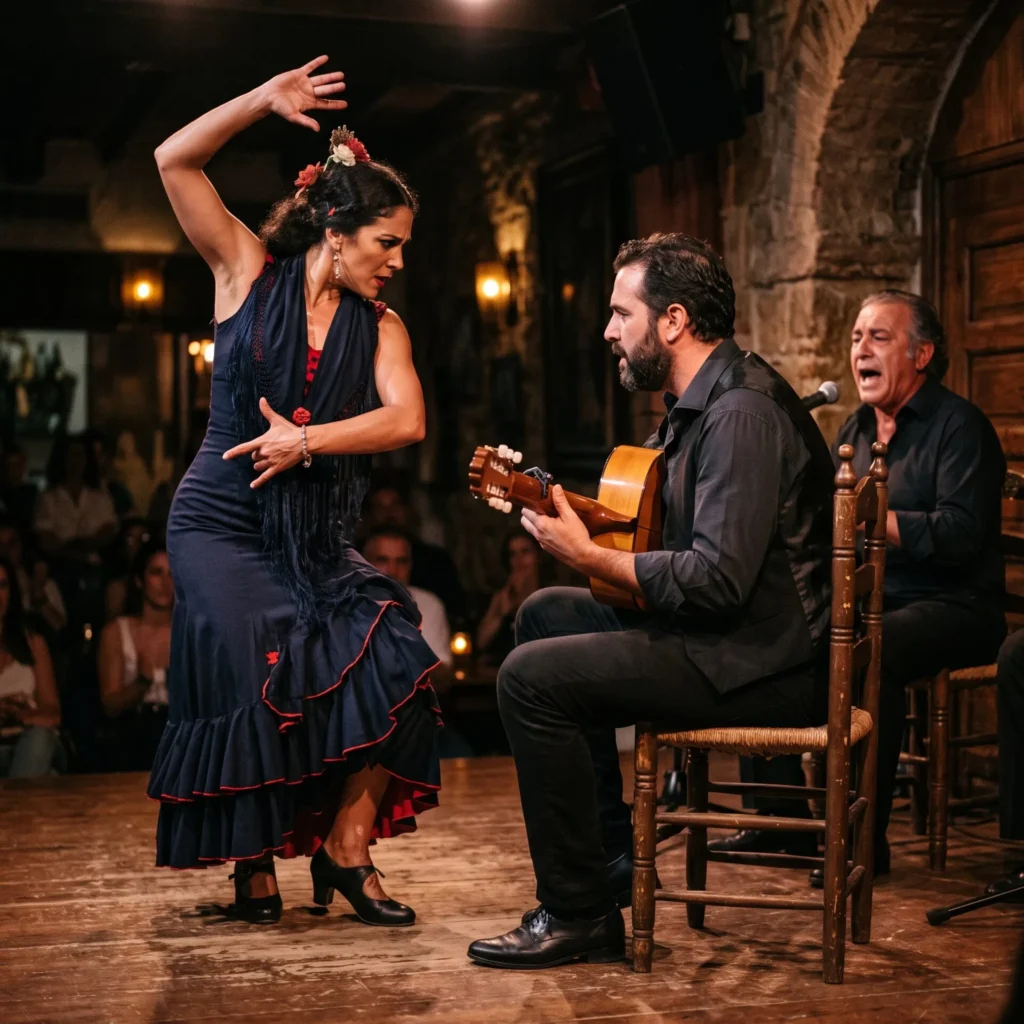
From the mid-20th century onwards, flamenco festivals and peñas grew, while tablaos consolidated a close-up professional format that brings together cante, baile and toque for national and international audiences.

The contemporary stage

Flamenco today coexists in theatres, festivals, tablaos, peñas, recording studios and experimental spaces. The tradition continues, but it constantly enters into dialogue with new forms of composition, dance and staging.

The three fundamental elements: cante, baile and toque

The internationally accepted definition of flamenco starts with three major disciplines. Each can appear separately, but together they form the core of the modern flamenco performance.

Cante

The flamenco voice. It conveys the lyrics, melody and a way of performing based on expressive resources, melismas, vocal breaks, intensity and personality.

Baile

Flamenco’s bodily expression. It integrates posture, arms, hands, movement, zapateado, llamadas, cierres and a constant relationship with cante and guitar.

Toque

The language of the flamenco guitar. It accompanies and sustains the compás, dialogues with cante and baile, and also has a fully developed solo repertoire.

Cante: the vocal heart of flamenco

The flamenco cante is not defined by having a “beautiful” voice in the conventional sense. What matters is the ability to interpret the palo, master its sections, breathe the melody, control time and communicate the lyrics with a recognisable personality.

There are clean, rough, dark, metallic, broken, high and low voices. Flamenco tradition has valued precisely this diversity. The singer works with melodic ornaments, melismas, appoggiaturas, portamentos, silences and accents that can profoundly alter the same lyric.

Flamenco lyrics are usually brief and largely come from popular poetry. They speak of love, loss, family, work, prison, death, joy, humour, pride, poverty, landscape, religion and everyday experience. Their power does not depend on literary complexity, but on the ability to condense an emotion into a few lines.

Among the great historical names of cante are Silverio Franconetti, Antonio Chacón, Manuel Torre, Pastora Pavón “La Niña de los Peines”, Antonio Mairena, Pepe Marchena and Manuel Vallejo, alongside countless artists who have preserved and transformed the different styles.

Qué es el flamenco: origen, características y elementos fundamentales

Baile: rhythm turned into movement

The flamenco baile uses the entire body as an expressive instrument. It is not only zapateado. Posture, gaze, placement, arms, hands, torso, movement, pauses and the relationship with space are as important as footwork.

Traditional baile contains structures shared with musicians and singers: entrances, llamadas, letras, escobillas, remates and cierres. The dancer can signal changes through a bodily llamada; the guitar and cante respond; the palmas reinforce the transition. This communication makes every performance slightly different.

From the mid-19th century onwards, baile became especially professionalised in the cafés cantantes. Wooden stages encouraged more brilliant footwork, and the stage gradually developed technical and aesthetic resources of its own. Later came major companies, flamenco ballets and contemporary proposals that greatly expanded the choreographic vocabulary.

Toque: the guitar as accompaniment and a voice of its own

The flamenco guitar emerged artistically in connection with accompaniment, but it stopped being a secondary element long ago. The toque organises harmonies, sustains the compás, prepares entrances, responds to the singer, accompanies the dance and creates its own instrumental spaces through falsetas.

During the 19th century, the profession of the specialised flamenco guitarist gradually became established. Since then, technique has evolved extraordinarily: rasgueados, picados, arpeggios, alzapúa, tremolos, golpes and different rhythmic resources form part of a specific guitar language.

Ramón Montoya, Sabicas, Niño Ricardo, Paco de Lucía, Manolo Sanlúcar and many other figures successively expanded the instrument’s possibilities. Today flamenco guitar has an independent concert tradition, although the art of accompanying cante and baile well remains one of the most highly valued skills within the genre.

Compás: flamenco’s invisible architecture

For anyone approaching flamenco for the first time, one of the most important words is compás. It does not simply mean “rhythm”: it is the cyclical organisation of time, accents and expectations shared by cante, toque, baile and palmas.

An artist may move ahead, delay a phrase or play with silence, but the group knows where it is because everyone shares the same rhythmic map. That collective sense of time is one of flamenco’s most fascinating characteristics.

Some palos use triple metres, such as different fandangos; others are structured in four-beat patterns, such as tangos and tientos; and there is a large family based on cycles of twelve beats, including soleá, bulerías, alegrías, cantiñas and seguiriyas, each with different accents and ways of feeling the cycle.

There are also cantes performed in free rhythm, in which the singer has great temporal flexibility and the guitar follows the breathing and melodic development. Malagueñas, granaínas and certain mining cantes clearly demonstrate this freedom.

Learning flamenco largely means learning to hear the compás. That is why palmas and rhythmic recognition are fundamental tools even for people who do not intend to become musicians or dancers.

What are flamenco palos?

Flamenco is not a single musical form. It is organised into dozens of families and styles known as palos. Spain’s Ministry of Culture identifies more than fifty styles associated with flamenco.

Soleá, seguiriya and related families

They represent some of the structures historically most closely linked to cante jondo. They usually demand a strong command of compás and a performance of great expressive intensity.

Tangos, tientos and binary rhythms

Tangos have a lively and flexible four-beat compás. Tientos are rhythmically related, although they develop a slower and more solemn character.

Cantiñas, alegrías and bulerías

The styles of Cádiz and bulerías show flamenco’s capacity for celebration, rhythmic play, virtuosity and collective improvisation.

Fandangos and related forms

The world of fandango is vast: Huelva, Málaga, Granada and other areas developed local and personal variants that were later flamencoised.

Tonás and unaccompanied cantes

Martinetes, tonás and other styles can be performed without guitar. They show that instrumental accompaniment is not an indispensable requirement for flamenco to exist.

Ida y vuelta and mining cantes

Guajiras, milongas and rumbas reveal Atlantic connections; tarantas, tarantos, mineras and cartageneras reflect other social and musical landscapes of south-eastern Spain.

Palmas and jaleo: accompaniment is also interpretation

The palmas are one of flamenco’s fundamental rhythmic instruments. They can be sharper and brighter or more muted, depending on the effect required by the performance. A good palmero does not simply repeat a pattern: they listen to the dynamics, know when to reinforce, when to hold back and how to accompany changes in intensity.

The jaleo includes exclamations and responses that encourage, signal or support what is happening: “¡olé!”, “¡arsa!”, “¡vamos allá!” and many other expressions. Jaleo is not about shouting at random. In flamenco contexts it functions as a form of communication that acknowledges an especially successful moment, spurs on the performer or marks the collective energy.

Palmas and jaleo remind us that flamenco was born and developed for a long time in participatory settings. The rigid separation between stage and audience is relatively recent compared with the long tradition of gatherings, festivities and family circles in which everyone could contribute in some way.

Zapateado, llamadas, remates, cierres and falsetas

Flamenco vocabulary contains numerous terms that describe specific moments in a performance. Knowing them helps us understand that a show is not improvised “without rules”, even though there is enormous creative freedom.

The zapateado uses the feet and footwear as a rhythmic resource. A llamada can announce an entrance or transition. A remate concentrates and resolves a phrase or section; a cierre marks a clearer conclusion. On the guitar, a falseta is an instrumental passage with an identity of its own that the guitarist inserts into the structure of the palo.

These conventions allow artists who are not performing a completely fixed choreography to understand one another on stage. Flamenco therefore combines something apparently contradictory: structure and improvisation.

Flamenco harmony and melody

The flamenco sound does not depend on a single scale or a single harmonic formula, but certain resources appear particularly often.

A significant part of the repertoire uses modal languages associated with the so-called flamenco mode, related to Phrygian sonorities and cadences that are highly characteristic of the guitar. Other palos clearly operate in major or minor keys, and some alternate or combine different harmonic behaviours.

Cante also brings a melodic flexibility that is difficult to represent fully in traditional Western notation. Singers use melismas, inflections, appoggiaturas, attacks and expressive tuning variations that form part of the style. This helps explain why learning a flamenco melody solely from sheet music is not the same as learning to sing it “por flamenco”.

In flamenco, tuning, rhythm and harmony are always subordinate to something broader: the performance. Two artists can sing the same lyric and the same style without ever producing an identical version.

The lyrics: concentrated popular poetry

Much flamenco poetry is built from short lines, often in traditional short metres, and stanzas drawn from popular tradition. This apparent simplicity allows for enormous emotional density.

A lyric can tell a complete story in three or four lines. It can express the loss of a mother, romantic disappointment, injustice, the joy of a celebration or a reflection on death. Performance transforms those words: repetition, silence or a melodic extension can turn an everyday line into the emotional centre of the entire cante.

Oral transmission has also generated countless variants. Lyrics travel from one singer to another, words change, they adapt to different palos or mix with authored texts. Federico García Lorca, Manuel Machado and many other writers took a deep interest in Andalusian popular poetry and its relationship with cante.

But one essential point should be remembered: flamenco does not need tragic lyrics to be profound. There are festive, humorous, romantic and bright styles. Reducing flamenco exclusively to pain would mean ignoring a large part of its repertoire.

The geography of flamenco: many territories within one tradition

Andalusia is the birthplace of flamenco, but within Andalusia each territory has developed repertoires, schools and ways of performing with a personality of its own.

Cádiz and Jerez

Cádiz, the Bay towns and Jerez de la Frontera are fundamental to cantiñas, alegrías, bulerías, seguiriyas, soleares and numerous personal styles. Jerez also preserves one of flamenco’s most powerful family and festive traditions.

Seville, Triana, Utrera and Lebrija

Seville was a decisive centre of professionalisation, especially during the era of the cafés cantantes. Triana has a flamenco memory of its own, while Utrera and Lebrija have produced essential artistic dynasties and ways of performing.

Málaga, Granada and Huelva

Málaga developed an extraordinary world of malagueñas and cantes abandolaos; Granada contributes granaínas, fandangos and the Sacromonte tradition; Huelva preserves an exceptional diversity of local fandangos.

Córdoba, Almería and Jaén are also part of Andalusia’s flamenco geography. Outside Andalusia, Murcia and the mining area of La Unión are essential for understanding the cantes de Levante, while Extremadura preserves highly distinctive flamenco traditions, especially around tangos and Extremaduran jaleos.

Flamenco therefore has a recognisable cultural homeland, but not a single birthplace. Its map is a network of cities, neighbourhoods, towns, families and musical routes that have influenced one another for generations.

Is flamenco the same as Andalusian folklore?

No. Flamenco is deeply connected with Andalusian folklore and has drawn from it, but it has developed its own specialised artistic language, repertoires, techniques and performance codes.

Many forms of popular music have been flamencoised, that is, reinterpreted through the flamenco language. Others have influenced the creation of palos or are performed in contexts where popular and flamenco musicians coexist.

This relationship explains why the boundaries are not always absolute. Flamenco has grown precisely through its ability to artistically appropriate diverse materials and turn them into something recognisable within its own system.

Are sevillanas flamenco?

The sevillanas belong primarily to Andalusian folklore and have their own structure, choreography and social function. They are danced extensively at fairs, pilgrimages and celebrations and form a central part of Andalusian popular culture.

However, their history maintains links with musical forms close to flamenco, and many flamenco artists have performed them. They can therefore appear in flamenco repertoires and contexts without it being correct to automatically identify “sevillanas” and “flamenco” as if they were the same thing.

Today, sevillanas are considered a flamenco palo.

The distinction is useful for understanding a broader idea: not all Andalusian music is flamenco, even though flamenco is profoundly Andalusian.

And what is duende?

Few words associated with flamenco have achieved as much international fame as duende. It is also one of the most difficult to explain without falling into clichés.

Duende is not a palo, a vocal technique or a musical element that can be measured. It is used to describe an exceptional state of inspiration, intensity and truth in performance: the feeling that, for a few minutes, the artist goes beyond correct execution and produces something unrepeatable.

Federico García Lorca contributed enormously to popularising the concept in his lecture Juego y teoría del duende. Since then, it has become almost a universal metaphor for flamenco creation.

But duende should not be used as a magical explanation for everything. A singer masters styles, a guitarist studies for years and a dancer works on technique, compás and the body. Flamenco emotion does not replace knowledge: it is built upon it. Duende, if it appears, comes afterwards.

Flamenco today: tradition, heritage and creation

Flamenco was inscribed in 2010 on UNESCO’s Representative List of the Intangible Cultural Heritage of Humanity. Recognition did not turn into heritage something that had not previously been heritage; it gave international visibility to a tradition that already functioned as an element of identity for many communities.

Today it is transmitted within families and artistic dynasties, but also in peñas, tablaos, academies, conservatoires, universities and professional companies. It can be heard at an intimate gathering and, the next day, take the stage in a major international theatre.

This breadth explains recurring debates about “purity” and innovation. Flamenco has always changed. The cafés cantantes changed the profession; recordings altered the way people learned; Ópera Flamenca broadened audiences; festivals recovered repertoires; Paco de Lucía revolutionised the guitar; contemporary dance incorporated new stage languages.

The useful question is not whether flamenco changes, because it always has, but how it changes and what relationship each new proposal maintains with the language that precedes it.

How to start listening to flamenco

You do not need to know music theory to enjoy it. But attentive listening reveals layers that can initially go unnoticed.

1. Find the pulse

Try to follow the palmas or the guitar pattern. Do not always count: first feel where the cycle returns.

2. Listen to the voice

Notice how the singer changes each line, breathes, lengthens syllables and builds tension and release.

3. Watch the dialogue

Notice how guitar, baile, cante and palmas respond to one another. Many decisions happen in real time.

4. Compare versions

Listen to the same palo performed by several artists. You will recognise a common structure and, at the same time, completely different personalities.

Some common misconceptions about flamenco

  • “Flamenco is a dance.” Dance is only one of its pillars. There are cante recitals, guitar concerts and palos performed without dance.
  • “All flamenco is sad.” There are profoundly dramatic seguiriyas, but also festive bulerías, alegrías, tangos, cantiñas and many bright, joyful styles.
  • “It was created by a single people.” The Roma community played an essential role, but flamenco developed within Andalusian society through interaction among diverse groups and traditions.
  • “Its Eastern origin has been perfectly proven.” There are affinities, hypotheses and historical influences, but many traditional theories about remote origins cannot be demonstrated as direct musical lineages.

What does allow us to recognise it

  • A repertoire organised into palos with rhythmic, melodic and expressive identities.
  • A specific relationship among cante, toque, baile and compás.
  • The importance of personal interpretation within inherited structures.
  • A historical and social tradition centrally linked to Andalusia.
  • Transmission through families, artists, peñas, stages, recordings and teaching.
  • A permanent capacity to transform musical materials without losing a recognisable identity.

So how can we define flamenco?

After exploring its history, perhaps we can return to the initial definition with more tools.

Flamenco is an artistic creation with Andalusian roots that transformed existing musical, poetic and dance traditions into a performance system of its own. It developed in contact with a historically diverse society, received contributions and echoes from different cultural worlds, and found in the Andalusian Roma community one of its essential agents of creation and transmission.

Its antecedents become visible in the 18th century and its modern configuration accelerated in the 19th, when the word “flamenco” began to be applied to the genre and the cafés cantantes professionalised singers, dancers and guitarists.

Since then it has never stopped evolving. What remains is a particular way of organising time, interpreting melody, turning words into cante and making artists interact. That continuity within change is probably one of the best explanations for why flamenco remains recognisable after almost two centuries of documented transformation.

Frequently asked questions about flamenco

Flamenco is an artistic expression with primarily Andalusian roots, based on cante, baile and toque and articulated through palos, compás patterns and its own performance codes. Its history is linked to Andalusian cultural tradition and to the essential role of the Roma community in its development.

Andalusia is recognised as the birthplace of flamenco. Cádiz, Jerez, Seville, Triana, Utrera, Lebrija, Málaga, Granada, Huelva and other Andalusian territories played fundamental roles, although flamenco also has important historical roots and developments in Murcia and Extremadura.

There is no single date. The first references to defined forms and specialised performers are documented in the 18th century. During the 19th century the genre gained greater public visibility, the term “flamenco” began to be used and it became professionalised, especially through the cafés cantantes.

Andalusian. It is the result of the blending of all the cultures that have passed through Andalusia. Roma people also participated in its development. Presenting it as a choice between “Roma” and “Andalusian” oversimplifies a process of cultural interaction in which Roma and non-Roma communities took part.

The three classical pillars are cante, baile and toque. Around them are other fundamental elements such as compás, palmas, jaleo and the shared codes used by performers.

They are families or styles that organise the repertoire according to characteristics of compás, melody, structure, character and tradition. Soleá, seguiriya, bulerías, tangos, alegrías, fandangos, tarantas and guajiras are some examples.

All have a musical organisation, but not all are performed over a marked rhythmic cycle in the same way. Some palos have a very clearly defined compás, while others are performed freely, such as certain malagueñas, granaínas and tarantas.

Sevillanas belong mainly to Andalusian folklore, although they have historical and artistic links with the flamenco world and are performed by many flamenco artists. In fact, they are considered a flamenco palo. It is not correct to use “sevillanas” and “flamenco” as synonyms.

The word has a complex history. The term “flamenco” existed much earlier as a demonym related to Flanders. In the 19th century it was also associated with what was perceived as Roma-influenced, and from the middle of that century it begins to be documented in relation to cante and later to the artistic genre. Other theories exist, but many remain hypotheses that have not been definitively proven.

Flamenco was inscribed in 2010 on UNESCO’s Representative List of the Intangible Cultural Heritage of Humanity.

Sources and references for further research

This guide has cross-checked institutional sources and research and educational materials on flamenco. The origins of the genre remain a subject of study, so it is especially important to distinguish historical documentation, hypotheses and interpretations.

Book online: the key to securing your seat

In many cities, flamenco tablaos sell out easily, especially on weekends and during peak season. That’s why, if your dates are set, the most important thing is to book online.

Direct recommendation: book online through our website to guarantee your seat and arrive with everything confirmed. If you already have your destination, go straight to your city to see available options and clear recommendations.

Flamenco Sevilla | Tablaos Flamencos

Seville

Flamenco Madrid | Tablaos Flamencos

Madrid

Flamenco Barcelona | Tablaos Flamencos

Barcelona

Flamenco Granada | Tablaos Flamencos

Granada

Flamenco Córdoba | Tablaos Flamencos

Cordoba

Flamenco Málaga | Tablaos Flamencos

Malaga

Flamenco Valencia | Tablaos Flamencos

Valencia

Flamenco Jerez | Tablaos Flamencos

Jerez

Find out more about this with your favorite AI:

Did you like this article? Share it!:

Tags: flamenco dance, flamenco guitar, flamenco palos, flamenco singing, history of flamenco, origins of flamenco, what is flamenco

Article published by:

Related articles