Flamenco festivals

Ciudad del Sol Lorca Festival 2026: programme, dates, competition and prizes

Ciudad del Sol Lorca Festival 2026: flamenco singing takes over the city again

The 35th International Flamenco Singing Festival “Ciudad del Sol” of Lorca will be held between September and October 2026 with a format combining a singing competition, performances, dance, talks, an exhibition, a documentary and a flamenco mass. One of this year’s main changes comes in the final stage: for the first time in this format, the decisive days will take place at the Margarita Lozano Auditorium, from 15 to 17 October.

Before the semi-final and grand final, around thirty contestants selected from more than fifty applications will take part in four qualifying rounds. The dates will be Saturdays 12, 19 and 26 September and 3 October, always at 18:00. The first will be held at the Palacio de Guevara, the second at the Alfonso X Civic Centre and the third at the premises of the Campillo Residents’ Association. The venue for the fourth round was still awaiting confirmation when the official programme was presented.

Last updated: 6 September 2026. The programme may change. Check times, venues and access conditions through official channels before travelling.

Essential information about the Ciudad del Sol Festival 2026

  • Edition: 35th International Flamenco Singing Festival “Ciudad del Sol”.
  • City: Lorca, Region of Murcia.
  • Qualifying rounds: 12, 19 and 26 September and 3 October 2026.
  • Qualifying-round time: 18:00.
  • Final stage: 15, 16 and 17 October 2026.
  • Final-stage venue: Margarita Lozano Auditorium.
  • Semi-final: Friday 16 October, 21:00.
  • Grand final: Saturday 17 October, 18:00.
  • Organised by: Peña Cultural Flamenca Ciudad del Sol, with the support of Lorca City Council.
  • Prizes: Sol de Oro, Sol de Plata, Sol de Bronce and two runners-up prizes.
  • Contestant registration: closed on 4 September 2026.

Quick answer: the Ciudad del Sol Lorca Festival 2026 celebrates its 35th edition with four qualifying rounds on 12, 19 and 26 September and 3 October, followed by a final stage from 15 to 17 October at the Margarita Lozano Auditorium. The Sol de Oro carries a €4,000 prize, the Sol de Plata €2,500 and the Sol de Bronce €1,500. The parallel programme includes an exhibition, talks, dance, a documentary, a flamenco mass and guest performances.

Competition schedule: four qualifying rounds before the final

The competition keeps preliminary rounds before an audience and jury as one of its central features. Four qualifying rounds have been announced for 2026, all on Saturdays at 18:00. This allows the event to run over several weeks and spreads flamenco across different venues in Lorca before the programme moves to the Margarita Lozano Auditorium.

Date Time Stage Venue
12 September 18:00 1st qualifying round Courtyard of the Palacio de Guevara
19 September 18:00 2nd qualifying round Alfonso X Civic Centre
26 September 18:00 3rd qualifying round Campillo Residents’ Association premises
3 October 18:00 4th qualifying round Awaiting confirmation in the official presentation
15 October To be confirmed Opening and festival address Margarita Lozano Auditorium
16 October 21:00 Semi-final Margarita Lozano Auditorium
17 October 18:00 Grand final and awards Margarita Lozano Auditorium

The high level of participation is once again a sign of the competition’s importance. The organisers reported more than fifty applications and the admission of around thirty contestants in order of submission, with the remainder placed on a reserve list. Registration closed on 4 September, so as of the date of this guide’s update it is no longer open to new applicants.

For audiences, the qualifying rounds offer something different from a conventional gala. They provide an opportunity to hear singers seeking to establish themselves or strengthen their careers, compare styles and repertoires, and follow the competition through to the semi-final. This competitive element, together with the tradition of the Peña Ciudad del Sol, is precisely what distinguishes the event from a festival built solely around contracted artists.

The final stage moves to the Margarita Lozano Auditorium

The main organisational change in 2026 is the choice of the Margarita Lozano Auditorium as the venue for the decisive stage. The official programme concentrates three days there: the opening and festival address on Thursday 15, the semi-final on Friday 16 and the grand final on Saturday 17 October.

The Margarita Lozano Auditorium is located at Calle Santa Quiteria, 28, 30800 Lorca, Murcia, Spain.

This is not a minor change. In a singing competition, acoustics, visibility and listening conditions directly shape the experience for both audience and jury. Lorca City Council has specifically highlighted the auditorium’s technical and acoustic qualities as one of the reasons for strengthening the festival’s final stage.

15, 16 and 17 October: the three decisive nights

15 October: opening, festival address and Susana Romero Alonso

The opening of the final stage will feature a performance by Susana Romero Alonso, a singer from Cádiz and winner of the 2025 Sol de Oro. The same day will also feature guest artist Emiliano Domínguez Bermúdez “El Crespo Zapata”, son of José Domínguez Muñoz “El Cabrero”. Styles mentioned in the presentation include soleá, seguiriya and serranas.

16 October: semi-final at 21:00

Friday will be devoted to the competition semi-final. Contestants who have made it through the qualifying rounds will compete for a place on the final night. The session will begin at 21:00.

17 October: grand final at 18:00

The final will begin at 18:00. It will determine the winners of the Sol de Oro, Sol de Plata and Sol de Bronce, as well as the runners-up prizes for the semi-finalists.

Prizes at the Ciudad del Sol Lorca Festival 2026

The competition maintains a clear and recognisable prize structure. The top award is the Sol de Oro, followed by the Sol de Plata and Sol de Bronce. Together, the three main prizes total €8,000, plus two runners-up prizes.

  • Sol de Oro: €4,000.
  • Sol de Plata: €2,500.
  • Sol de Bronce: €1,500.
  • Two runners-up prizes: €700 each.

A competition that also creates visibility

Beyond the prize money, the value of competitions like this also lies in the visibility they provide. In flamenco, many competitions have historically served as places to discover voices, give younger artists opportunities and connect performers from very different backgrounds with fans, peñas, programmers and industry professionals.

In Lorca, that competitive dimension is combined with an extensive cultural programme. The result is a festival that does more than choose a winner: it uses the competition as the core around which other educational and performance activities are developed.

More than a competition: exhibition and talks

The 35th edition expands its calendar with activities that approach flamenco from different perspectives. The announced programme includes visual arts, research, memory, dance, documentary film and a religious celebration with flamenco music.

“El rostro del cante y la lidia”

On Friday 2 October at 20:00 the exhibition is scheduled to open El rostro del cante y la lidia, by Málaga-born artist based in Murcia Cristóbal Pérez García “Toval”. It will remain at the Palacio de Guevara until the end of October.

Four talks

Álvaro Zaldívar Gracia will discuss Federico García Lorca and Manuel de Falla’s relationship with Granada’s 1922 Concurso de Cante Jondo. José Francisco Ortega Castejón will give two talks, one introducing flamenco and another focused on “la lorquina”, an old style of flamenco singing associated with Lorca. The fourth talk will be given by Curro Piñana, who will offer an introduction to eastern Spanish flamenco styles, accompanied in a singing demonstration by Pablo Barrionuevo.

Documentary on El Cabrero and flamenco mass

Mi patria es la libertad

Among the new additions is a screening of Mi patria es la libertad, a documentary about José Domínguez Muñoz “El Cabrero”. Directed by Joaquín Mimbreros with the collaboration of Elena Bermúdez, the film explores the artistic and personal life of one of the most recognisable flamenco singers of recent decades.

Flamenco mass on 12 October

For the first time, the festival will include a flamenco mass. The service is scheduled for Monday 12 October at 11:00 at San Mateo parish church. Participants will include Murcia singer Maribel Castillo, guitarist Faustino Fernández and students from Ballet Ciudad del Sol with a choreographed intervention.

Dance, Grupo Antares and tribute to Juan Picazo Carrillo

The three days of the final stage will not be devoted exclusively to singing. The organisers have announced dance performances by a flamenco ensemble and students from the Escuela de Ballet Ciudad del Sol. The programme is also expected to feature Grupo Antares de Murcia and other guest groups.

The 2026 edition will also have a particularly emotional element with a tribute to Juan Picazo Carrillo, who recently died and presented the festival for around thirty years. His figure was closely linked to the event’s own stage memory, giving the tribute a significance that goes beyond a formal distinction.

The programme also includes tributes to other people and institutions connected with the preservation and promotion of flamenco.

Tickets and access: what we know

The official programme presentation published by Lorca City Council details dates, venues and times for the main stages, but does not set a general ticket price or a single sales system for the 2026 edition in that announcement. For that reason, prices from previous editions should not automatically be applied to the current programme.

If you want to attend a qualifying round, semi-final, final or parallel activity, we recommend checking the latest information on the Peña Cultural Flamenca Ciudad del Sol website, Lorca City Council channels and the Margarita Lozano Auditorium cultural programme. If advance sales are announced, we will add the official link here.

This precaution is particularly important for the final stage, as the change of venue may involve a different access system from previous years.

How to plan a visit to Lorca during the festival

If your main aim is to follow the competition, the easiest dates to plan around are the Saturdays with qualifying rounds and, above all, the final-stage weekend. Friday 16 and Saturday 17 October bring together the semi-final and final, so a two-night stay lets you experience the most intense competitive part of the festival.

Visitors who want to combine flamenco and heritage can take advantage of activities at the Palacio de Guevara and Lorca’s historic centre. The exhibition on 2 October also provides another reason to visit the city before the final stage.

For fans interested in research and eastern Spanish styles, the talks by Curro Piñana and José Francisco Ortega Castejón are particularly relevant for their focus on cantes levantinos and the lorquina.

Complete your trip with flamenco in Murcia

If you are staying longer in the Region of Murcia, the festival can become the centre of a wider flamenco route. For a different experience from the competition —with a regular show, reserved seating and a tablao format— you can browse our selection of flamenco in Murcia.

A festival and a tablao do not compete with each other: they offer different experiences. The competition lets you discover voices and follow a contest; a tablao is designed for visitors who want to book a specific performance and enjoy singing, dance and guitar in a stable format on the same night. If you are planning a trip, combining both can give you a much fuller view of contemporary flamenco.

You can also consult our general guide to flamenco tablaos in Spain to compare cities and book shows along your route.

Why Ciudad del Sol is a distinctive flamenco event

The Ciudad del Sol Festival reaches its 35th edition in 2026. That continuity already places it in a different category from occasional series. The combination of a competition, an organising peña, a cultural programme and institutional support has allowed it to build its own identity around flamenco singing.

Its location in Lorca adds another point of interest. Flamenco in south-eastern Spain has its own historical development, connected with mining and eastern Spanish styles and with areas that are sometimes left outside narratives focused more heavily on Seville, Cádiz or Jerez. The programme’s attention to those styles and to research into the lorquina strengthens that local character.

Memory, research and new voices

The recovery —or at least the study— of disappeared forms such as the lorquina may be one of the most valuable aspects in the medium term. A festival does not preserve flamenco only when it books artists: it also does so when it documents repertoires, generates research, creates context for fans and opens listening spaces for new voices.

That is why the 2026 edition is worth following both for the competition result and for the programme as a whole. The new Margarita Lozano Auditorium concentrates the most visible part, but the festival itself spreads across different Lorca venues from September onwards, combining competition, outreach, memory and performance.

Frequently asked questions about the Ciudad del Sol Lorca Festival 2026

The qualifying rounds will take place on 12, 19 and 26 September and 3 October 2026. The final stage will run from 15 to 17 October at the Margarita Lozano Auditorium.

The semi-final and grand final will be held at the Margarita Lozano Auditorium in Lorca. The semi-final starts at 21:00 on Friday 16 October, and the final begins at 18:00 on Saturday 17 October.

The winner of the previous edition’s Sol de Oro was Cádiz singer Susana Romero Alonso. She will perform during the opening day of the 2026 final stage.

The Sol de Oro carries a €4,000 prize. The Sol de Plata receives €2,500, the Sol de Bronce €1,500, and two runners-up prizes of €700 are awarded.

No. Registration for the 2026 edition closed on 4 September. The organisers reported more than fifty applications and around thirty admitted contestants.

Yes. An exhibition, four talks, dance and music performances, a documentary about El Cabrero, a flamenco mass and several tributes have been announced.

The official presentation checked on 6 September did not yet specify a general price or a single sales link for the final stage. Check the festival’s official channels, Lorca City Council and the Margarita Lozano Auditorium before travelling.
Book online: the key to securing your seat

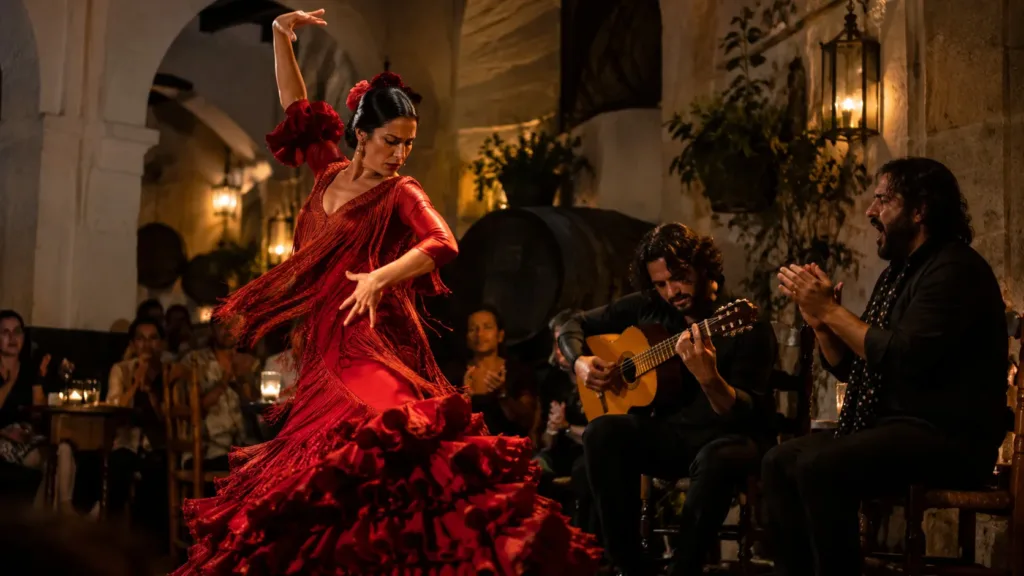
In many cities, flamenco tablaos sell out easily, especially on weekends and during peak season. That’s why, if your dates are set, the most important thing is to book online.

Direct recommendation: book online through our website to guarantee your seat and arrive with everything confirmed. If you already have your destination, go straight to your city to see available options and clear recommendations.

Flamenco Sevilla | Tablaos Flamencos

Seville

Flamenco Madrid | Tablaos Flamencos

Madrid

Flamenco Barcelona | Tablaos Flamencos

Barcelona

Flamenco Granada | Tablaos Flamencos

Granada

Flamenco Córdoba | Tablaos Flamencos

Cordoba

Flamenco Málaga | Tablaos Flamencos

Malaga

Flamenco Valencia | Tablaos Flamencos

Valencia

Flamenco Jerez | Tablaos Flamencos

Jerez

Find out more about this with your favorite AI:

Did you like this article? Share it!:

Tags: Ciudad del Sol de Lorca, Flamenco festivals 2026, Flamenco in Lorca

Article published by:

Related articles

Trasnoches Flamencos 2026: seven nights of guitar, singing and dance in Málaga