Real differences between “show-only” and “show + dinner”
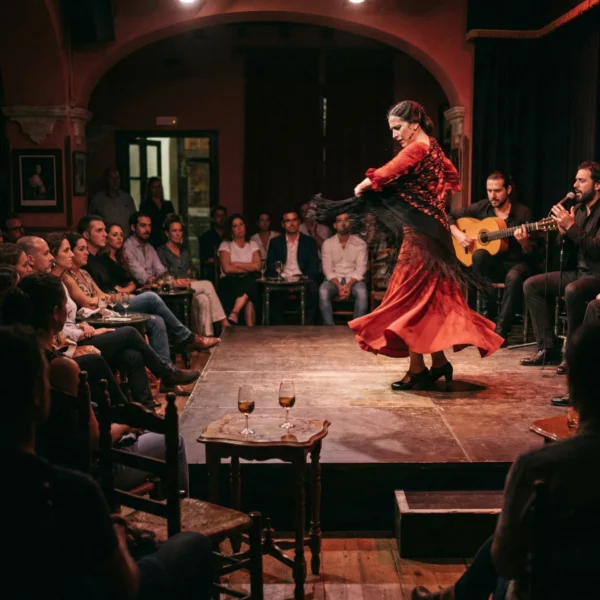
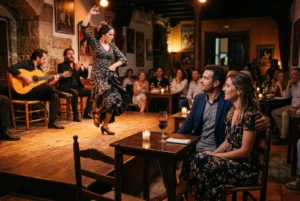
In practice, you’re not choosing between “two tablaos”, but between two different rhythms for your evening. Flamenco in a tablao is all about closeness: feet hitting the wood, the breath before a closing phrase, the dialogue between guitar and singing, the tension when the room falls silent. In one format or the other, that “atmosphere” changes.
Show-only (or with a drink):
- The room feels more like a “small theater”: there’s usually more silence and better focus on the performance.
- There are fewer parallel distractions (service, plates, clearing tables), so the experience is more continuous.
- It’s ideal if you want to notice nuances: cues, endings, changes of rhythm and small gestures that get lost in bigger venues.
Show + dinner:
- The plan is more “all-in-one”: dinner, toasts, conversation and the show within the same evening.
- There’s usually more activity around you (waiters, plates, drinks), and that can break the atmosphere in delicate moments.
- It fits when what you want is a full evening and a social vibe, even if the room is less silent.
A useful idea: if you think “I just want flamenco”, you’ll lean toward show-only. If you think “I want an easy, comfortable night”, you’ll lean toward dinner + show.
What changes in the experience (silence, pace and focus)
1) Silence and concentration
Flamenco isn’t just what you see: it’s what you hear and what happens between notes. In an intimate tablao, a well-held silence matters. In a dinner format, that silence is harder to keep because of the service dynamics. It doesn’t mean “worse”, it means different.
2) The pace of the evening
In show-only, the rhythm is usually more direct: you arrive, sit down, the show starts and you let it carry you. In dinner + show, dinner sets the pace: serving, clearing, ordering drinks, chatting… and that makes the “flamenco mode” switch on in a different way.
3) Split attention
In show-only, your mind has one job: watch and listen. In a dinner show, your attention splits even if you don’t want it to (cutting food, drinking, talking, looking). If you’re the kind of person who gets moved by a closing phrase or a final pose, show-only often helps you feel it more.
4) The final feeling
Many people leave a show-only saying “I really felt it”. People who choose dinner + show often leave saying “what a lovely night”. Both are great, but they point to different goals.
Pros and cons (no clichés)
Show-only
Pros
- Maximum immersion: fewer interruptions, more intensity, and more focus on singing, guitar and dance.
- Ideal for a first time if you want to understand what makes a tablao special.
- Perfect if you like to have dinner “your way” before or after, without dinner shaping the experience.
- It usually favors respect for silence and the most delicate moments of the performance.
Cons
- It doesn’t solve the “full evening” plan (you’ll need to organize dinner separately if you want it).
- If you’re going with a big group, it can require a bit more coordination (meeting points, dinner, timings).
Show + dinner
Pros
- Convenience: everything in one place, without overthinking.
- Very practical for groups and celebrations (birthdays, anniversaries, farewell nights, etc.).
- If you’re not obsessed with silence, it can be a perfect night: eat, toast, and enjoy the show.
Cons
- More movement and room noise: waiters passing by, plates, conversations… and that can reduce the “atmosphere”.
- Attention is divided: even if the show is excellent, you don’t experience it the same way as when you’re 100% focused.
The trick: choose based on your goal, not on “it includes more things”.
Which option to choose depending on your case
Scenario A: it’s your first time and you want to “get” flamenco
If you want to leave thinking “now I understand it”, show-only is usually the safest bet: full attention, fewer distractions, and a more direct experience.
Scenario B: you’re coming as a couple and looking for emotion
As a couple, show-only often works beautifully: it creates an intimate atmosphere and the details of the performance land more deeply. If you want to round off the night, you can have dinner before or after wherever you like.
Scenario C: you’re coming with a group and want convenience
Here, dinner + show makes sense for logistics. Tip: if you truly care about the flamenco, try to keep the show moment with fewer phones and less conversation. That shift improves the experience a lot.
Scenario D: you’re celebrating something and want a “full evening”
Dinner + show fits very well. If you want the flamenco to hit harder, choose a dinner format that doesn’t “invade” the most intense moment of the performance (depending on the venue), and switch into “show mode”, not “restaurant mode”.
Scenario E: noise and movement bother you
Show-only, no doubt. In an intimate tablao, focus is everything. If you get distracted by service moving around, dinner will pull you out of the moment.
Scenario F: you prefer to eat well “on your own terms”
Dinner elsewhere, then show-only. It’s a top combination: you choose the restaurant you like and then experience flamenco with full focus.
Checklist: decide in 5 questions
1) What do you want to remember tomorrow: the flamenco or the full evening?
If you want to remember the singing and dance clearly, choose show-only. If you want to remember a complete evening, dinner + show.
2) Do you care about silence?
If you care (a lot), choose show-only. If you don’t care too much, dinner + show can work.
3) Are you going with a group?
With a group, dinner + show is usually the most convenient. But if the group wants flamenco with intensity, show-only can also fit (it just requires organizing dinner separately).
4) Do you have a tight schedule?
If you’re short on time, show-only can give you more margin (arrive, sit, done). If you want everything solved in one go, dinner + show simplifies—but it requires punctuality.
5) Do you want to “feel it” or “have a good time”?
Both can go together, but if your priority is to “feel it”, show-only usually wins for immersion.
What if you’re going with kids?
In general, tablaos are usually kid-friendly, but some set a minimum age or recommend specific times. If you’re going with little ones and your priority is for them to stay comfortable, an early show and a plan with fewer waits often works better. As for “dinner vs. show-only”, think about your child: if you feel it will be hard for them to stay focused or seated for long, a simpler plan (show-only) can be easier; if you need dinner for logistics, choose it knowing the atmosphere will be more dynamic.